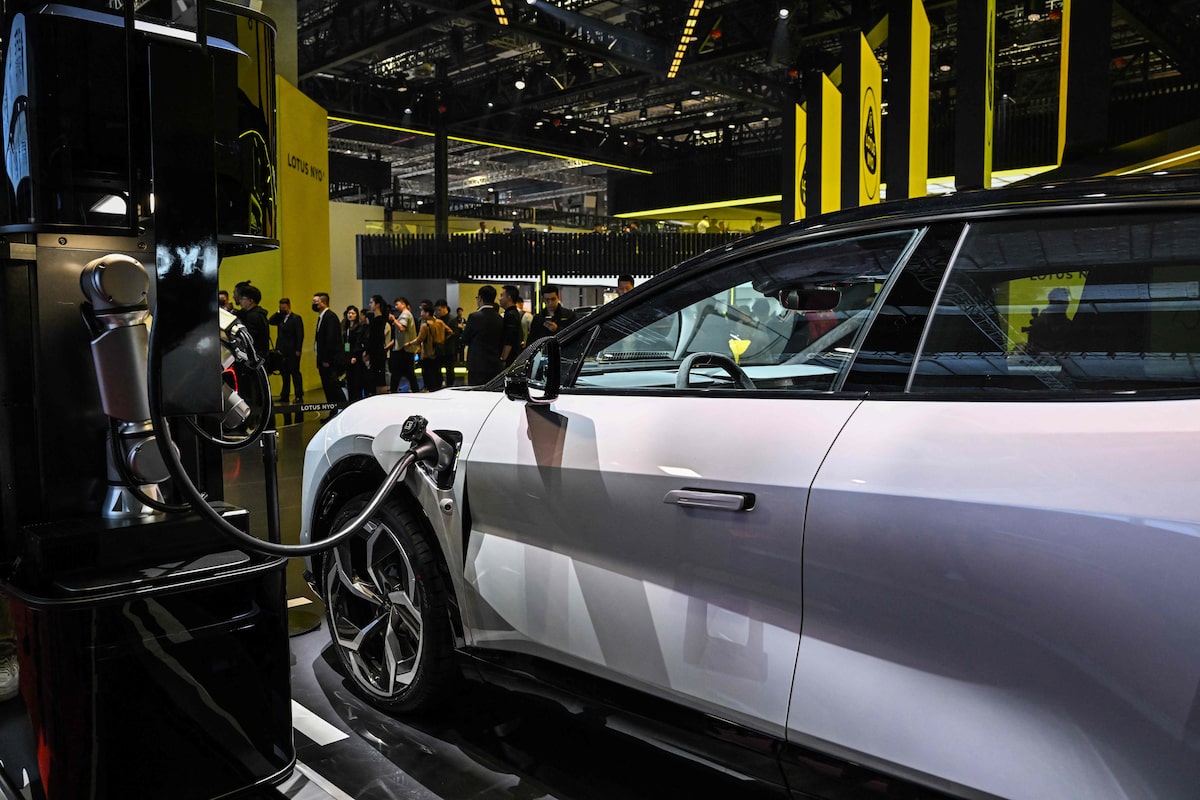
A Lotus Eletre charging at the company’s stand at the 20th Shanghai International Automobile Industry Exhibition in 2023.HECTOR RETAMAL/AFP/Getty Images
Lotus, the British sports car brand that currently sells just one model at low volume in Canada, is aiming to be among the first companies to sell Chinese-made EVs in Canada under the federal government’s new import quota system.
The brand, known as a cult-favourite maker of lightweight performance cars, is now under the umbrella of Chinese giant Geely, which also owns Volvo and Polestar.
The car they are hoping to start shipping to Canada is the Lotus Eletre, a battery-powered “Hyper SUV” made in Wuhan, China. It is already listed on dealer websites and is expected to land in Canadian showrooms in the third quarter of 2026, according to Massimiliano Trantini, president and chief executive officer of Lotus Cars Americas.
“Our Eletre is already homologated [meets road worthiness standards] for Canada and we will be hosting our official launch event very soon,” Mr. Trantini said in an e-mail to The Globe and Mail.
Explainer: What to know about the Canada-China tariff deal on EVs and canola
The price will likely be well into six-figure territory, and the vehicle will have a cabin lined with leather from Scottish tannery Bridge of Weir and up to a neck-snapping 905 horsepower. The Lotus Eletre is not – to state the obvious – one of the affordable new Chinese EVs many Canadians were hoping to see after the federal government announced lower tariffs and a new quota system.
In January, Prime Minister Mark Carney struck a “strategic partnership” with Beijing under which Canada will reduce the tariff to 6.1 per cent on a limited number of Chinese-made EVs. It’s a sharp reduction from the previous 100-per-cent tariff rate that Canada imposed on all Chinese EVs, in tandem with the United States, in 2024. In return, Beijing reduced tariffs on a number of Canadian agricultural and food exports.
Prior to the 100-per-cent tariff, carmakers including Volvo, Polestar and Tesla shipped cars to Canada from China. After the tariff was put in place, they shifted Canada-bound production to factories in Europe and elsewhere.
For the first year of this new program, which runs until the end of next February, 49,000 Chinese-made EVs will be allowed into Canada at the lower tariff rate.
As of March 12, no import permits have been issued under the quota, according to a spokesperson for Global Affairs Canada.
Several brands that manufacture EVs in China are interested in taking advantage of the new quota system, including China’s third-largest auto maker Chery.
Part of the rationale for slashing tariffs was that it would boost the availability of affordable EVs. By 2030, the government says about 70,000 Chinese-made EVs will be imported under the new quota system and half will need to have an import price of $35,000 or less.
Unlike other cars the brand makes, the Lotus Eletre all-electric SUV is neither lightweight nor low-power.Courtesy of manufacturer
Lotus Technology Inc., however, operates exclusively in the luxury market.
“Canadian customers in the upper segments have a strong affinity for SUVs and luxury vehicles. Our Eletre Hyper SUV is a natural fit for this market,” wrote Mr. Trantini.
The lower tariff rate on Chinese-made EVs allows Lotus to cut the planned retail price of the Eletre in Canada by approximately 50 per cent, a move Lotus hopes will spur rapid growth.
The company has six dealers across Canada, with plans to add more. “Our plan is to grow the dealer network in line with demand, which we expect to increase rapidly following our market entry,” Mr. Trantini added.
Opinion: Good EV plan, Canada. The risk now lies in execution
Only the gas-powered Lotus Emira sports car, which is made at the company’s historic plant in Hethel, England, is currently available in Canada. Mr. Trantini wouldn’t reveal how many of those approximately $140,000 sports cars have been sold here to date. He did say, however, that “the reception [to the Emira] has been encouraging and gives us strong confidence ahead of the broader EV rollout.”
But the Eletre may be a tough sell in Canada. Sales of EVs dropped significantly last year and there are already a wide range of high-priced luxury electric SUVs on offer from other brands including the likes of BMW, Mercedes-Benz, Audi, Rivian, Tesla, Volvo, Porsche and Cadillac.
Also, Lotus is not a household name, known primarily to Formula 1 racing fans and car enthusiasts who appreciate the brand’s driver-focused, lightweight, low-horsepower sports cars. As the brand’s first electric SUV, the Eletre is neither lightweight nor low-powered.
It arrives after last year’s announcement that Lotus would cut a third of its work force at its British headquarters in Hethel, where the company has been based since 1966.
Lotus Technology Inc. LOT-Q, the company’s Chinese division, which is poised to acquire 100 per cent of Lotus’s British operation, reported deliveries of 4,612 vehicles worldwide through the first nine months of 2025.
That represents a decline of 40 per cent compared with the same period in 2024, which the company attributed to tariff impacts and the phased delivery of upgraded models.