Local transit leaders say the transition to all-electric isn’t always simple, especially as they’re tasked with balancing reliability and the cost to taxpayers.
NORFOLK, Va. — Public transit leaders in Hampton Roads say the push toward cleaner transportation is underway, but switching to electric buses isn’t as simple as replacing diesel vehicles.
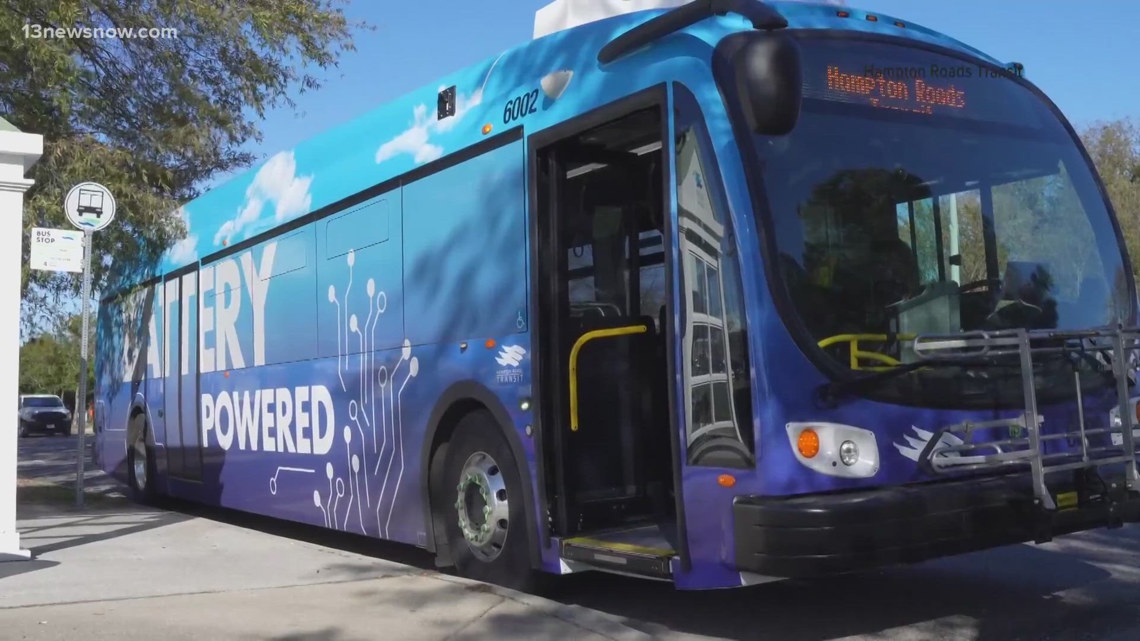
Hampton Roads Transit has been testing electric buses for several years as part of a broader effort to reduce emissions and modernize the region’s transit system. While the technology offers environmental benefits, officials say challenges with cost, reliability, and infrastructure remain part of the equation.
Early adoption brought lessons
Hampton Roads was among the first transit systems in Virginia to put electric buses into service. According to Sybil Papas, chief engineering and facilities officer for HRT, the agency launched its first electric buses in 2020 after receiving grant funding to purchase six vehicles.
“At the time, we were really on the cutting edge,” Pappas said. “When you’re on the cutting edge… You expect that you’re going to learn some things along the way, and we definitely did.”
The buses, manufactured by Proterra, were expected to travel about 225 miles on a single charge. In reality, the range was far shorter.
“We had our manufacturer tell us the buses would get about 225 miles on a charge,” Pappas said. “And then they actually got about 100 miles on a charge. So, they were stopping in the middle of Virginia Beach Boulevard halfway through their route because the battery was gone.”
The limitations created operational challenges for drivers and riders alike.
“If a bus operator took one out and it got stuck, they didn’t want to drive it again,” she said. “They’d go back to dispatch and say, ‘Please don’t give me another electric bus. I just want a diesel bus.’”
Cold weather also proved problematic. Without an auxiliary diesel heater installed, riders complained buses were extremely cold during the winter months. Drivers running the defroster to stay warm drained the battery even faster.
Soon after those challenges emerged, Proterra filed for bankruptcy, leaving HRT without manufacturer support or a reliable supply of replacement parts.
“That turned our ability to get spare parts into zero,” Pappas said. “We really struggled to keep the buses running.”
Environmental benefits remain a major draw
Despite the setbacks, transportation and environmental advocates say electric buses could still play an important role in improving air quality.
“Electric vehicles will be producing no tailpipe emissions,” said Alleyn Harned, executive director of Virginia Clean Cities. “So, for a diesel equivalent, you’d be seeing no particulate matter and no nitrogen oxides coming off the back of the bus.”
Those pollutants don’t just stay in the air.
“The particulates and nitrogen oxides eventually come back down when it rains,” Harned explained. “So, there’s an opportunity not just to clean the air, but also to help protect waterways like the Chesapeake Bay.”
Virginia communities have increasingly explored alternative fuels and cleaner transportation technologies in recent years.
“Virginia produces no oil,” Harned said. “So there has been a lot of work across municipalities and transit districts exploring ways to improve air quality and economic outcomes through cleaner fuels and vehicles.”
Electric buses are often supported by partnerships with federal agencies like the Federal Transit Administration’s low- or no-emission bus programs, which help local transit systems offset the cost of adopting new technology.
Cost remains a major hurdle
While electric buses may reduce pollution, the price tag remains one of the biggest barriers.
According to Pappas, diesel buses currently cost HRT about $850,000 each. Electric buses can cost nearly twice as much.
“Electric buses are costing about $1.6 or $1.7 million,” she said. “So for the cost of two diesel buses, you could get one electric.”
Reliability also factors into the decision.
“In our experience, the electric buses spend more time parked under the deck than they do on the road compared to diesel,” Papas said. “So you might actually need two electric buses to do the job of one diesel bus.”
For agencies that rely heavily on taxpayer funding and grants, those economics are difficult to justify without additional financial support.
“HRT depends heavily on grant money,” Pappas said. “If the state said they were prepared to fund the difference between a diesel bus and an electric bus, that would change the equation. But right now, that funding isn’t there.”
Transit already plays a role in reducing emissions
Even without electric vehicles, transit agencies say buses already help reduce pollution by getting more people out of single-occupancy vehicles.
“Transit is sustainable by its nature,” Pappas said. “When you have a bus carrying 40 or 50 people in one direction, that’s a lot fewer cars on the road and a lot fewer emissions.”
HRT officials say the system is also becoming cleaner through newer diesel models that produce far fewer pollutants than older buses.
Modern diesel buses can produce more than 80% less nitrogen oxide and particulate emissions than buses built two decades ago.
Meanwhile, electric transit already exists in Hampton Roads through The Tide light rail, which runs entirely on electric power.
What’s next for electric buses in Hampton Roads
HRT is continuing to study the technology before committing to a large-scale shift. The agency currently operates six electric buses and plans to add two more from a different manufacturer to evaluate how newer models perform.
“We’re in the process of buying two other electric buses from a different manufacturer,” Papas said. “Based on the reviews we’ve seen, we expect it to be a vastly different experience.”
Those additional buses will allow HRT to collect more data on range, reliability, and long-term costs before deciding how quickly to expand its electric fleet.
For advocates like Harned, the gradual approach is part of how technological transitions typically unfold.
“It takes plans, steps of progress, and then another set of plans,” he said. “Communities learn from each other, and that makes all the difference as these technologies evolve.”
For now, transit leaders say the focus remains on balancing environmental goals with the practical realities of operating a reliable transit system.
“We want to be good stewards of taxpayer money,” Pappas said. “Our job is making sure people can get to work every day and get home again, reliably and efficiently.”