Net zero mandates on the sale of electric cars risk causing “significant” damage to the motor trade and should be urgently reviewed, industry leaders say.
The government has set strict targets for zero-emission vehicles (ZEVs), requiring manufacturers to hit specific sales numbers each year or face fines.
But “the gap between ambition and demand is too great” and manufacturers are struggling to hit the quotas, warned Mike Hawes, chief executive of trade body the SMMT.
This is despite car makers handing out billions in discounts. The government is set to review the mandate next year, but Mr Hawes said the situation was more urgent than that.
Without certainty, he warned, “the UK’s attractiveness, not just as a market but as a manufacturing location, evaporates”.
“Decarbonisation, if we get this wrong, can mean de-industrialisation,” he said.
By 2030, 80 per cent of cars sold must be zero emission, and this rises to 100 per cent by 2035. Last year, 28 per cent of cars should should have been electric.
Although almost a quarter of sold cars were zero emission this still fell short of the mark.
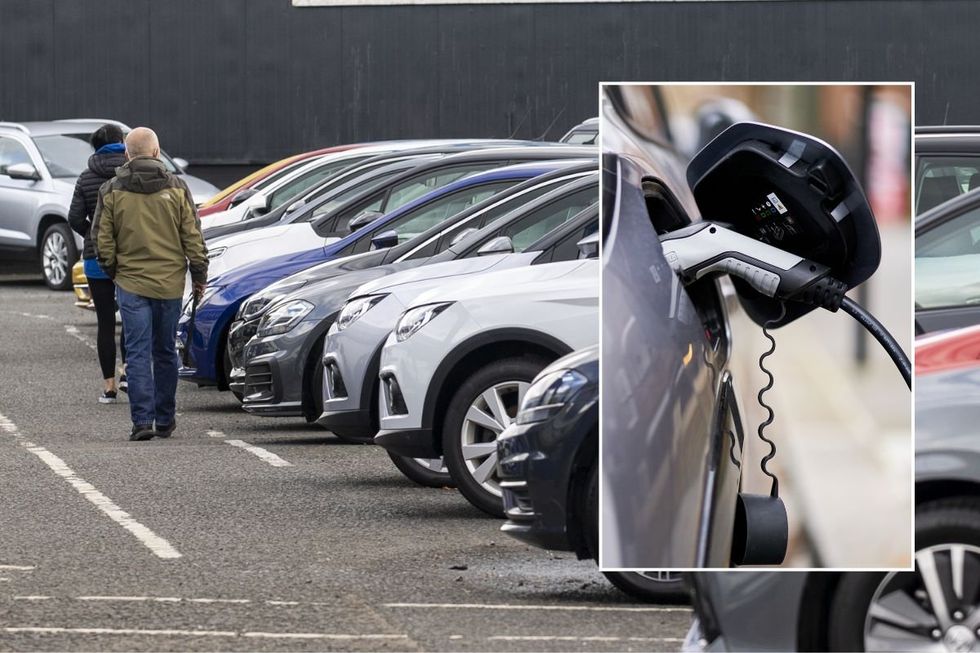
By 2030, 80 per cent of cars sold must be zero emission
| PA
The UK is already behind its target of 33 per cent of sales by the end of 2026, and Mr Hawes said: “I don’t know anyone in the industry who thinks we will get to 80 per cent EVs by 2030.”
He was speaking at the SSMT Electrified conference in London, which hosted experts in the electric market and the UK’s transition to zero emissions.
Mr Hawes stressed that the industry “remains totally committed to net zero”. But he pointed out that the mandates, which became law in 2024, were conceived in 2020.
Since then, the world has endured Covid, the Russian invasion of Ukraine, soaring energy prices and now the conflict in Iran.

Having more electric cars on Britain’s roads is a key pillar to Ed Miliband’s net zero ambitions
| PA
He said that manufacturers had poured billions into EV discounts to help drive the market. Last year, the average discount on a new EV was £11,000, with discounts totalling £10billion.
But Mr Hawes warned: “You can’t do that forever – it’s a fast way to go out of business. “Everyone will comply with the mandate. We have no option. But compliance comes at a tremendous cost.”
Mr Hawes said that Europe had “crossed the Rubicon” and relaxed its own rules on the number of ZEV sales. Canada has also loosened regulations, he said, and called on the UK to follow suit.
He said: “Other major markets have responded, and we should do too. “The EU has crossed the Rubicon. It is scaling back some of its targets. Canada shelved its own mandate for a more flexible CO2 based approach.
“The US has obviously written off, it seems, its transition. That’s not a road we wish to go down, but, when the world changes, so must we.
“The current approach is clearly not working for cars or vans and we have, next on the horizon, the greater challenges around how you decarbonise HGVs.
“The mandate is too far ahead of the consumer and it’s in danger of damaging our industry significantly. “The government is committed to reviewing the mandate but we can’t wait until 2027. We need it reviewed now, and resolved now.”
He stressed that the UK had done well in the electric car market, saying: “This really is a success story. In eight or nine years we have gone from next to none to a quarter of the market.
“That should be a celebration.”
But he said this didn’t mean the mandates were correct. He said: “To say the mandate is working – headline figures, yes, we are seeing an increase in EV sales, But the cost of getting there is not what the mandate was intended to do because it puts a huge amount of pressure on manufacturers and makes the UK that much harder to invest in.”
Martin Sander, head of sales for Volkswagen, said electric cars were desirable enough to own without government targets. He said: “Nobody really wants to be mandated about everything.”
He explained: “Do we really believe we can encourage consumers to get their heads around EVs and their benefits, to get excited about electric vehicles if we are always talking about mandates, telling them you are going to be ‘mandated’ to do something?
The government has set strict targets
| OCTOPUS ENERGY
“We have to change the language we are using. Let’s talk about the benefits of electric vehicles and take away the real or emotional hurdles that consumers might see.
“Then it doesn’t matter whether we want to be at 80 per cent in 2030 or in 2033.”
Keir Mather, minister for decarbonisation, told the conference that the motor trade was “foundational” to the economy. However, he rejected calls to hold the review earlier.
He said: “When it comes to the ZEV mandate review, we need to make sure that that takes place to meet the facts that we have, to meet our carbon obligations, our desire to make the cost of living easier for working people.
“But it also needs to make good business sense for the automotive manufacturers who are a foundational part of the UK economy.
“We need to have that conversation.”
He said of the mandate review: “Work is beginning this year but early 2027, we feel, is the right point to make sure that we can test properly where the pressure points lie in the ZEV mandate and make sure it continues to work for manufacturers.”