
Listen to the article
5 min
This audio is auto-generated. Please let us know if you have feedback.
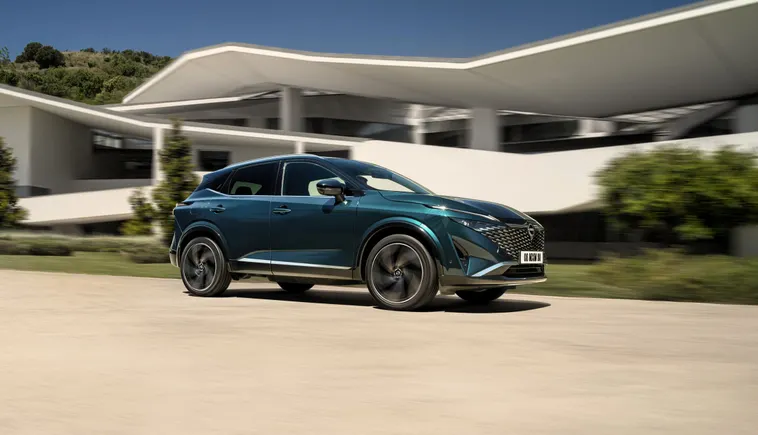
FARMINGTON HILLS, Mich. – If we didn’t know an electric motor was all that was powering the wheels in the Nissan Qashqai test car, we would have mistaken it for a traditional internal-combustion-engine propulsion system.
A press of the accelerator from a standstill brought the muffled 1.5L turbocharged 3-cyl. to life, seemingly revving in concert with the vehicle’s reaction and motion.
But in reality, the engine was firing up only to power an attached generator that sent electricity through an inverter and into an electric motor driving the front wheels. At no point was the ICE directly powering the wheels, Kurt Rosolowsky, vehicle evaluation and test engineer for Nissan North America, told us at a media briefing here during a test drive of the Japanese automaker’s e-Power hybrid system.
At this event, we drove European-specification Qashqai CUVs with the same hybrid system that we’ll see in the U.S. launch of the e-Power system later this year in the 2027 Rogue. The Rogue is slightly larger than the Qashqai, which is the Euro-equivalent of the Rogue Sport that was discontinued in the U.S. market.
Similar systems offered by other automakers are sometimes referred to as extended-range electric vehicle powertrains, including General Motors’ pioneering Voltec system employed in the now-shelved Chevrolet Volt and Cadillac ELR. Stellantis plans to employ an EREV system in the coming Ram 1500 REV and a version of the Jeep Grand Wagoneer.
Unlike the coming Rogue, those vehicles also employ a charging port and a larger battery to allow longer driving distances without the engine-generator having to start up to support the powertrain. The Rogue e-Power eschews plug-in charging in favor of a smaller, lighter 2.1-kWh lithium-ion battery, Rosolowsky said. Regenerative braking also recharges the battery.
Driving the Qashqai provided good insight into e-Power and how it will function and feel in the coming Rogue. Nissan presentations and press materials said the system should provide the feel of an electric vehicle, with strong torque from zero rpm and mostly inaudible operation across the driving spectrum.
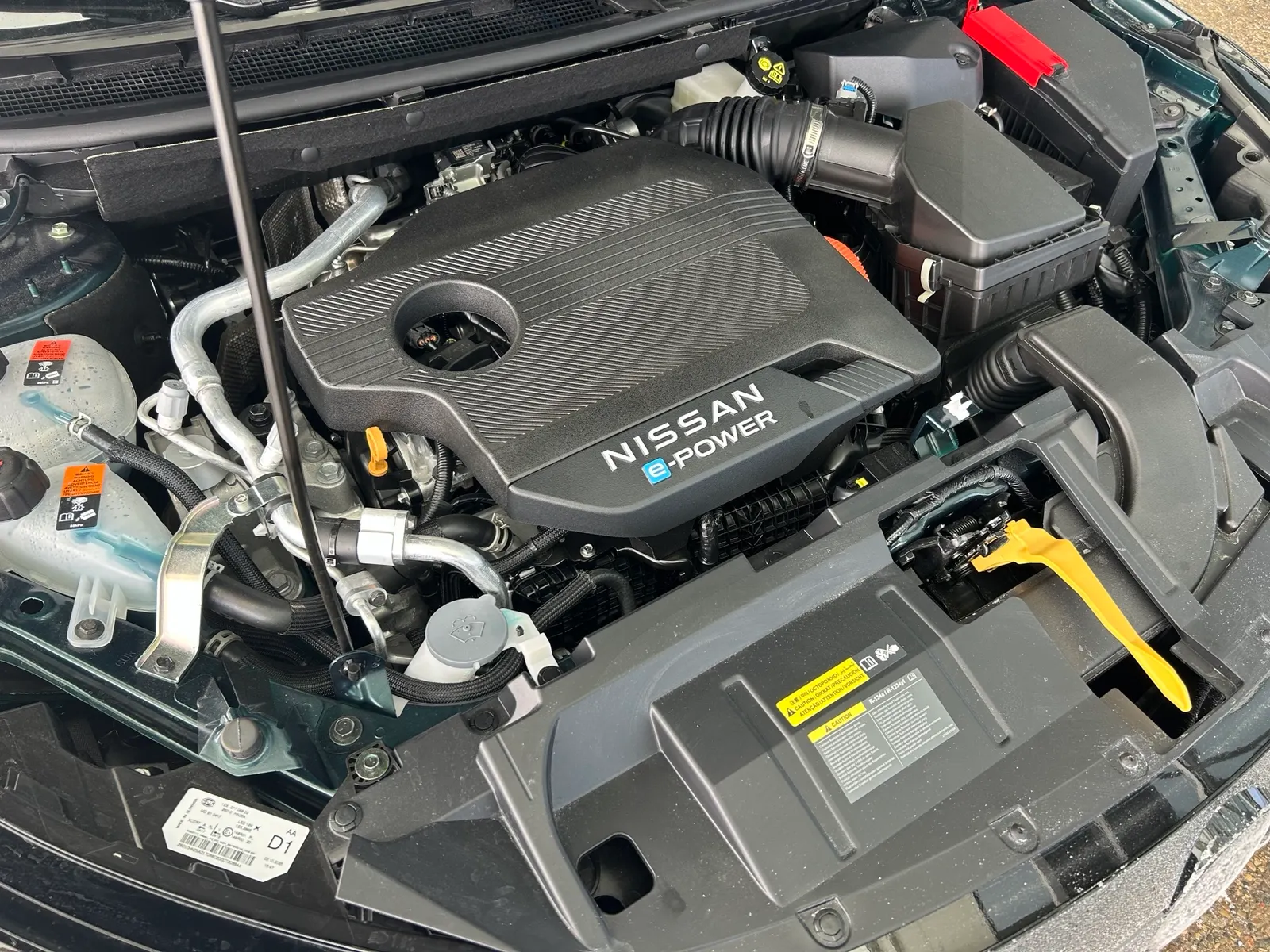
Under the hood of Euro-spec Nissan Qashqai e-Power. An electric motor provides propulsion, and the gasoline engine is never engaged to the wheels.
Courtesy of Nissan
Rosolowsky said Nissan has taken particular care to reduce engine noise and vibration in this third-generation application of e-Power. This latest take in the Qashqai was very refined and quiet in operation, with little noticeable vibration as a result of the engine starting, revving or shutting down during driving.
There were no unexpected pulsations or herky-jerky handoffs that we have noted in many hybrids over the years.
While our test vehicle offered the smooth power delivery of an electric powertrain, albeit with less of the torquey, zero-rpm launch we’ve come to expect from electric vehicles, we noticed that the engine fired up consistently to spin the generator to provide sufficient power to drive the electric motor.
The result was an electric propulsion system that “sounded” a lot like a traditional ICE powertrain, with engine rpm and sound rising in concert with accelerator pedal pressure. That’s different than GM’s Voltec powertrain, with which the engine often noticeably revved to generate electricity but was out of sync with acceleration. In European press releases describing the system, Nissan referred to this as “Linear Tune,” intended to eliminate the disconnect between engine speed and vehicle performance.
Conversely, the Qashqai exhibited very little of the electric-motor “whir” that we’ve come to expect in EVs.
Another powertrain quirk: Mash the pedal and the e-Power’s steady-state engine revs were similar to the rubber-band “motorboating” drivetrain feel of recent-vintage Nissan models equipped with continuously variable transmissions.
The e-Power hybrid includes two control options borrowed from Nissan’s electric cars: a “B” (for Brake mode) shifter mode that amps up regenerative braking from the powertrain, and e-Pedal Step, which allows gentle stop-and-go driving with less use of the brake pedal.
On our short, 13-mile test drive, the Qashqai e-Power recorded 39 mpg at an average speed of 38 mph over suburban surface streets and expressways, an improvement over the 32 mpg combined rating for the current U.S.-model front-drive Rogue powered by a 1.5L VC-Turbo. Both e-Power and VC-Turbo powertrains will be offered in the U.S. market.
Official specs for the Rogue e-Power haven’t yet been revealed, but e-Power in the Qashqai is rated at 188 hp and 229 lb.-ft. of torque. Rosolowsky said the third-gen e-Power system is optimized for European and U.S. driving at higher speeds over longer distances. He also expects towing capability to be similar to the Qashqai e-Power’s 1,500 lbs.