Unlock the Editor’s Digest for free
Roula Khalaf, Editor of the FT, selects her favourite stories in this weekly newsletter.
Shares of CATL soared after the world’s biggest battery maker reported higher than expected earnings, with strong demand in energy storage systems, including for AI data centres, as the company looks for growth beyond electric vehicles.
CATL’s Hong Kong-listed shares climbed as much as 9.7 per cent on Tuesday after it reported full-year net profit of Rmb72.2bn ($10.4bn) late on Monday, 42 per cent higher than in 2024 and ahead of analyst estimates. Its shares in Shenzhen rose as much as 6.2 per cent.
The results highlight the Chinese battery maker’s centrality to the world’s transition away from fossil fuel-based energy and transport systems, just as global oil and gas supply chains are rocked by conflict in the Middle East.
The main bourses in Hong Kong and mainland China rose about 1 per cent on Tuesday as oil prices retreated following US President Donald Trump’s comments that the war in Iran would end “very soon”.
31%
CATL’s projected 2026 sales growth, according to Citi
CATL’s revenue in 2025 was 17 per cent higher than the year prior at Rmb423.7bn, as sales from energy storage, including for power grids and AI data centres, were 9 per cent higher and overseas sales rose 18 per cent.
The company said “in overseas markets, increased energy demand from data centres and the need for flexible resource regulation” had driven growth in energy storage system batteries.
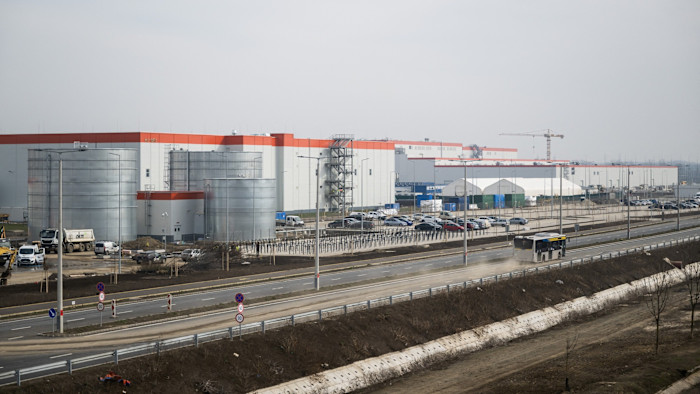
CATL, which raised $5.3bn last year in a secondary listing in Hong Kong, said on Monday it planned to issue up to Rmb40bn in bonds as it continues to expand its overseas business, including new factories in Germany, Hungary, Indonesia and Spain.
EV battery revenue was up 25 per cent last year, much higher than many analyst estimates and amid expectations of a slower pace of growth in China, the world’s biggest EV market, this year.
While the group’s global market share for EV batteries has reached a record 39 per cent, it faces long-term challenges from US moves to block China from American supply chains.
The EU is also developing a regulatory framework for increased local components in manufacturing, a move that threatens to erode the margins of Chinese groups’ low-cost operations in the region.
Citi has forecast CATL’s sales will grow 31 per cent in 2026, with those for energy storage batteries jumping 45 per cent and EV batteries rising 27 per cent.
Recommended

Experts said the war in Iran had underscored to Beijing the importance of its energy self-sufficiency efforts through the electrification of its transport and manufacturing base.
CATL’s management has estimated compound annual growth rates for the battery industry of 20-30 per cent for the next five years.
Bernstein analysts attributed the relative stability of CATL’s earnings to the group’s upstream resource investments, which include mines for key battery component lithium, as giving a “natural hedge” and helping the group absorb commodity price swings.
They also noted a robust technology outlook for CATL following deep investments in solid-state and sodium-ion batteries as well as the development of larger cells for energy storage systems.
“The technology leadership position bodes well for the long-term competitive position of the company,” Bernstein analysts said in a research note.