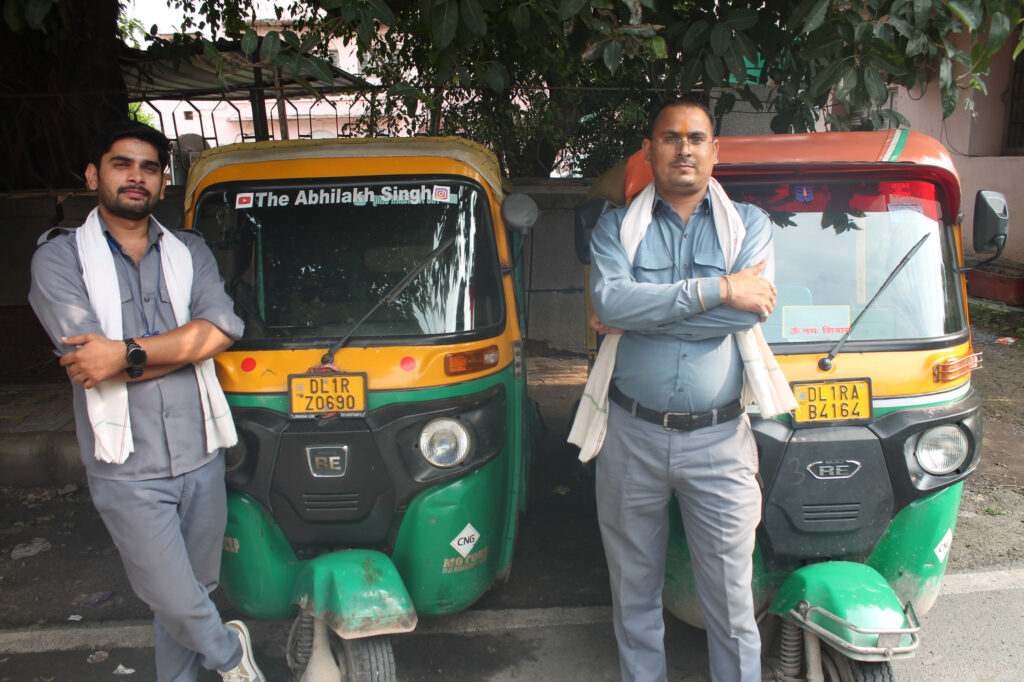
Abhilakh Singh, a YouTuber, drives an autorickshaw — a three-wheeled passenger vehicle often referred to as an auto — for a living in New Delhi, India’s capital.
Earlier, passengers would flag the vehicle on the road to engage him. For the past two years, he has been working with Uber, an app-based ride-hailing service that offers two-and three-wheelers, as well as cars, for local rides. Now passengers hail him through the app.
From 8 am, he drives his compressed natural gas (CNG)-petrol mix auto for up to 10 hours a day, making a net profit of about Rs 40,000 ($453) per month.

Traditional yellow-and-green autos, also known as tuk-tuks in other countries, are a popular mode of transport in New Delhi (Julián Reingold for The Xylom)
Driving an auto in New Delhi — one of the most polluted cities in the world — is not easy. Auto drivers complain about many pollution-related health issues, as they are on the road for hours at a stretch.
Switching to electric vehicles would reduce Delhi’s pollution, in addition to offering other benefits. So why haven’t drivers like Abhilakh Singh switched to EVs?
Vehicular Emission and New Delhi’s Air Quality
New Delhi’s air quality index (AQI) — a measure including particulate matter (PM) used to indicate the quality of outdoor air — is ‘unhealthy’ most of the time. It reaches hazardous levels during Diwali, when firecrackers are burst, and after the paddy-harvesting season, when farmers in neighboring states burn the stubble.
“There has been an increase of 40% traffic in the last five years. When air quality is announced as low, I wear a mask. Sometimes traffic and pollution make driving stressful,” says Abhilakh Singh.

Abhilakh Singh (left) stands next to his auto, outside the India Habitat Centre, New Delhi, waiting for customers to hail him (Julián Reingold for The Xylom)
Transportation remains a major contributor to air pollution, with wide-ranging impacts on public health, the economy, the environment, and social equity, according to Sophie Gumy, technical officer in the Department of Environment, Climate Change, and Health at the World Health Organization (WHO).
Despite an unprecedented railway electrification program successfully undertaken across the country’s 70,000-plus route kilometers (43,500 route miles) of broad-gauge rail in the past decade, the Indian Ministry of Environment, Forest, and Climate Change has acknowledged that vehicular emissions remain a major cause for air pollution in the Delhi-National Capital Region (NCR) and pose a serious public health challenge.
Popular Transport Fills a Niche
New Delhi offers several linked mobility options: a network of efficient, safe, and reliable government-run buses and metro lines, as well as private vehicles, such as autos and e-rickshaws.
Let’s Go to the Ends of the Earth.
Subscribe to The Xylom’s free weekly newsletter to get more dispatches from our Editor-at-Large.
“As in other emerging economies, where local or state-sanctioned public transport doesn’t exist or is insufficient, tuk-tuks, rickshaws, and motorbike taxis can be seen as part of the urban landscape,” says Andrea San Gil León, executive director of Global Network for Popular Transportation, an organization working towards decarbonizing transportation.
Any local transport service that is publicly provided but privately owned and operated is termed as popular transport. As of mid-2025, there were 273 million two- and three-wheelers in India, indicating that Delhiites preferred them as their mode of transport.
India’s vehicle ownership is projected to surge from 226 million in 2023 to nearly 500 million by 2050, more than doubling the current stock, according to Council on Energy, Environment and Water (CEEW), a policy research organization. Two-wheelers will account for nearly 75% of the total, while private cars are expected to triple to 90 million.
While two-wheelers represented nearly 75% of all vehicles sold in FY 2023-24, electric two-wheelers accounted for 6% of the total two-wheeler sales, according to Vasudha Foundation, a research organization.

Two technicians stand next to an electric auto at an EV charging station on the outskirts of New Delhi (Julián Reingold for The Xylom)
Though two-wheelers were primarily personal vehicles, they have also been serving as motorbike taxis in the last few years, thanks to platforms such as Uber. They monetize the gap in public transport by aggregating popular transport.
Compare this to New York City, which has its own popular transport — the dollar van, serving localities with poor transportation options. These minibuses with 12–20 seats reach working-class neighborhoods beyond the reach of the New York City Subway and offer customized service, with drivers applying their knowledge of small geographies to outperform centrally planned buses. The government has struggled for the past half-century to regulate the dollar vans.
Through the Clean Transit Access Program (CTAP), the New York State Energy Research and Development Authority (NYSERDA) is trying to electrify shuttle vans and non-emergency medical transit vehicles operating in New York City’s disadvantaged neighborhoods.
Nationwide analysis of EV fleet electrification highlights that EV charging infrastructure — especially in transit deserts or disadvantaged neighborhoods — takes time to build out, and reliable electricity capacity can be a constraint.
Of India’s passenger transport, San Gil León says, “The state is responsible for mass transportation but leaves the development of taxis to private companies.”
“Such two-and three-wheelers create the ‘intermediate public transport’ category. Despite not receiving much investment, these allow for integration into the existing infrastructure,” she adds.

A technician extracts the detachable motorbike battery at an EV charging station in Gurugram, on the outskirts of New Delhi (Julián Reingold for The Xylom)
Integrating Popular and Public Transport
India is yet to present its nationally determined contributions (NDCs) for 2035.
“As India prepares its updated NDC, rapidly electrifying two-and three-wheelers and expanding the metro network are more than a climate goal — it’s a public health lifeline. However, to truly tackle pollution at both the destination and the source, we must ensure that these vehicles are not merely cleaning our city streets while shifting the environmental burden elsewhere. A transition to electric mobility becomes a holistic solution only when the fuel is from clean, renewable energy,” says Harjeet Singh, Founding Director of the Satat Sampada Climate Foundation, an organization working for climate justice.
However, popular transport has largely been overlooked in the NDCs, with only Angola and Uganda recognizing emissions from informal vehicles, prompting mobility experts from the Transformative Urban Mobility Initiative (TUMI) to create a Global NDC Template for Popular Transport to facilitate policymakers’ work.
Amritsar, Hyderabad, and Bengaluru are some Indian cities that have integrated informal transportation with mass transport systems, while promoting electric autos for last-mile connectivity.
According to TUMI, improving the efficiency of popular transport vehicles represents 4% of the 12% reduction in CO2 emissions globally and can have a significant effect in emerging economies where they are most used.
In New York City, Dollaride — a company that brings clean transportation to underserved communities — says that drivers could save up to 70% by electrifying dollar vans. Since most neighborhoods where the dollar vans operate experience high levels of air pollution, this is an opportunity to kill two birds with one stone.
“Dollar van electrification can be a key element of the overall vehicular fleet electrification program. Dollar vans account for a small share of overall vehicular emissions, but they are concentrated in certain neighbourhoods that are predominantly low-income. As a result, electrifying them may help clean the air in these areas, which are particularly exposed to higher rates of air pollution,” says Yonah Freemark, a housing and urban development expert at the Urban Institute.
Switching to Electric Vehicles
Since Indian cities rely on informal public transportation systems (IPTs), which serve as feeders to mass transit and contribute 4–6% of mode share, the country is adopting electric vehicles to address rising fuel prices and poor urban air quality.
Though Abhilakh Singh, the YouTuber and auto driver, knows that EVs would reduce pollution, he cites a few reasons for not buying one. “The electric auto runs about 150 kilometers, but the CNG auto runs up to 250 km in a day. Also, an electric auto is expensive, and I can’t afford one right now.”
Rashmi Chowdhury, another driver, is interested in getting an EV, but struggles to save money, given the maintenance cost and mileage of her vehicle.
The Delhi EV policy offers incentives for electric three-wheelers in the form of road taxes and registration fee exemptions.
Many drivers, including Rashmi Chowdhury, are not aware of these incentives.

Rashmi Chowdhury would like to switch to an electric motorbike at some point in the future (Julián Reingold for The Xylom)
Mohammed Ahad, 36, an auto driver for the last 17 years, switched to an EV two years ago. He charges his vehicle in private parking spaces, paying Rs 120 ($1.31).
“It takes six hours to go from zero to full charge. Once charged, it will run for 100 km. Profit is good. I earn Rs 500–700 ($5.45-7.64) a day. CNG brings more money, but I chose this because I don’t have to spend on fuel,” says Ahad. “Electric autos are necessary to reduce pollution. I am content.”
According to Vivek Jain, CEO and co-founder of Stride Green, a company that offers finance and leasing services, there’s a critical gap between traditional financing and clean mobility’s unique needs.
If countries considered electrification of vehicles as a climate action beyond an economic or social measure, they could leverage climate funds, says San Gil León.
Auto drivers like Abhilakh Singh know they will have to eventually switch. “The transition will be gradual. I will need to change my trip timings and get used to charging the vehicle,” he says. “As charging stations increase and technology improves, this transition will become easier and more convenient.”
This story was produced with the support of the Global Network of Popular Transportation and edited by Jency Samuel. Laasya Shekhar contributed to the story.