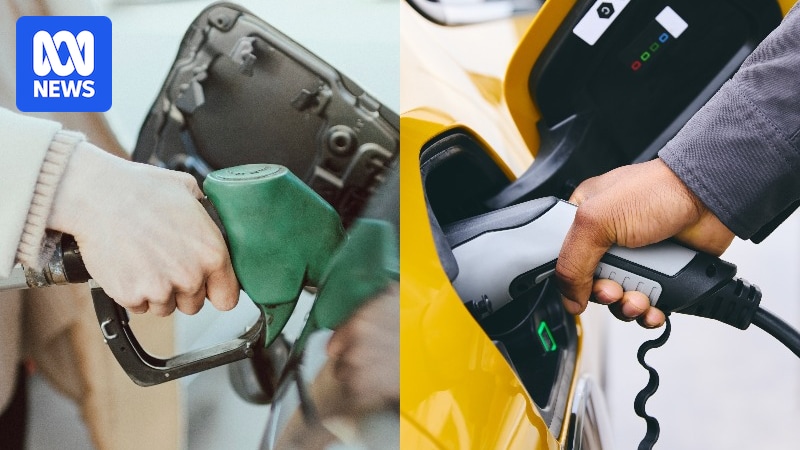
Conflict in the Middle East is driving up global crude oil prices and some petrol stations in Australia are already charging more at the pump.
Economists have warned the price of Unleaded 91 could rise by about 40 cents a litre in coming weeks.
A 30 per cent increase in crude oil prices would add about $30 to the cost of refuelling a standard-size 50 litre petrol tank in Sydney, adding to household costs amidst a cost-of-living crisis.
So, will more car buyers switch to an electric vehicle (EV) to save money?
The ABC has obtained exclusive modelling and crunched the numbers on operating costs for a typical petrol car and its electric equivalent.
How fuel prices factor into EV uptake
EVs generally cost more to buy than their petrol and diesel counterparts, but less to run.
This means that, over time, they tend to be cheaper to own than conventional cars.
The combined cost of buying and running a vehicle, including fuel, electricity, servicing, insurance, depreciation in value, and so on, is known as the total cost of ownership.
We’ve calculated the cost of ownership of a medium-size petrol SUV and its EV equivalent, both available in Australia, driven about 15,000km every year for a decade.
After about five years the EV owner is saving money by paying less for fuel.
Now, this is only a rough estimate based on assumptions about how far the cars are driven, the cost of electricity, and so on (more detail on the assumptions are at the end of this article).
One of the most significant assumptions is the cost of fuel.
We’ve used $2.08 per litre, which was the city-wide average for Unleaded 91 in Sydney, before the price of crude oil went up.
If the price of crude goes up 20 per cent, the same petrol stations may charge $2.50/L.
A 20 per cent increase in the price of oil knocks a year off the time it takes for the EV to start generating savings, due to lower running costs.
If the price goes up to $2.90/L, that knocks another year off.
Each 40 cent rise in the cost of petrol adds about $4,000 to the cost of running a typical petrol car over 10 years.
So, rising fuel prices make EVs a cheaper option.
Strong association between higher petrol prices and EV uptake
But you may be wondering: is this how other people buy their cars?
Do they study the petrol price and the cost of ownership and then switch to EVs?
And the short answer is: yes, petrol prices affect EV uptake.
A study published last month matched fuel prices with EV and combustion vehicle registrations in Denmark, Finland, Norway and Sweden from early 2019 to late 2022.
It found that, on average, a 1 per cent increase in the petrol price increased the sales of EVs by 0.85 per cent.

Tax incentives make EVs cheaper to buy in Norway than regular cars. (Supplied: Norwegian EV Association)
At that rate, if petrol prices went up 20 per cent, EV uptake might surge an additional 17 per cent on top of an already increasing number of sales.
To put this in context, EV sales in Australia were up 38 per cent year-on-year in 2025.
Another recent study analysed monthly vehicle sales data from 2017 to 2022 in the world’s largest EV market: China.
It found that an average 1 Chinese Yuan per litre increase in petrol price, equivalent to $0.21/L, was associated with a 4.67 per cent increase in EV sales.
Does this finding apply to Australia?
The finding does apply to an extent, study co-authors Yanlai Chu and Xiaobing Zhang told the ABC in a written statement.
Dr Chu, from Renmin University of China, and Dr Zhang, from the Technical University of Denmark, also co-authored the study of Nordic countries.
“The [China] result should not be interpreted as a simple linear rule that can be directly applied to other countries,” they said.
Car buyers in China were more likely to choose an EV due to superior charging infrastructure and other policies designed to promote EVs.
But they added, “higher gasoline prices are likely to encourage EV adoption in Australia”.
The two studies also found that when petrol prices went up, car buyers tended to favour certain kinds of EVs that took greater advantage of the running-cost savings.
In the Nordic countries, smaller, cheaper EVs became more popular.
For China, fully battery-electric vehicles (BEVs) became much more popular while plug-in hybrids, which burn fuel when they run out of charge, became less so.
Small BEVs in China saw the biggest increase in sales.
“Our results suggest that operational cost differences are particularly important for cost-sensitive buyers, such as those considering small or lower-priced vehicles,” the co-authors said.
Interestingly, rising electricity prices didn’t stop people buying EVs, the study of Nordic countries found.
It suggested this might be because retail electricity prices weren’t advertised as clearly or as widely as the cost of petrol.
So if electricity prices go up, as they have done recently, EV sales may not be affected.
High prices could flow to heavy vehicles
Higher fuel prices may have a bigger impact on the uptake of EV trucks.
In exclusive modelling for the ABC, business consultants Mov3ment calculated the impact of increase in the cost of diesel on a semi-trailer driving 90,000km per year.
With diesel at its current price of $1.81/L, an EV semi-trailer is actually more expensive to run than a diesel one.
Diesel has to climb to $2.11/L for the electric truck (charged at 30 cents per kilowatt-hour) to break even with the diesel one on running costs.
If diesel got as high as $2.41/L, the diesel truck would cost $13,000 more to run than its battery-powered equivalent.
“When diesel prices go up an EV gets more attractive,” Mov3ment director Mark Gjerek said.
‘Fuel price shock very much in front of us’
Another question remains: how long do petrol prices have to stay high to have any effect?
At least six months, according to the Australian EV charging company JET Charge.
Long queues form at servos as fuel prices climb
In modelling provided to the EV Council and its members, JET Charge looked at what would happen if global oil prices rise 30–50 per cent for 6–18 months and Australian petrol and diesel prices increase 40–70 cents per litre.
It predicted the higher fuel prices would boost EV sales an extra 10 per cent for the duration of the “price shock” event.
“What has become clear over the last week is the scenario around a fuel price shock is now very much in front of us,” said Kristian Handberg, head of future business at JET Charge.
Fuel prices will need to stay high for at least six months to have a measurable impact on EV uptake, he said.
This is because most car buyers will defer their decision to see what happens with fuel prices.
“You probably go, ‘I might just sit tight for a little bit and see what happens.’”
US President Donald Trump has said the military operation in Iran would be over in “four to five weeks” and top officials have stressed that this will not be a prolonged conflict or “forever war”.
But there’s also a risk the conflict will escalate and that “Operation Epic Fury” will prove more complicated than the White House may have hoped.
A note about assumptions
The article compares the total cost of ownership for petrol and electric versions of a medium-size SUV as the price of petrol rises.
We tried to make the example generic, so that it can serve as a rough guide to as many people as possible.
The cost of electricity, EV subsidies, stamp duty, and so on, differ across the country. Some people drive more than others. Some charge off solar. Some use public chargers.
The example assumes:
No EV subsidies, discounts on stamp duty, or registration costs (since most states have dropped them)Cars are driven 15,000km per year (about the national average)The EV user mostly charges their car off rooftop solar, but also sometimes uses public charging