Bidirectional Charging Market Summary
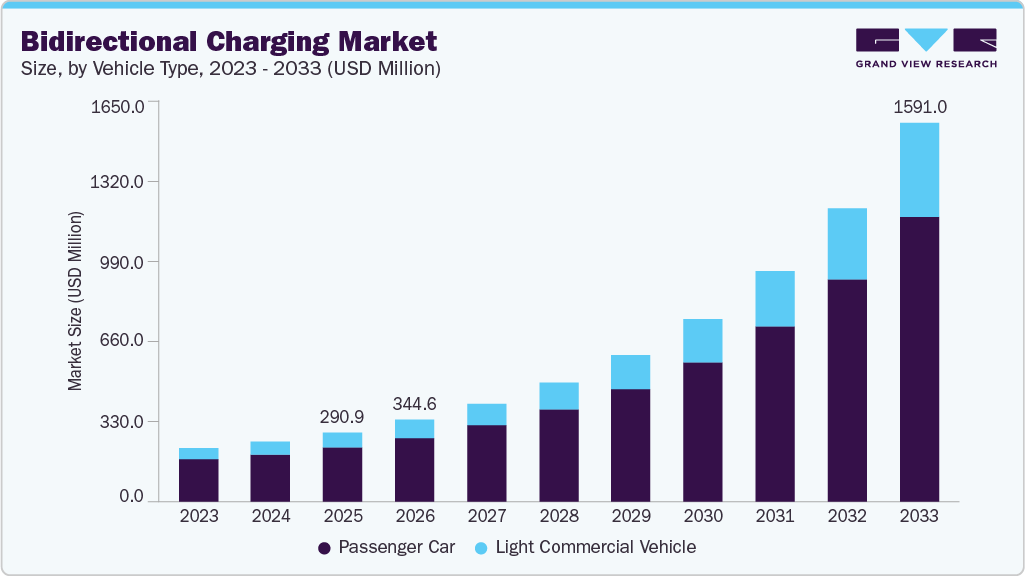
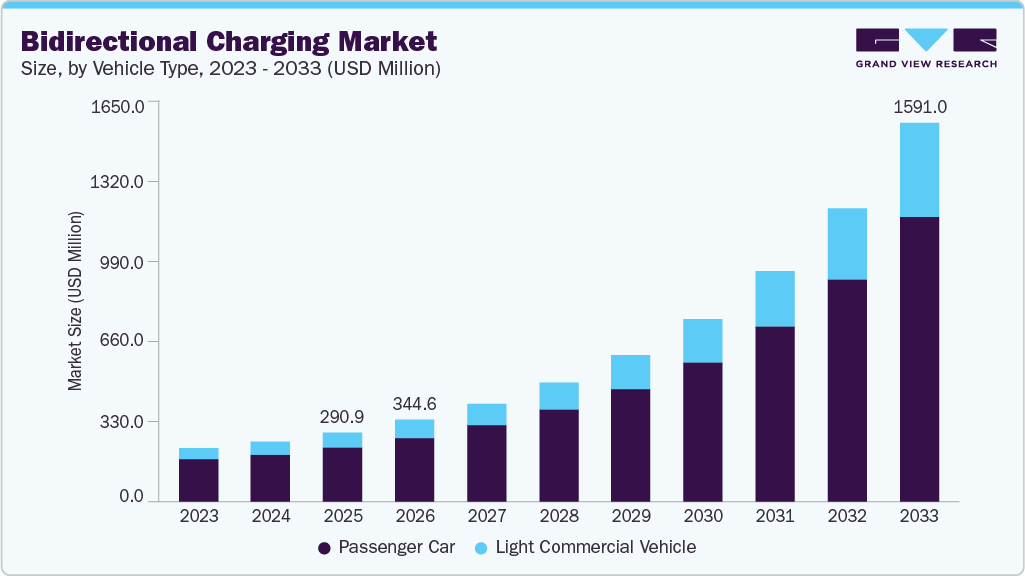
The global bidirectional charging market size was estimated at USD 290.9 million in 2025 and is projected to reach USD 1,591.0 million by 2033, growing at a CAGR of 24.4% from 2026 to 2033. The rapid growth in electric vehicle adoption and the increasing need for grid flexibility amid rising renewable energy integration are major growth factors behind the growth bidirectional charging market.
Key Market Trends & Insights
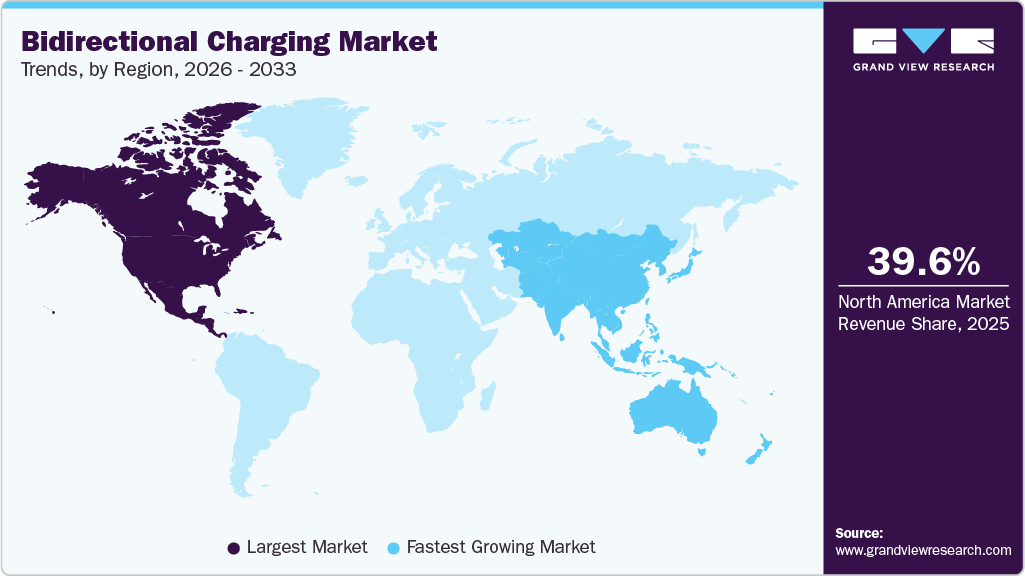
North America dominated the bidirectional charging and accounted for a share of 39.6% in 2025.
The U.S. bidirectional charging market held a substantial share in 2025.
By vehicle type, the passenger car segment dominated the market in 2025 and accounted for the market share of 78.6%.
By propulsion type, the BEV segment dominated the market in 2025.
By charging type, the AC charging segment dominated the market in 2025.
Market Size & Forecast
2025 Market Size: USD 290.9 Million
2033 Projected Market Size: USD 1,591.0 Million
CAGR (2026-2033): 24.4%
North America: Largest market in 2025
Asia Pacific: Fastest growing market
One of the primary advantages of bi-directional EV charging is its contribution to electric grid stability. Surplus energy can be absorbed during periods of high generation and fed back into the grid during peak demand, thereby helping to balance supply and demand fluctuations. In addition, during power outages, backup power can be supplied to homes, hospitals, and other critical facilities through bi-directional EV charging. It can also function as a distributed energy resource, enhancing the overall resilience of the energy system. Thus, the increasing demand for bidirectional charging solutions, owing to their numerous benefits, is expected to drive market growth.
Factors such as increased renewable energy integration and greater energy flexibility are expected to drive the bidirectional charging market, as power systems increasingly rely on intermittent sources such as solar and wind. Several market players are introducing bidirectional charging systems that allow renewable energy-powered EV charging. For instance, in September 2025, Solarwatt introduced the bidirectional Charger Max wallbox, which enables two-way energy flows to support solar-powered EV charging and, in the future, electricity feed-in to homes. The solution also features calibration compliance and supports individual billing, making it suitable for both residential and multi-user applications. Such initiatives are expected to contribute to the growth of the market.
The growing emphasis on grid resilience and urban electrification is expected to accelerate investments in bidirectional charging infrastructure. Commercial fleet operators are increasingly adopting advanced charging technologies that enable electric vehicles to operate as distributed energy resources, thereby contributing to urban energy system stability and flexibility. For example, in September 2025, the California Energy Commission awarded USD 1.1 million to a Brooklyn-based EV charging company under its Enabling Electric Vehicles as Distributed Energy Resources program to develop the curbside vehicle-to-grid EV charger. The initiative aims to deploy bidirectional curbside charging infrastructure that allows electric vehicles to both draw electricity from and feed power back into the grid, reinforcing the broader industry shift toward commercialization of V2G solutions.
The regulatory landscape of bidirectional charging is evolving as governments and utilities adapt to the growing role of electric vehicles as distributed energy resources. Regulations primarily focus on grid interconnection standards, safety certifications, metering, and compensation mechanisms for energy exported back to the grid. In some regions, vehicle-to-grid (V2G) and vehicle-to-home (V2H) deployment is driven by utility approval processes, grid codes, and market rules for demand response and ancillary services. Supporting pilot programs and incentives are emerging, but market adoption remains dependent on regulatory clarity around energy pricing, billing, and grid participation frameworks.
The bidirectional charging market faces several restraints that are expected to hinder its growth. A primary technical concern is battery degradation, as frequent charging and discharging cycles in V2G systems can accelerate wear and reduce overall battery lifespan. In addition, the rollout of bidirectional charging infrastructure is constrained by the need to upgrade existing grid systems and the requirement for specialized charging equipment capable of managing two-way energy flows, both of which increase complexity and slow adoption. Furthermore, the higher cost of bidirectional chargers compared to conventional unidirectional systems can discourage adoption, particularly in price-sensitive residential markets.
Vehicle Type Insights
The passenger car segment dominated the market in 2025 and accounted for the market share of 78.6%. The segment’s growth is driven by factors such as the rapid adoption of electric passenger vehicles and the increasing integration of advanced energy management technologies. Passenger EVs are widely used in residential settings, making them well-suited for V2H and V2G applications. These vehicles enable households to use stored battery energy for backup power during outages, peak-load management, and improved utilization of renewable energy sources, such as rooftop solar. Supportive government policies, growing consumer awareness of energy resilience, and expanding charging infrastructure further strengthen the adoption of bidirectional charging in the passenger car segment.
The light commercial vehicle segment is expected to grow at the fastest CAGR over the forecast period. The growing demand for electrification is driving the adoption of bidirectional charging in light commercial electric vehicle fleets. The concept of fleet electrification with vehicle-to-grid (V2G) builds on smart charging by treating vehicles as mobile energy storage assets. Through bidirectional charging, commercial EVs can supply energy back to the grid or provide backup power during emergencies. This integration enables fleet operators to generate additional revenue while supporting grid stability through controlled, optimized charging that aligns with both grid requirements and operational needs.
Propulsion Type Insights
The BEV segment dominated the market in 2025. The Battery Electric Vehicle (BEV) segment plays a crucial role in the advancement of bidirectional charging, as BEVs are fully powered by large-capacity batteries that can both store and supply electricity. With bidirectional charging, BEVs enable energy to flow from the grid to the vehicle and from the vehicle back to homes (V2H), buildings (V2B), or the grid (V2G). This capability transforms BEVs into mobile energy storage assets, supporting backup power during outages, peak load management, and better integration of renewable energy sources. The global rise in BEV adoption is leading automakers and energy providers to integrate bidirectional charging to enhance vehicle value, improve grid resilience, and support decentralized energy systems, thereby strengthening the growth of the BEV segment.
The PHEV segment is expected to grow at a moderate CAGR over the forecast period. The segment’s growth is driven by the transitional role that plug-in hybrid electric vehicles play in the broader electrification landscape. Consumers and fleet operators prioritizing electric driving capability alongside extended range assurance are sustaining the presence of PHEVs across multiple markets. Rising electricity price volatility and increasing interest in backup power solutions further support demand, as PHEVs can provide short-duration household energy support during peak pricing periods or grid outages.
Charging Type Insights
The AC charging segment dominated the market in 2025. AC charging is increasing due to its cost-effectiveness, ease of installation, and suitability for daily charging needs. Compared to DC fast chargers, AC chargers require lower infrastructure investment and simpler grid upgrades, making them more accessible for residential, workplace, and small commercial installations. The growing adoption of electric vehicles for daily commuting has increased demand for reliable overnight and workplace charging, where high charging speeds are not essential. In addition, AC charging is considered more battery-friendly, as it supports longer battery life through slower, controlled power delivery, thereby the rising adoption of AC charging solutions.
The DC charging segment is expected to grow at the fastest CAGR over the forecast period. The segment’s growth can be attributed to its ability to efficiently manage two-way power flow between electric vehicles, homes, buildings, and the power grid. In DC bidirectional charging, power is transferred directly to the EV battery without requiring onboard conversion, resulting in higher efficiency, faster response times, and reduced energy losses. It makes DC charging particularly suitable for advanced applications such as V2G, V2H, and V2B. In addition, DC bidirectional systems support higher power capacities, enabling reliable backup power and grid stabilization services. Growing investments in smart grids, renewable energy integration, and high-capacity EV charging infrastructure are further driving the adoption of DC bidirectional charging solutions across residential, commercial, and utility-scale applications.
Application Insights
The V2H segment dominated the market in 2025, driven by the increasing adoption of electric vehicles capable of supplying electricity to residential buildings from their batteries. Through V2H systems, power is delivered directly to home electrical panels, enabling backup support during grid outages and facilitating energy cost optimization during peak tariff periods. The increasing development of V2H bidirectional charging solutions is expected to propel the growth of the segment. For instance, in November 2025, Polestar introduced a bidirectional charging solution enabling V2H functionality. Through this solution, EV batteries are used as backup energy sources, with plans to expand into additional markets and vehicle models.
The V2L segment is expected to grow at a moderate CAGR over the forecast period. The growing adoption of Vehicle-to-Load technology, which allows electric vehicles to act as power sources for electronic devices and equipment, is contributing to the growth of the segment. Through this capability, power can be supplied to devices such as laptops, mobile phones, and household appliances, extending energy use beyond vehicle charging. For example, the IONIQ 6 from Hyundai features bidirectional V2L technology integrated with BlueLink connectivity, allowing power usage to be monitored and controlled via smartphones. In addition, a more spacious and comfortable interior is provided, with V2L ports intuitively placed and easily accessible. This design ensures convenient access to vehicle-generated power during long journeys, outdoor activities, or temporary power needs.
End-use Insights
The residential segment dominated the market in 2025. The segment’s growth is driven by the growing adoption of electric vehicles and the need for reliable home energy solutions. Through V2H technology, EVs enable households to use stored battery energy for backup power during grid outages, peak load management, and energy cost optimization. Residential bidirectional charging is increasingly integrated with rooftop solar and home energy management systems, allowing excess renewable energy to be stored in EV batteries and reused when needed. Rising electricity prices, more frequent power disruptions, and supportive government incentives are further accelerating adoption. Rising EV ownership is making bidirectional residential charging a practical and cost-effective solution for improving household energy resilience and sustainability.
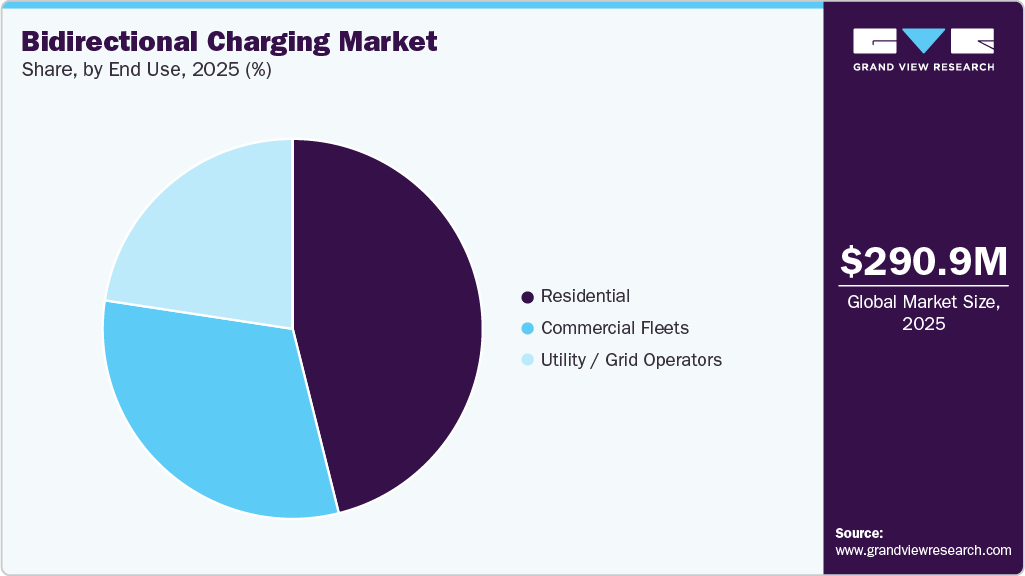
The utility/grid operators applications segment is expected to grow at a significant CAGR from 2026 to 2033. The growth of the segment is driven by the rising need for grid flexibility, stability, and renewable energy integration. With greater integration of intermittent solar and wind generation into power systems, utilities are increasingly turning to distributed energy resources to deliver frequency regulation, peak load management, voltage support, and capacity reserves. In addition, growing peak demand pressures in urban areas, grid congestion challenges, and the need to defer costly infrastructure upgrades further encourage utilities to deploy vehicle-to-grid (V2G) programs.
Regional Insights
North America bidirectional charging market dominated the global industry and accounted for a share of 39.6% in 2025. The high penetration of electric vehicles, growing focus on grid resilience, and increasing frequency of power outages are driving regional adoption. Strong public-private collaborations between automakers, utilities, and charging solution providers are accelerating the deployment of V2H and V2G projects. Supportive government policies, pilot programs, and smart grid investments are further driving market growth.
U.S. Bidirectional Charging Market Trends
The U.S. bidirectional charging market held a substantial share in 2025, driven by early technology adoption, large-scale utility pilot programs, and rising residential demand for backup power and energy cost optimization.
Europe Bidirectional Charging Market Trends
The Europe bidirectional charging market is expected to register a moderate CAGR from 2026 to 2033. Strong decarbonization targets, renewable energy integration, and advanced grid infrastructure support growth of the market in the region. Increasing deployment of V2G projects and supportive regulatory frameworks are also driving the adoption of bidirectional charging solutions across the region.
The UK bidirectional charging market is expected to grow at a significant CAGR over the forecast period, driven by rapid EV adoption, dynamic electricity pricing, and strong government-backed smart energy initiatives. The country focuses on decarbonizing the power sector, expanding renewable energy capacity, and enhancing grid flexibility is accelerating the deployment of V2H aV2G solutions.
The German bidirectional charging market held a substantial share in 2025, supported by the country’s strong emphasis on energy efficiency, grid stability, and advanced power infrastructure. Strong government support, high EV penetration, and active participation from automotive OEMs and utilities continue to drive adoption, positioning Germany as a key contributor to the European bidirectional charging market.
Asia Pacific Bidirectional Charging Market Trends
The Asia Pacific bidirectional charging market is expected to grow at the fastest CAGR during the forecast period, driven by the growing adoption of electric vehicles. The rising EV adoption is supported by government incentives, expanding charging infrastructure, and domestic EV manufacturing. This is driving strong demand for V2G and V2H solutions, allowing EVs to support grid stability, manage peak electricity demand, and provide backup power.
China dominated the regional market in 2025, supported by strong government-led V2G initiatives, the presence of large EV fleets, and extensive integration of bidirectional charging into urban energy management systems. China’s focus on grid balancing, peak load management, and renewable energy integration has accelerated the deployment of bidirectional charging across residential, commercial fleet, and utility applications.
The India bidirectional charging market is expected to grow over the forecast period, driven by the increasing adoption of electric vehicles and the need for reliable energy solutions. EV adoption in the country is supported by government incentives, time-of-day electricity tariffs, and expanding charging infrastructure.
Key Bidirectional Charging Company Insights
Some of the key companies in the bidirectional charging market include Wallbox Chargers, and Tesla among others. These companies focus on product innovation, R&D and strategic initiatives such as new product launches, business expansions, partnerships, collaborations and mergers and acquisitions.
Wallbox is a prominent electric vehicle charging solutions provider with a strong focus on the bidirectional charging market. The company develops advanced technologies that enable vehicle-to-home (V2H) and vehicle-to-grid (V2G) energy transfer, allowing EVs to act as mobile energy storage systems. Wallbox’s key bidirectional products include Quasar and Quasar 2, designed primarily for residential applications and supporting controlled energy flow between compatible EVs, homes, and power grids. By integrating smart software, energy management features, and grid connectivity, Wallbox is playing a crucial role in advancing bidirectional charging adoption and supporting smarter, more resilient energy ecosystems globally.
Tesla is a prominent electric vehicle (EV) and clean energy technology company actively advancing bidirectional charging capabilities across its product ecosystem. Tesla’s integrated approach combines innovations in EVs, energy storage, and grid services to support vehicle-to-home (V2H), vehicle-to-grid (V2G), and energy backup applications. The company’s electric vehicles, such as the Model 3, Model Y, Model S, and Model X, feature hardware and software that can enable bidirectional energy flow, allowing the vehicle’s battery to supply power back to the home or the grid when appropriately configured.
Key Bidirectional Charging Companies:
The following key companies have been profiled for this study on the bidirectional charging market.
Wallbox Chargers
Tesla
Enphase
Fermata Energy
GM Energy
Indra Renewable Technologies Limited
IoTecha
RedEarth Energy Storage
Recent Developments
In February 2026, Tesla launched its vehicle-to-grid (V2G) program in select Texas markets to enable electric vehicles to support the power grid actively. The initiative allows Cybertruck owners to discharge energy from their vehicle’s battery back to the grid during periods of high electricity demand, creating a new value stream for users through bill credits. The program leverages Cybertruck’s large battery capacity and Tesla’s energy management ecosystem to improve grid stability and peak-load management. By integrating EVs as distributed energy resources, the initiative aims to enhance grid resilience, support the integration of renewable energy, and accelerate the adoption of bidirectional charging solutions in future energy system.
In August 2024, Nissan announced advancements to the Fermata Energy FE-20 bidirectional charger and V2X platform for compatibility with the Nissan LEAF in the U.S. market, strengthening its position in the bidirectional charging ecosystem. During the same period, the company highlighted that the enhanced FE-20 system complies with required UL and CHAdeMO standards and supports two-way power flow, enabling vehicles to both charge and supply electricity back to buildings or the grid. The next-generation solution also delivers higher power output, improved certifications, optimized system design, and lower manufacturing costs, supporting wider commercial and utility adoption.
Bidirectional Charging Market Report Scope
Report Attribute
Details
Market size value in 2026
USD 344.6 million
Revenue forecast in 2033
USD 1,591.0 million
Growth rate
CAGR of 24.4% from 2026 to 2033
Base year for estimation
2025
Historical data
2021 – 2024
Forecast period
2026 – 2033
Quantitative units
Revenue in USD million/billion, and CAGR from 2026 to 2033
Report coverage
Revenue forecast, company market share, competitive landscape, growth factors, and trends
Segments covered
Vehicle type, propulsion type, charging type, application, end-use, region
Regional scope
North America; Europe; Asia Pacific; Latin America; MEA
Country scope
U.S.; Canada; Mexico; UK; Germany; France; China; India; Japan; Australia; South Korea; Brazil; Kingdom of Saudi Arabia (KSA); UAE; South Africa
Key companies profiled
Wallbox Chargers; Tesla; Enphase; Fermata Energy; GM Energy; Indra Renewable Technologies Limited; IoTecha; RedEarth Energy Storage
Customization scope
Free report customization (equivalent up to 8 analysts working days) with purchase. Addition or alteration to country, regional & segment scope.
Pricing and purchase options
Avail customized purchase options to meet your exact research needs. Explore purchase options
Global Bidirectional Charging Market Report Segmentation
This report forecasts revenue growth at global, regional, and country levels and provides an analysis of the latest industry trends in each of the sub-segments from 2021 to 2033. For this study, Grand View Research has segmented the global bidirectional charging market report based on vehicle type, propulsion type, charging type, application, end-use, and region:
Vehicle Type Outlook (Revenue, USD Million, 2021 – 2033)
Passenger Car
Light Commercial Vehicle
Propulsion Type Outlook (Revenue, USD Million, 2021 – 2033)
Charging Type Outlook (Revenue, USD Million, 2021 – 2033)
Application Outlook (Revenue, USD Million, 2021 – 2033)
End Use Outlook (Revenue, USD Million, 2021 – 2033)
Residential
Commercial Fleets
Utility / Grid Operators
Regional Outlook (Revenue, USD Million, 2021 – 2033)
Frequently Asked Questions About This Report
b. The global bidirectional charging market size was estimated at USD 290.9 million in 2025 and is expected to reach USD 344.6 million in 2026.
b. The global bidirectional charging market is expected to reach USD 1,591.0 million by 2033, at a compound annual growth rate of 24.4%.
b. The passenger car segment dominated the market in 2025 and accounted for the market share of 78.6%. The segment’s growth is driven by factors such as the rapid adoption of electric passenger vehicles and the increasing integration of advanced energy management technologies.
b. Some key players operating in the architectural services market include Wallbox Chargers, Tesla, Enphase, Fermata Energy, GM Energy, Indra Renewable Technologies Limited, IoTecha, and RedEarth Energy Storage
b. The rapid growth in electric vehicle adoption and the increasing need for grid flexibility amid rising renewable energy integration are major growth factors behind the growth bidirectional charging market.