Follow us today…


The automotive world was sent into a tailspin this month as Ford Motor Company released its February sales data, revealing a staggering 71% decline in electric vehicle (EV) sales compared to the same period last year. For a company that has bet billions on the “Model e” division, these figures are more than just a speed bump; they represent a potential structural collapse in consumer demand for the current electric lineup.
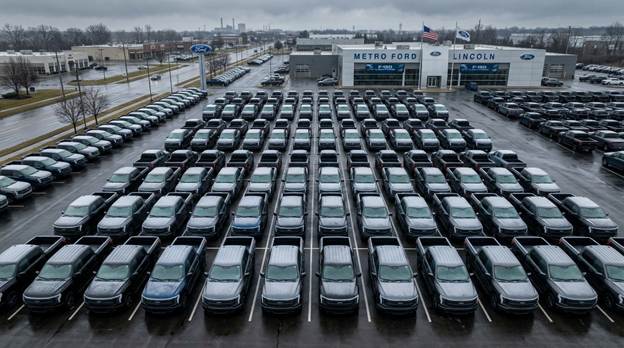
While Ford’s internal combustion engine (ICE) trucks and hybrids continue to carry the financial load, the F-150 Lightning—once hailed as the harbinger of a new era—is seeing its momentum evaporate. Enthusiast forums and industry analysts are no longer whispering about a “cooling” market; they are shouting about a deep freeze. The F-150 Lightning, which was intended to bridge the gap between traditional workhorse utility and futuristic tech, is now sitting on dealer lots in record numbers.
A Tale of Three Markets: US, Europe, and China
Ford’s struggle is not happening in a vacuum, but the severity of its decline is uniquely jarring when compared to global peers. In the United States, the EV market has hit a “plateau of reality.” Early adopters have already made their purchases, and the “pragmatic majority” remains skeptical of range, towing capabilities, and infrastructure. While General Motors and Rivian have also seen growth rates slow, none have reported a cliff-dive as precipitous as Ford’s 71% drop.
In Europe, the situation is more nuanced. Manufacturers like BMW and Volkswagen are seeing modest EV growth, but the removal of government subsidies in major markets like Germany has caused a noticeable dip. However, European makers are pivoting faster to smaller, more affordable EV platforms—something Ford has struggled to do with its heavy-duty focus.
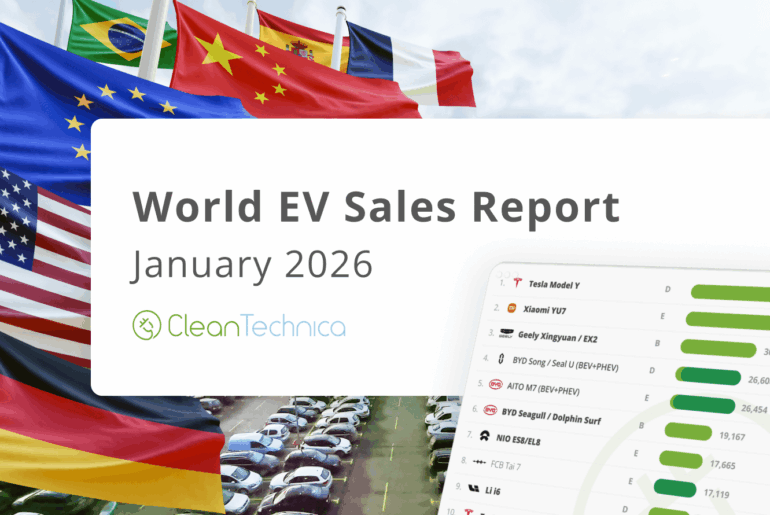
Conversely, China remains an alternate reality. Companies like BYD and Xiaomi are seeing explosive growth, driven by aggressive pricing and vertical integration. BYD recently overtook Tesla in global volume by offering EVs at price points Ford simply cannot match. The disparity is clear: Ford is fighting a price and infrastructure war in the West, while Chinese makers are winning a volume and technology war in the East.
The Global Temperature: Is the EV Market Truly Dying?
Despite the headlines, EVs are not “dying” worldwide; they are maturing. Global EV sales grew by roughly 30% in the last calendar year, but the distribution of that growth is uneven. In regions with robust charging networks and high fuel costs, adoption remains steady. The “cooling” trend is specifically localized to large-format vehicles in the North American market.
The issue is one of expectation versus reality. The industry predicted a linear upward trajectory, but the reality is a jagged staircase. Ford’s decline suggests that the “Truck Guy” demographic—the core of Ford’s identity—is the hardest to convert. Without a breakthrough in solid-state batteries or a radical expansion of high-speed charging in rural areas, the F-150 Lightning remains a “suburban luxury” rather than a “job site necessity.”
The Marketing Void: Did Ford Stop Selling the Dream?
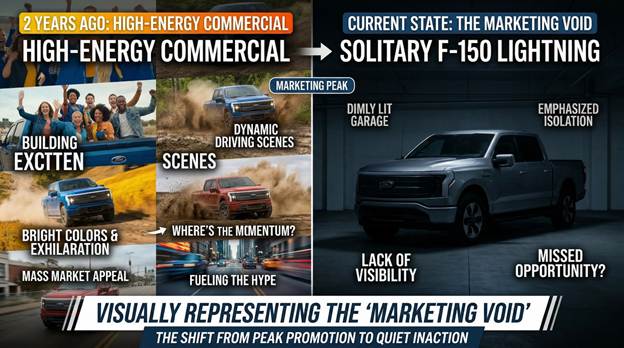
A significant portion of this decline can be attributed to a strategic retreat in marketing. During the initial launch of the Lightning, Ford’s marketing was ubiquitous, focusing on the “frunk” and the ability to power your home during a blackout. Today, that messaging has gone quiet.
Industry analysts argue that Ford shifted its ad spend back toward high-margin internal combustion vehicles like the Bronco and the Super Duty to shore up quarterly profits. By starving the EV division of “educational marketing,” Ford left the door open for misinformation regarding cold-weather performance and battery degradation to take root in the public consciousness. To sell a $70,000 electric truck, you cannot just list features; you must sell a lifestyle shift. Ford has stopped selling the shift and started selling the metal, and the metal isn’t moving.
How Ford Can Plug Back In
To reverse this downward trend, Ford must move beyond the “compliance vehicle” mentality. First, they need to address the “Price-to-Utility” gap. The Lightning is currently priced as a premium product, but it is used as a utility tool. Ford must find a way to offer a “Work Pro” trim that is genuinely affordable for small business owners, likely through the use of Lithium Iron Phosphate (LFP) batteries which are cheaper to produce and more durable for daily charging.
Secondly, Ford needs to lean into the NACS (Tesla Supercharger) transition more aggressively. While Ford was the first to announce the switch to Tesla’s charging standard, the rollout of adapters has been slow. Until a Ford owner feels as confident as a Tesla owner when planning a road trip, the sales slump will continue.
Is Ford Actually Doing the Work?
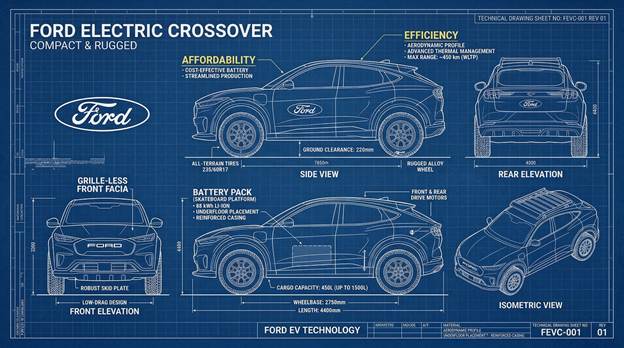
The irony is that Ford is taking steps to course-correct, but the results won’t be felt for months. CEO Jim Farley has recently pivoted the company’s strategy to focus on a “Skunkworks” team developing a low-cost EV platform to compete with Chinese imports and Tesla’s upcoming “Model 2.”
They have also cut production of the Lightning at the Rouge Electric Vehicle Center, a painful but necessary move to prevent dealer inventory from bloating further. While these moves are pragmatic, they are defensive. Ford is currently playing not to lose, rather than playing to win.
Wrapping Up
Ford’s 71% February EV sales crash is a sobering reminder that the transition to electric is not guaranteed. It is a complex alchemy of infrastructure, pricing, and consumer psychology. While Ford remains a leader in supply chain logistics, they have hit a wall with the American consumer.
To survive the “cooling” market, Ford must:
Drastically lower the entry price of their EV trucks through LFP battery technology.
Re-engage the public with an educational marketing campaign that addresses towing and cold-weather myths.
Accelerate the transition to smaller, more efficient EV platforms that appeal to urban buyers, not just traditional truck enthusiasts.
The F-150 Lightning isn’t a failure, but it is a “first-gen” product facing “second-gen” problems. If Ford can weather this storm by pivoting to affordability and better charging integration, this 71% dip will be a footnote. If they don’t, it may be the beginning of the end for the Blue Oval’s electric ambitions.
Disclosure: Images rendered by Artlist.io
Rob Enderle is a technology analyst at Torque News who covers automotive technology and battery developments. You can learn more about Rob on Wikipedia and follow his articles on TechNewsWord, TGDaily, and TechSpective.
Follow us today…