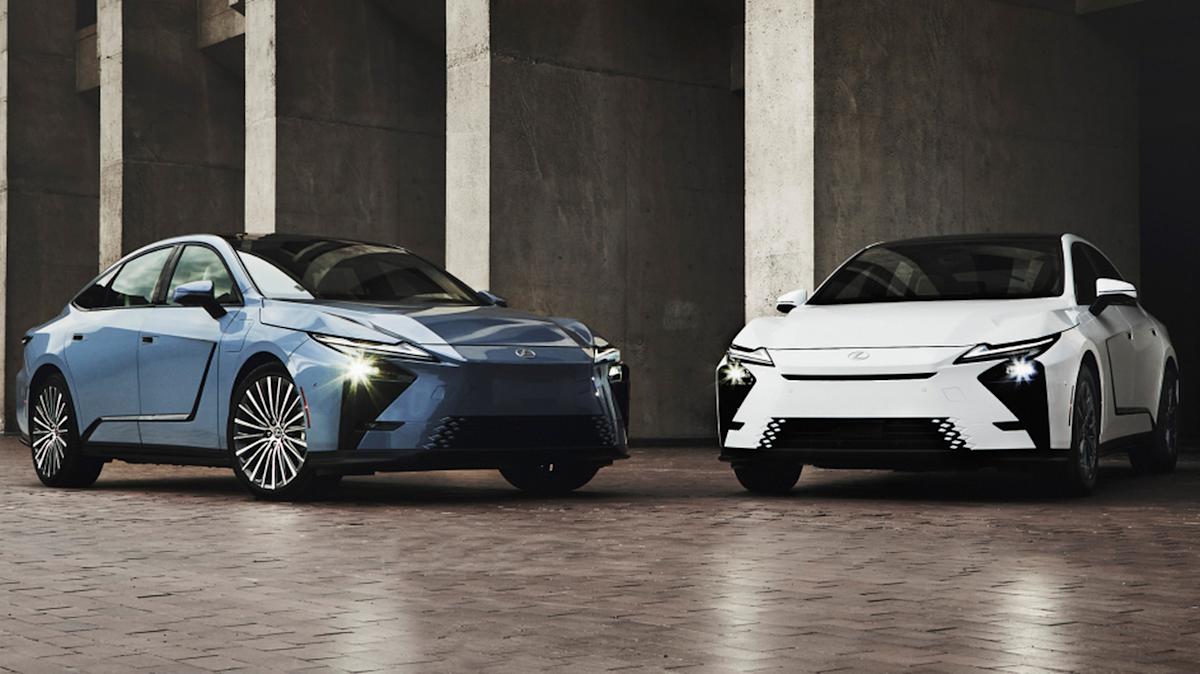
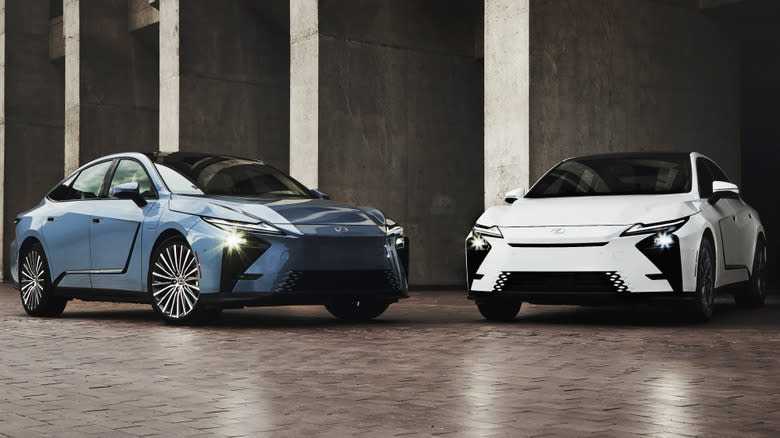
A front three quarter shot of a blue ES EV and a white ES Hybrid parked nose toward eachother on brick in front of concrete pillars – Lexus
The beloved Toyota Camry went hybrid-only in its latest redesign, but Lexus’ version of the Camry, the ES, took things one step further by offering only hybrid or a new fully electric powertrain for its 2026 redesign. We first saw the 2026 Lexus ES about a year ago, but official pricing was just announced last week, and in a shocking (ha!) turn of events, the EV is cheaper than the hybrid. The cheapest Lexus ES you can buy in 2026 is the electric ES 350e, which starts at $48,795 including destination, while the cheapest ES 350h hybrid starts at $50,995.
Both trim levels of the hybrid, the base Premium and $55,795 Premium+, come standard with front-wheel drive but can be had with all-wheel drive for $1,400 more. The ES 350e is front-wheel-drive only and comes in Premium or $57,195 Luxury trim levels; if you want all-wheel drive on an electric ES, you’ll have to upgrade to the dual-motor ES 500e Premium, which starts at $51,795, or the range-topping ES 500e Luxury that starts at $60,195.
Read more: 10 Of The Largest Private Car Collections In The World
The EV sits in a unique market position, with few direct competitors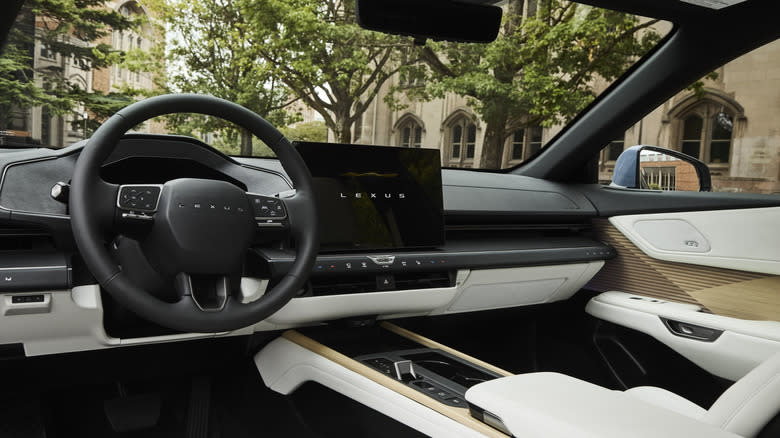
A look at the dashboard of the 2026 Lexus ES with a white and black color scheme, wood on the doors, and trees and buildings out the windows – Lexus
The hybrid ES uses a 2.5-liter inline four-cylinder engine, an ECVT, and electric motors for a combned output of 243 horsepower. The press release says that both front-wheel-drive and all-wheel-drive models produce the same power, but adding AWD drops the 0-to-60 time from 7.4 seconds to 7.2 seconds. Lexus says full specs for the U.S.-market 2026 ES are not available just yet, and a breakdown of what features each of the trim levels get has also yet to be made public.
In the front-wheel-drive ES 350e you get a 220-horsepower electric motor that’s good for a 7.7-second 0-to-60 time, while the ES 500e gets a second motor at the rear axle for a total of 338 horsepower, lowering the 0-to-60 time to 5.4 seconds. Lexus estimates the ES 350e will have a cruising range of approximately 300 miles, and the ES 500e will do around 250 miles on a full charge. Both come standard with the Tesla-style NACS charge port and an 11-kW on-board AC charger. Lexus hasn’t said the maximum charge rate yet (it’ll likely just be 150 kW like Toyota’s other EVs), but we know it can go from 10% to 80% in an unimpressive 30 minutes when DC fast-charging.
Lexus
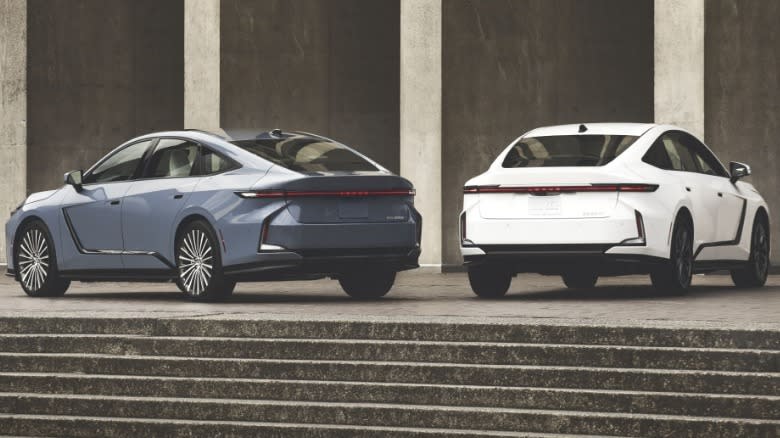
The ES occupies a strange niche segment. It technically competes with usual executive sedan suspects like the BMW 5 Series, Genesis G80, Audi A6, and Mercedes-Benz E-Class, but it’s the sole front-wheel-drive option in the class. In electric form, it will compete with the BMW i5 and Audi A6 E-Tron, both of which are significantly more expensive than even the ES 500e. The new Polestar 4 is 10 inches shorter than the ES, but it’s also a segment-straddling crossover, while the Mercedes-Benz CLA is similarly priced, much smaller but also a lot more efficient. Lexus hasn’t yet said when the ES will go on sale, but it should be sometime this spring or summer.
Want more like this? Join the Jalopnik newsletter to get the latest auto news sent straight to your inbox, and add us as a preferred search source on Google.
Read the original article on Jalopnik.