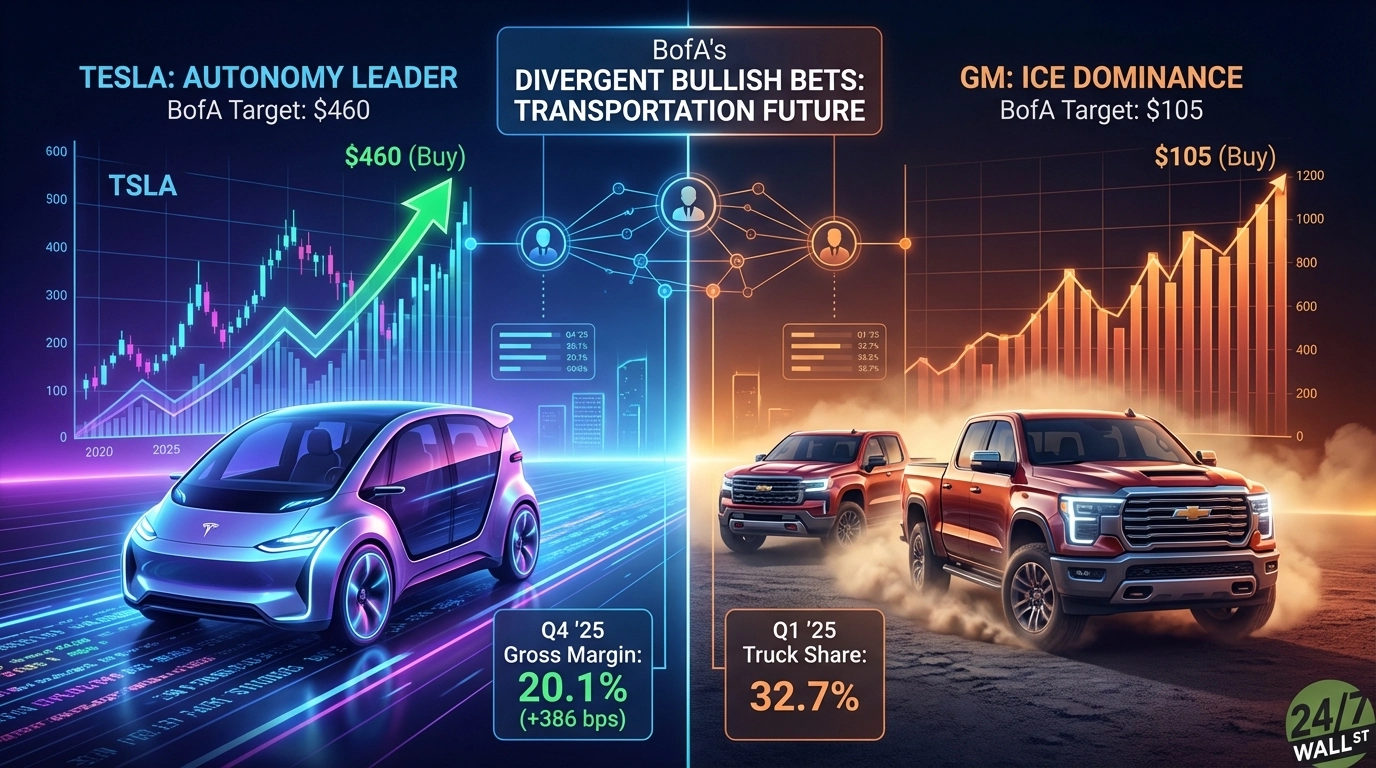
Bank of America is making two bold, contrasting bets on the future of transportation: BofA reinstated Tesla with a Buy rating and a $460 price target, calling it the current leader in consumer autonomy, while analyst Alexander Perry initiated coverage of General Motors with a Buy rating and a $105 price target, betting that GM’s truck and SUV dominance becomes even more profitable as EV pressure releases. Both calls are bullish. The logic behind each is completely different.
The Tesla Autonomy Thesis
Tesla (Nasdaq: TSLA) | TSLA Price Prediction is trading at $399.95 as of this morning, below BofA’s $460 target and meaningfully below its 52-week high of $498.83. The broad analyst consensus sits at $420.90, making BofA’s target notably more aggressive than the Street average.
The bull case isn’t about car sales. Tesla’s robotaxi service launched in Austin in June 2025 and is expanding to Dallas, Houston, Phoenix, Miami, Orlando, Tampa, and Las Vegas in the first half of 2026. Cybercab volume production starts this year. The narrative is shifting from automaker to autonomous mobility platform, and BofA is pricing in that transition.
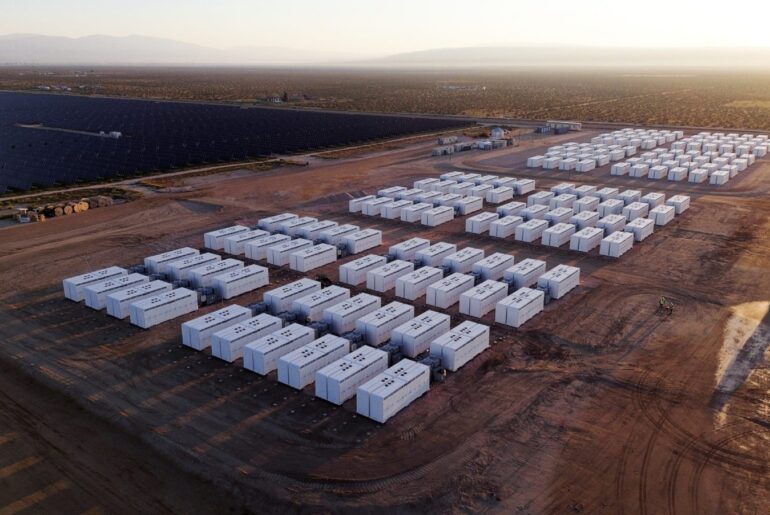
The underlying numbers give the thesis grounding. Despite vehicle deliveries falling 16% year-over-year in Q4 2025, gross margin actually expanded 386 basis points to 20.1%. The energy segment hit record Q4 deployments of 14.2 GWh, with revenue up 25% year-over-year. And Tesla ended the quarter with $44.059 billion in cash, up 173% year-over-year — a company investing aggressively while maintaining margin discipline on the core business.
Prediction markets are skeptical on some adjacent bets. Kalshi puts Optimus on sale before 2027 at just 19% probability, and the crowd’s median expectation for Q1 2026 deliveries sits around 330,000 units. The robotaxi story is real, but the timeline is the debate.
The valuation is the honest risk. Tesla trades at a trailing P/E of 356.75 and a forward P/E of 196.08. You are not buying a car company at these multiples — you are buying a bet that autonomous ride-hailing becomes a massive, high-margin business and that Tesla owns a dominant share of it. BofA believes that. The 17 Hold ratings versus 20 Buy and Strong Buy ratings show this is genuinely contested.
The GM ICE Dominance Thesis
GM (NYSE: GM) tells a different story. BofA’s $105 target implies roughly 33% upside from $79.07. The broader analyst consensus sits at $94.62, with 7 Strong Buy and 11 Buy ratings against just 2 Sell or Strong Sell.
The thesis is straightforward: regulatory tailwinds are letting GM lean into its most profitable products. Trucks and SUVs generate the margins. GM held 32.7% truck market share in Q1 2025 and expanded its U.S. market share to 17.2% in Q4 2025. North America capacity utilization hit 104.7% in Q4.
The EV restructuring charges look bad on paper — GM took $7.2 billion in special charges in Q4 2025. But management’s 2026 guidance of $11.00 to $13.00 in adjusted EPS and $13.0 to $15.0 billion in EBIT-adjusted signals those are one-time costs, not structural drag. A 20% dividend increase and a new $6 billion buyback authorization backs that confidence with capital.
CEO Mary Barra put it plainly on the earnings call: “We believe that formula is sustainable, which is why we’re increasing our dividend and planning future share repurchases.” At a forward P/E of just 6.18x, the market is pricing in doubt that BofA thinks is unwarranted.