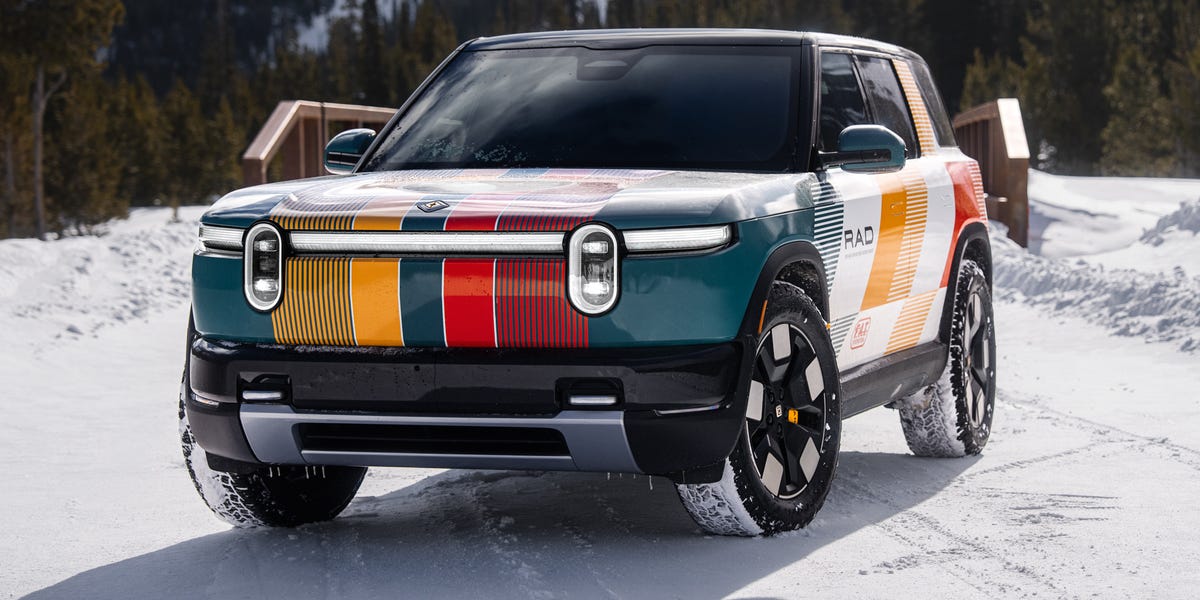
Rivian is driving straight into a new era. Between it simultaneously gone public with its Rivian Adventure Department and clinching a second-place finish at the 2026 FAT International Ice Race in Big Sky, Montana last week, it’s easy to see the California-based automaker is focusing on performance these days. But change rarely happens all at once—and Rivian is no exception to this rule, according to chief design officer Jeff Hammoud and chief R1 engineer Luke Lynch.
A core tenet of skunkworks design is secrecy, an attribute Rivian has now forfeited by revealing its adventure-forward engineering arm. But the decision to go public with RAD is less about shrouded prototype models and more about transparency for Rivian owners, Lynch explained. While the sweeping drive mode selector known as the RAD Tuner, now available on quad-motor R1 models, was privately in development for some time, Rivian wants future performance hardware and software innovations to be created more collaboratively with its owners.

Rivian
“I think it’s really about trying to find the limit,” Lynch told Road & Track. “You can set a goal—I think about the Porsche Cayenne and the Trans-Siberian trail—and we want to go and do that. How do we make a car to do that, or how do we adapt one of the cars that we’ve got to go and do it? It doesn’t have to [become] a whole vehicle. It’s just something that you should give to the customer to have fun.”
While Lynch declined to comment on the potential for future RAD-branded models, the lead engineer for the R1 line emphasized the importance of Rivian’s home-brewed hardware. The electric automaker decided a few years back to move production of its electric motors in-house, replacing the Bosch motors used on first-generation models—which ultimately paved the way for the RAD Tuner.

Rivian
The moves go beyond hardware and software. Rivian’s design language has always stood out as unique, aggressive, and grounded. For the most part, these characteristics mean that Rivian doesn’t have to alter its muscle-bound, rounded-box shape to fit with RAD’s mission. Still, there’s room to play, as Rivian wants to emphasize that RAD is a division with a bit of autonomy; the projects it focuses on aren’t completed through run-of-the-mill product planning processes, and they’re entirely focused on enthusiasts.

Rivian
“Our RAD Tuner started off [as] this engineering diagnostics tool that the team was using to control all the different behaviors in the vehicle. And it’s what we use to create the drive modes for Rebel Rally and Pikes Peak. We said, ‘This is such a cool tool for engineers, but what if we actually made this available to the customers?’ So that was one of the things where maybe not everybody would want to use it, but it’s the enthusiasts who want to go in and try those things,” Mammoud said.
We’ll have to wait and see how Rivian’s performance department matures, but based on our first experience, its focus seems to be razor-sharp. Performance is the fastest way to any enthusiast’s heart, whether that’s outright horsepower or the silly ability to push power exclusively to the rear wheels in a 7000-pound electric SUV. For those who can mount the $122,000 price barrier for a quad-motor R1, Rivian gives them nearly complete control of the how to fiddle with its performance—and it seems we should expect such freedom in Rivian models in the future, too.
Related Stories
A New York transplant hailing from the Pacific Northwest, Emmet White has a passion for anything that goes: cars, bicycles, planes, and motorcycles. After learning to ride at 17, Emmet worked in the motorcycle industry before joining Autoweek in 2022 and Road & Track in 2024. The woes of alternate side parking have kept his fleet moderate, with a 2014 Volkswagen Jetta GLI and a BMW 318i E30 street parked in his Queens community.
![Volkswagen's affordable electric SUV is almost here [Images]](https://www.evshift.com/wp-content/uploads/2026/03/1772649647_Volkswagen-affordable-electric-SUV-770x515.jpeg "Volkswagen’s affordable electric SUV is almost here [Images]")
![Volkswagen’s affordable electric SUV is almost here [Images]](https://www.evshift.com/wp-content/uploads/2026/03/LhLLttOoWchmHNp7pC3MxJQ58CstpSiHQYImjXKxjd0-770x515.jpeg "Volkswagen’s affordable electric SUV is almost here [Images]")