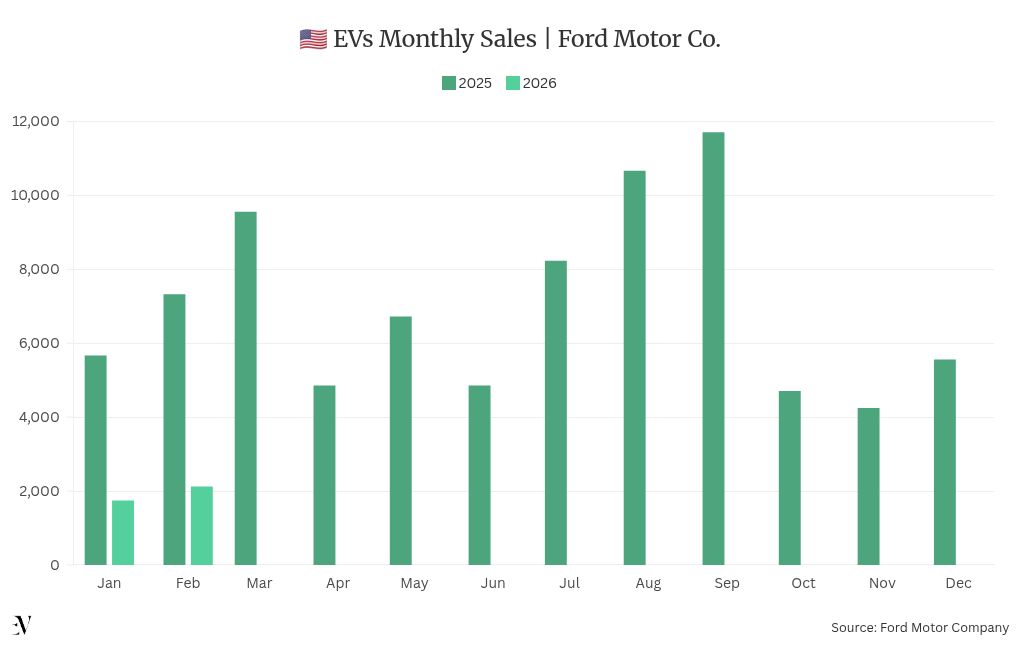
Ford Motor Co.‘s electric vehicle sales plunged 71% in February, extending the steepest decline in the company’s EV history as the Detroit automaker retreats from battery-powered models in favor of hybrids and a next-generation platform.
The sales decline follows Ford‘s decision late last year to permanently discontinue the F-150 Lightning, its flagship electric pickup, and pivot toward hybrid models and a new low-cost electric platform.
The company sold 2,122 electric vehicles in the United States last month, down from 7,326 units in February 2025, according to data released Wednesday.
The F-150 Lightning electric pickup — once Ford‘s flagship EV — fell 76.3% to just 522 units.
Year-to-date EV sales through February declined 70.3% to 3,865 units, marking the fifth consecutive month of year-over-year declines.
Ford’s electrified lineup — which includes hybrids — fell 37.7% to 14,132 units, while hybrid-only sales dropped 21.8% to 12,010 units.
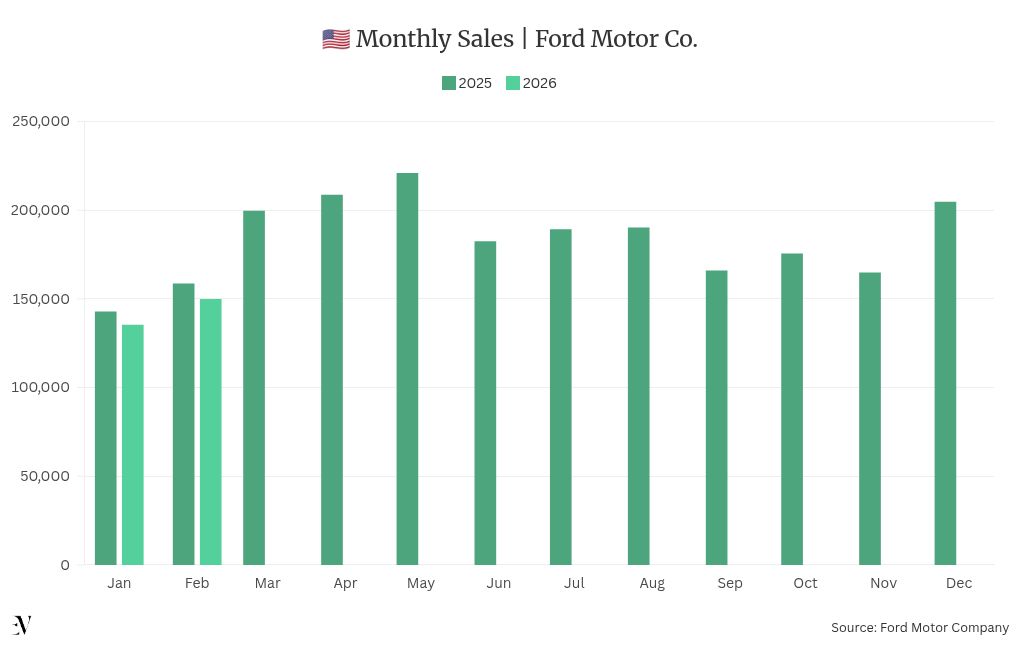
The company’s internal combustion engine business, which was nearly flat in February, declining just 0.1% to 135,830 units.
$4.8 Billion in Losses
Ford‘s EV unit — named Model e — recorded $4.8 billion in losses for the full year of 2025, including $1.2 billion in the fourth quarter alone.
The losses were $300 million below those reported a year earlier, which the company attributed to slight improvements in structural costs and a shift from high-end trucks in North America to smaller electric cars in Europe.
The company forecasts its EV business will lose between $4 billion and $5 billion in 2026, with Chief Financial Officer Sherry House reaffirming that Model e is not expected to turn profitable until 2029.
Late last year, Ford warned of a $19.5 billion writedown after restructuring its EV strategy in response to US policy shifts and rising demand for gasoline-powered vehicles.
Shift From High-End EVs
CEO Jim Farley has framed the pullback as a strategic response to softening demand at the top of the market.
After the federal EV tax credit expired on September 30, “the last couple of months have been really clear to us,” Farley said, noting a 5% contraction in the overall EV market.
“More importantly, the very high-end EVs, the $50,000, $70,000, $80,000 vehicles, they just weren’t selling,” the CEO said.
Even as Ford‘s EV sales halved in the fourth quarter of 2025, the F-150 Lightning retained its lead in the electric pickup segment, outselling Tesla’s Cybertruck and General Motors’ electric trucks.
For the full year of 2025, Ford‘s electric vehicle sales fell 14.1% compared to 2024, despite a demand surge in the third quarter driven by buyers racing to claim the federal tax credit before its expiration.
Universal EV Platform
Ford is now betting on its Universal EV Platform to revive its electric business from 2027 onward.
The company announced last August that it is investing approximately $5 billion to develop a midsize electric pickup truck priced around $30,000 — significantly below the entry-level price of the discontinued Lightning.
The strategy extends to overseas markets, where Ford is partnering with Renault and Volkswagen in Europe to lower costs.
“We are very focused on using Renault’s platform, especially their B-sized EV, to dramatically reduce our costs and improve the profitability of our EV business in Europe,” Farley said.
The EV restructuring has also affected battery production. Ford had been producing batteries in Louisville through its partnership with South Korean manufacturer SK On. The company will now focus on battery energy storage systems, an area where competitor Tesla is well established.
Overall Sales
Total Ford Motor Co. sales in February fell 5.5% to 149,962 vehicles from 158,675 a year earlier. Year-to-date sales through February declined 5.4% to 285,324 units.
Truck sales dropped 9.4% to 83,067 units, led by a 16.2% decline in F-Series pickups to 49,682 units. SUV sales fell 2.4% to 62,582 units, though the Bronco posted a 27.6% gain to 12,553 units and Explorer sales rose 33.4% to 20,100 units.
The Mustang was the sole car in Ford‘s lineup, with sales rising 54.5% to 4,313 units.
Lincoln brand sales increased 12.2% to 7,578 vehicles, with the Navigator up 31.8% to 1,310 units and the Aviator surging 50.1% to 2,037 units.