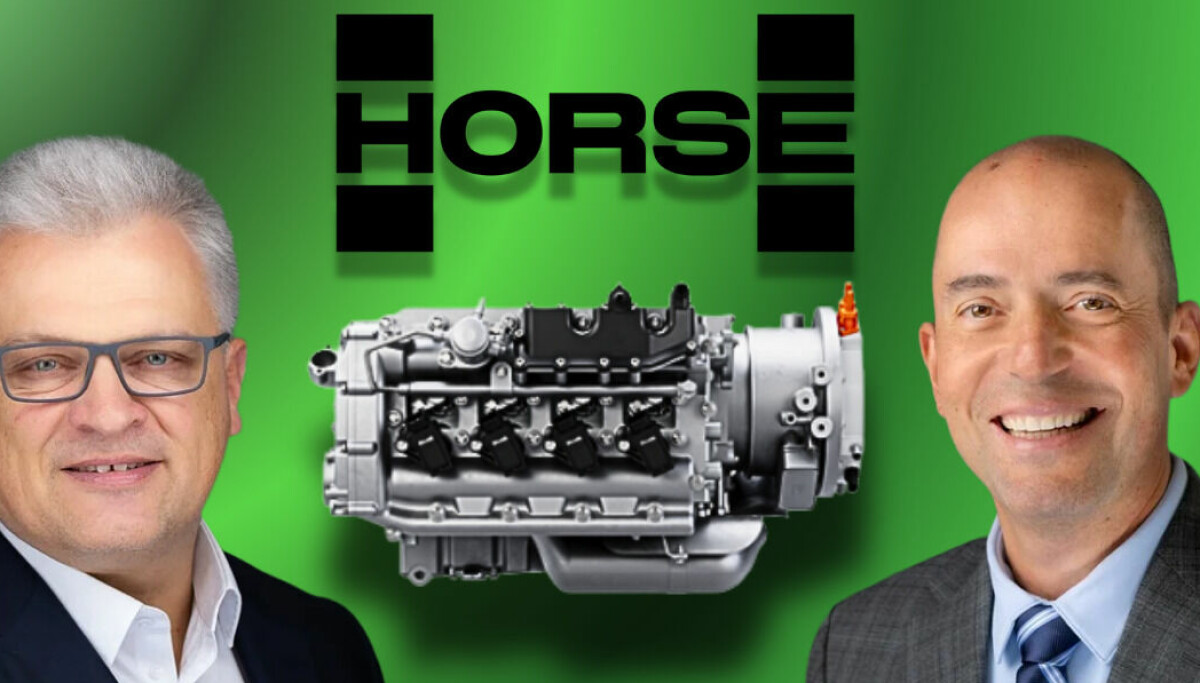
The internal combustion engine was supposed to be dying. For most of the past decade, the automotive industry organised itself around that premise, redirecting capital, talent, and factory floor space towards battery electric vehicles. Combustion research, in the words of HORSE Powertrain’s chief executive, Matias Giannini, “received limited attention.” But a choreography of critical setbacks has meant that EV timelines have been seriously thwarted. The result, he suggests, is a gap in the market large enough to build a company around.
That company, established in May 2024 as a joint venture between Renault and Geely, with Saudi Aramco holding a 10% stake, aims to do something that few in the industry had seriously contemplated: industrialise the combustion engine as a commodity and sell it as a shared service to OEMs who no longer wish to bear the cost of developing it alone. With 19,000 employees, 17 manufacturing plants and five R&D centres across Europe, China and Latin America, HORSE Powertrain is positioning itself as the world’s most credible answer to a question the industry has been reluctant to ask.

Matias Giannini, Chief Executive Officer, HORSE Powertrain
HORSE Powertrain
The commodity argument: When engines stop setting you apart
The logic begins with a disarmingly simple observation. As electrification accelerates and OEMs deprioritise combustion as a source of brand differentiation, the engines they continue to produce are, in Giannini’s view, no longer worth building alone. His argument is direct:
“Smaller combustion and hybrid powertrains – those with an engine displacing less than two litres – become a commodity, not a USP. Whether the industry accepts it or not, it is no longer economically smart for OEMs to independently produce engines and hybrid powertrains that are functionally identical. These engines are not a source of differentiation.”
The economic case is equally blunt. By pooling development with a specialist provider, Giannini contends that OEMs can “cut development costs five- to ten-fold,” freeing capital for the areas where competitive differentiation still matters: software, connectivity, interior design and autonomous systems. The company targets annual revenues of around €15 billion (~$17.5 billion), covering what it describes as 80% of global hybrid and combustion powertrain market demand.
The implication is striking. At a time when Renault’s Luca de Meo and Geely’s Eric Li have both staked significant corporate capital on this venture, HORSE Powertrain is not merely a supplier. It is an argument about the structural future of automotive manufacturing itself.
With its compact structure, [the C15 range extender] can fit into the most challenging spaces, allowing OEMs to adapt their BEVs into hybrids without having to make major changes to the vehicle and avoiding a total rethink of their EV strategies
A briefcase that changes everything: Compact, integrated, and purpose-built for 2040-ready BEVs

Ingo Scholten, Deputy Chief technology Officer, HORSE Powertrain
HORSE Powertrain
The most vivid embodiment of HORSE Powertrain’s industrial philosophy is the C15 range extender, unveiled at IAA Mobility in Munich in September 2025. Measuring just 50 x 55 x 27.5 centimetres in its naturally aspirated configuration – roughly the dimensions of an overnight bag – the C15 integrates a 1.5-litre four-cylinder engine, generator, inverter, and cooling package into a single module. It is designed to meet Euro 7, China 7 and SULEV20 emissions standards, and it is intended to drop into an existing battery electric vehicle without requiring a fundamental rethink of the platform.
“The C15 is unlike any other range extender,” says Giannini, “providing a unique solution for manufacturers and customers alike. With its compact structure, it can fit into the most challenging spaces, allowing OEMs to adapt their BEVs into hybrids without having to make major changes to the vehicle and avoiding a total rethink of their EV strategies.”
The engineering story behind the C15 is, if anything, more interesting than the marketing pitch. Ingo Scholten, HORSE Powertrain’s Deputy Chief Technical Officer, describes a design process in which compactness was not an afterthought but the central organising principle.
“The C15 was conceived as a fully integrated energy conversion module,” he says, “with packaging flexibility as a core design objective from the outset. Beyond compactness, a key focus was achieving a very flat architecture, enabling easy integration across a wide range of vehicle platforms.”
That flatness – enabling horizontal or vertical installation, and compatibility with both wet sump and dry sump configurations – required treating every component as part of a single tightly coupled system. “Interfaces were minimised, and functional elements were deliberately positioned to optimise mass distribution, thermal behaviour, and NVH performance within a very constrained envelope,” Scholten notes. The underlying engineering solutions are the subject of ongoing patent applications.
The HORSE Powertrain C15 Range Extender
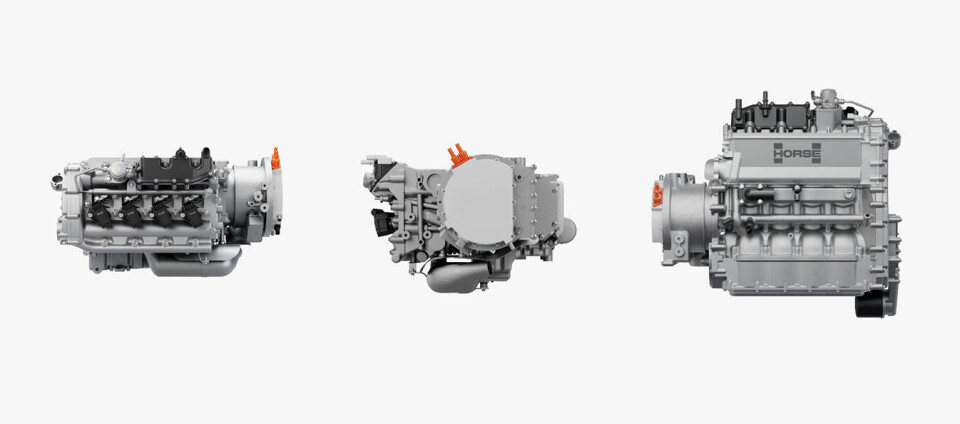
Smaller than a suitcase, larger than the problem it solves
HORSE Poertrain
Compared to traditional range extender designs, which were typically adapted from existing powertrains and integrated late in the development cycle, the C15’s purpose-built architecture represents a meaningful step forward in integration discipline.
One platform, two powertrains
The strategic implications of the C15 extend well beyond the unit itself. For OEMs, the ability to build both a battery electric vehicle and a range-extended hybrid from the same underlying platform resolves one of the most costly dilemmas of the transition period. Traditionally, as Giannini observes, OEMs had to “maintain dual manufacturing capabilities,” essentially doubling the facilities required to produce two fundamentally different products. The C15 dissolves that constraint.
“OEMs can focus on electric vehicles, using an essentially all-electric assembly line. With very little modification the C15 can be dropped into a BEV’s front compartment or in the rear. It means OEMs can continue to sell hybrids while maintaining one common platform, since the hybrid is derived from a BEV – rather than being descended from a radically different combustion-first architecture.”
Manufacturing feasibility is integrated into the design process from day one, not imposed as a downstream limitation. Our approach starts with extensive market analysis and benchmarking activities, combined with close and continuous dialogue with our customer
The commercial flexibility this creates is considerable. Whether regional markets swing towards electrification or pull back towards combustion, an OEM with a single shared platform can adapt without dismantling its production model. “Whether the market pivots back towards combustion or it doubles down on EV, they have both bases covered and can dial capacity up or down on either engine type depending on what the market demands, without having to completely rethink their production model,” says Giannini.
Design-for-Manufacturing as a founding philosophy
Behind HORSE Powertrain’s product claims lies an engineering methodology that Scholten describes as foundational to the company’s identity. Rather than treating manufacturing feasibility as a downstream constraint, HORSE embeds it into the design process (Design-for-Manufacturing) from the outset.
“Manufacturing feasibility is integrated into the design process from day one, not imposed as a downstream limitation. Our approach starts with extensive market analysis and benchmarking activities, combined with close and continuous dialogue with our customers. This allows us to clearly identify the critical pain points OEMs face – whether related to packaging, cost, industrial scalability, emissions compliance, or system integration – and to translate these challenges into concrete engineering targets.”
Read The Article:
HORSE accelerates digital twin integration at Valladolid
HORSE, the Renault-Geely joint venture, is harnessing digital twins at its Valladolid plant to transform powertrain production, boost flexibility in EV output, reduce emissions and embed data-driven decision-making across its operations.
The same discipline extends to emissions compliance. Euro 7 – which significantly expands testing conditions, durability requirements, and calibration effort – is not treated as a regulatory add-on to be addressed late in development. “Rather than treating emissions as an add-on, we design combustion systems, thermal management, aftertreatment interfaces, and control strategies as a single, integrated system,” Scholten explains.
To manage the scale and complexity of Euro 7 validation across its multi-OEM programmes, HORSE Powertrain increasingly deploys AI-based tools and advanced data analytics to accelerate calibration loops and improve repeatability. The company works across what Scholten describes as “multiple OEMs and brands, across a wide range of vehicle segments and applications,” building a depth of Euro 7 expertise that no individual OEM could accumulate working alone.
HORSE C15 — Technical Specification
Max Power — N/A
70kW
Naturally Aspirated
Max Power — Turbo
120kW
Turbocharged
Displacement
1.5L
4-Cylinder Inline
Compression Ratio
14.5:1
Direct Injection
Fuel
Gasoline
e-Fuel Compatible
Key Features
Briefcase-shaped system combines a 1.5-litre, 4-cylinder engine with generator, exhaust, and cooling unit, packaged horizontally or vertically
Designed for simple integration with existing EDUs; fits into the front compartment of BEV platforms or in the rear
Scalable from B-segment passenger vehicles through to light commercial vehicles (LCVs)
Compatible with wet or dry sump configurations; installs horizontally or vertically to suit platform constraints
Technical Specifications
Configuration
4-cylinder inline
Induction
Naturally Aspirated / Turbocharged
Fuel Injection
Direct Injection
Compression Ratio
14.5 : 1
Fuel Type
Gasoline & e-Fuel
Dimensions (mm)
500 × 550 × 275
Orientation
Horizontal or Vertical
Sump Configuration
Wet or Dry Sump
Euro 7
China 7
SULEV20
e-Fuel Ready
BEV Platform Compatible
Engineering the 50% engine and the efficiency limits of combustion
If the commodity argument is the commercial heart of HORSE Powertrain’s proposition, the efficiency roadmap is its scientific spine. The company is bringing to market engines achieving brake thermal efficiency above 44%, and has set a target of exceeding 50% by 2035. This matters because it frames the combustion engine not as a technology in managed decline but as one still capable of meaningful performance gains.
“These kinds of improvements are not achievable for any individual OEM. It is only by consolidating investment under one specialist that we can bring about the low carbon future the industry aspires to.”
Two technologies showcased at IAA Mobility point towards the shape of that frontier. The first is a Gallium Nitride high-efficiency generator, which Scholten describes as enabling “higher switching frequencies, improved efficiency, and significantly increased power density” – particularly valuable in compact hybrid and range extender applications where efficiency, packaging, and thermal management must be balanced simultaneously. The second is Turbulent Jet Ignition, a combustion technology that improves combustion stability and supports more aggressive efficiency strategies.
We’re not here to convince people that combustion power is preferable to electric…But the reality is that BEVs are not going to work in every market as it stands.
“Technologies like TJI allow us to continue extracting meaningful efficiency gains from combustion engines while significantly reducing their environmental impact.”
Both technologies are progressing along what Scholten calls “clear industrial roadmaps, aligned with the next generation of hybrid and low emission powertrains that will be required over the coming decade.” Neither is presented as a research curiosity. The timelines for production deployment depend on application and customer strategy, but the direction of travel is clear.
The 2040 reckoning: Combustion engines, collaboration, and global market needs
Underlying all of this is a projection that the automotive industry has found easier to acknowledge in private than in public. By 2040, HORSE Powertrain estimates, combustion engines will still be present in more than half of the world’s passenger cars. Giannini is not shy about the implication:
“We’re not here to convince people that combustion power is preferable to electric. Whether you’re a consumer or an OEM, we all want the same thing: practical, affordable, low-emission solutions. But the reality is that BEVs are not going to work in every market as it stands. Because of this, it’s important that we don’t ignore the combustion engine and continue to innovate so that we’re not stuck with outdated engines.”
This combination of global consolidation and regional presence enables HORSE Powertrain to deliver robust, scalable solutions that are both technically consistent and finely tuned to specific market needs
The company is also developing engines compatible with biofuels and other alternative fuel options, ensuring its powertrain solutions can serve markets where grid decarbonisation lags behind vehicle electrification. “We will continue to invest in this technology, so that other OEMs don’t have to, ensuring we address a truly global market,” Giannini says.
The R&D network that supports this ambition spans five centres with regional proximity to customers in Europe, Latin America and China. Core technologies are developed jointly and shared across the network, while local teams address the regulatory and usage-pattern differences that make powertrain development irreducibly regional. As Scholten puts it: “This combination of global consolidation and regional presence enables HORSE Powertrain to deliver robust, scalable solutions that are both technically consistent and finely tuned to specific market needs.”
HORSE Powertrain, with its 125-year lineage through Renault and Geely, is not a startup making bold claims from a clean sheet. It currently produces over eight million engines and transmissions annually for more than fifteen OEMs, including Renault, Dacia, Volvo Cars, Nissan, Mitsubishi Motors and Mercedes-Benz. The industrial credibility is real.
Articles Chosen For You…
What remains to be seen is whether the OEM community, long conditioned to regard the engine as a strategic asset, will fully embrace the logic of sharing it. Giannini, for his part, frames the question in terms that leave little room for equivocation:
“As the mobility sector faces mounting regulatory pressure and escalating costs, those organisations that collaborate most effectively will hold the greatest competitive advantage.”
Whether that is a prediction or a sales pitch depends, perhaps, on whether you are buying or selling.