Your support helps us to tell the story
From reproductive rights to climate change to Big Tech, The Independent is on the ground when the story is developing. Whether it’s investigating the financials of Elon Musk’s pro-Trump PAC or producing our latest documentary, ‘The A Word’, which shines a light on the American women fighting for reproductive rights, we know how important it is to parse out the facts from the messaging.
At such a critical moment in US history, we need reporters on the ground. Your donation allows us to keep sending journalists to speak to both sides of the story.
The Independent is trusted by Americans across the entire political spectrum. And unlike many other quality news outlets, we choose not to lock Americans out of our reporting and analysis with paywalls. We believe quality journalism should be available to everyone, paid for by those who can afford it.
Your support makes all the difference.Read more
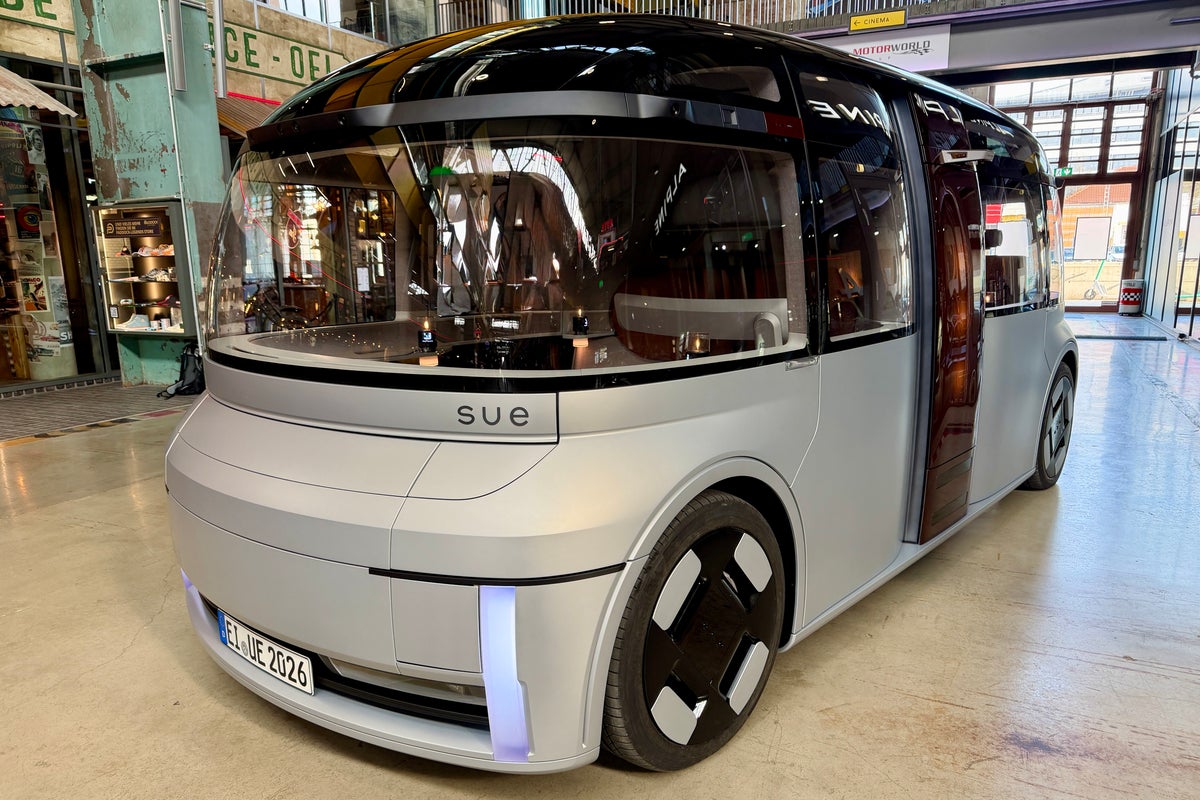
A new all-electric autonomous shuttle has made its international debut in Munich, offering a glimpse into how its creators believe public transport could evolve in the age of self-driving technology.
The vehicle, called Sue – short for self-driving urban e-shuttle – has been developed by UE Studios, a company that’s more used to building motor show concept cars and special vehicles for movie use.
Unlike many autonomous concepts that focus on robo-taxi services or futuristic city pods, Sue has been conceived specifically as a shared public transport vehicle.
open image in gallery
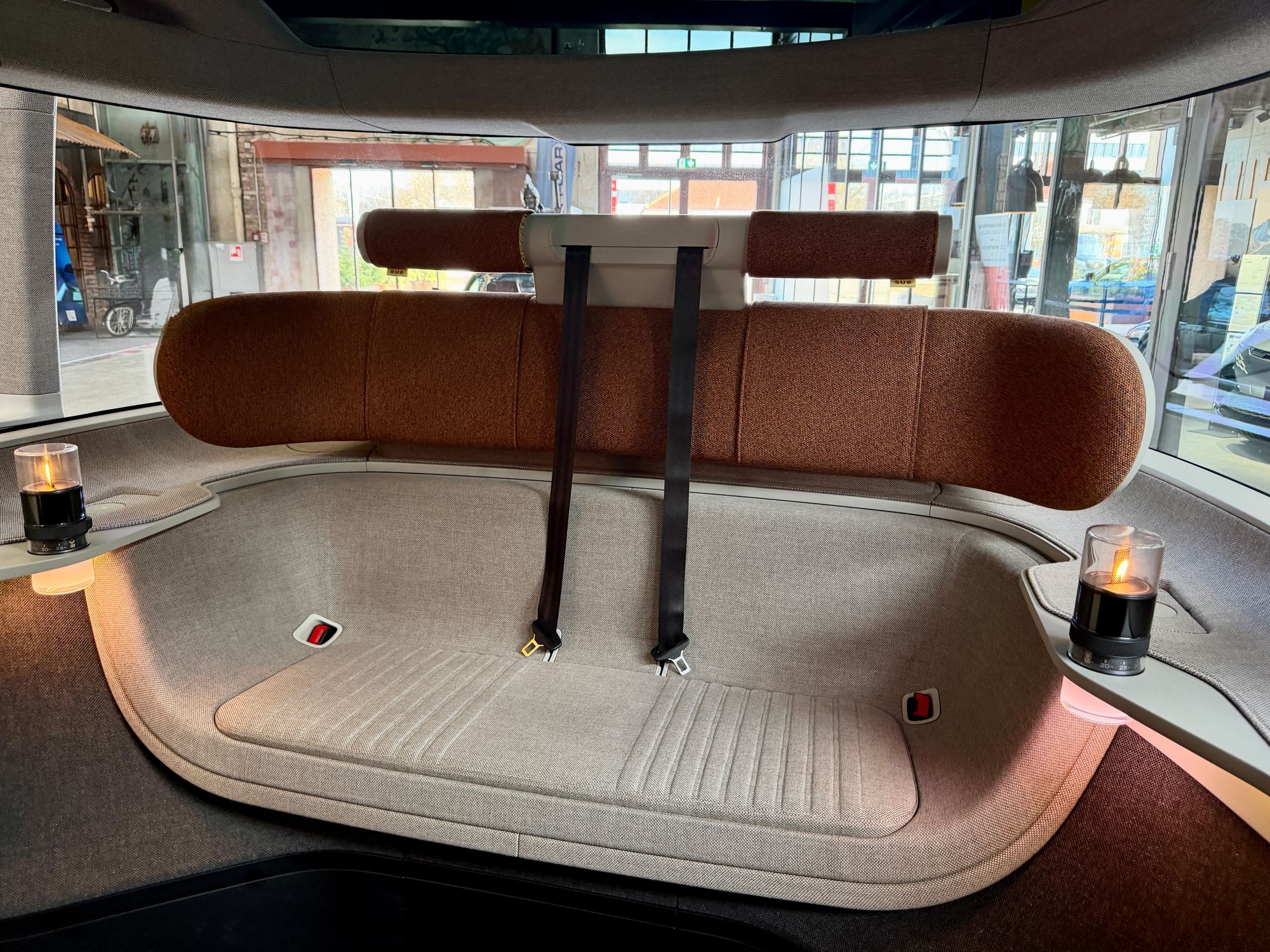
Sue can seat up to eight people in two separate cabins. Digital candles show users where to sit (Steve Fowler)
Sue was created with support from the German government and the European Union. Development, design, vehicle platform and autonomous software were all created in Germany.
“We conceived SUE from the ground up as a shared vehicle for public transport. It is not designed for individual ownership but to equally address the needs of passengers and operators,” said Alexander Uedelhoven, project lead and authorised signatory at UE Studios.
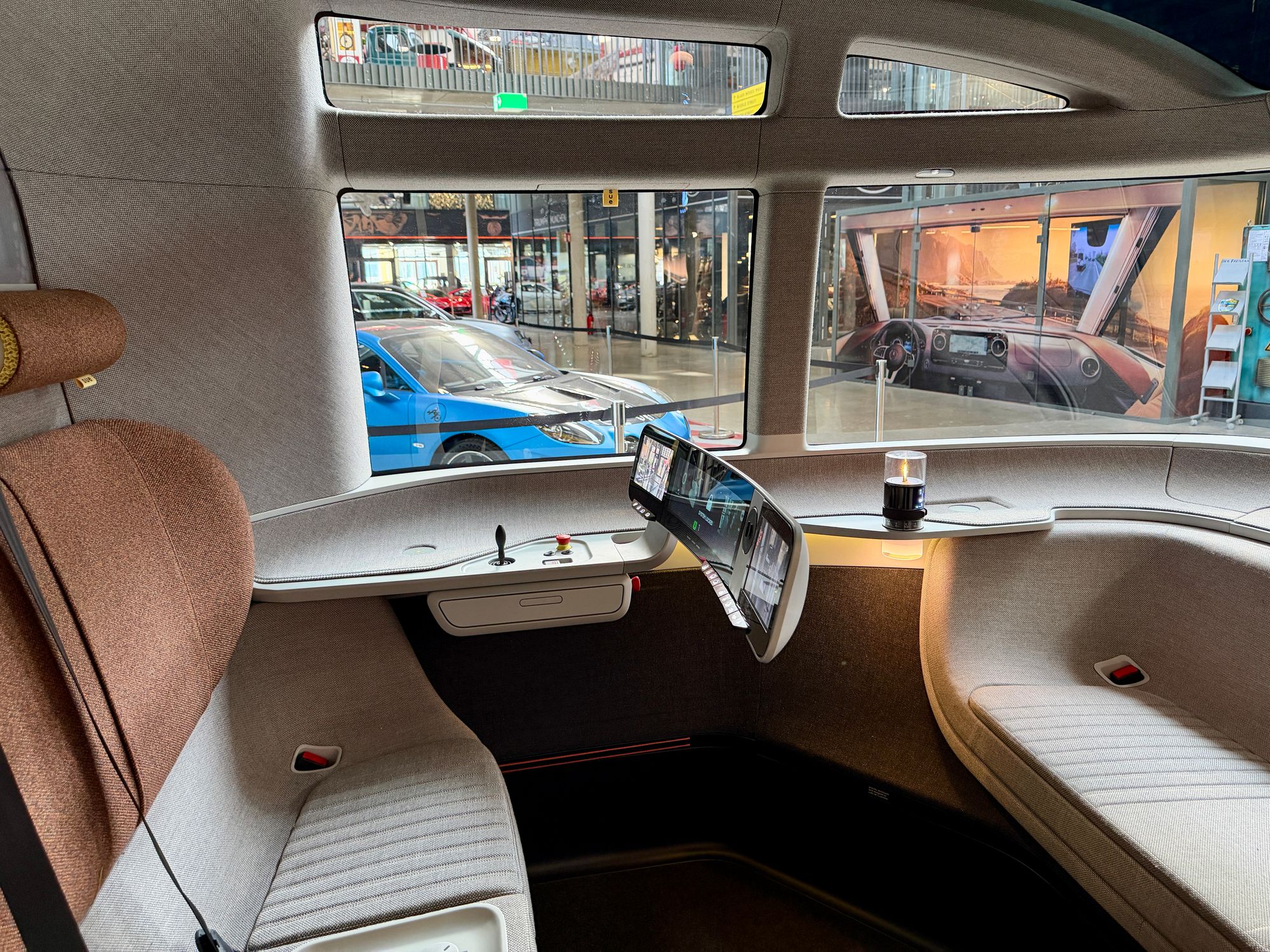
Unlike many design-led studies, Sue is not just a static show car. It is road registered, carries number plates and can be driven. Under current regulations it operates with an onboard operator, but the vehicle has been engineered for fully-autonomous use.
“The way we built the cars right now from a legal aspect, we need to have an operator,” Uedelhoven explained. “But we built a car that will be fully autonomous.”
The shuttle can reach speeds of up to 31mph, significantly higher than many low-speed autonomous pods currently being trialled, which typically operate at around 7 to 12mph. UE Studios has already secured permission for autonomous operation in a defined region in Bavaria, where the vehicle could connect two villages.
In terms of layout, Sue sits somewhere between a conventional bus and a private hire vehicle. In its current configuration it seats six passengers plus an operator, rising to eight seats in fully-autonomous mode. The idea is to support both ride-sharing and more exclusive ride-hailing use, with two distinct interior sections that can be booked separately.
“We said we want to build a car that’s kind of ride-sharing and ride-hailing,” Uedelhoven said.
open image in gallery
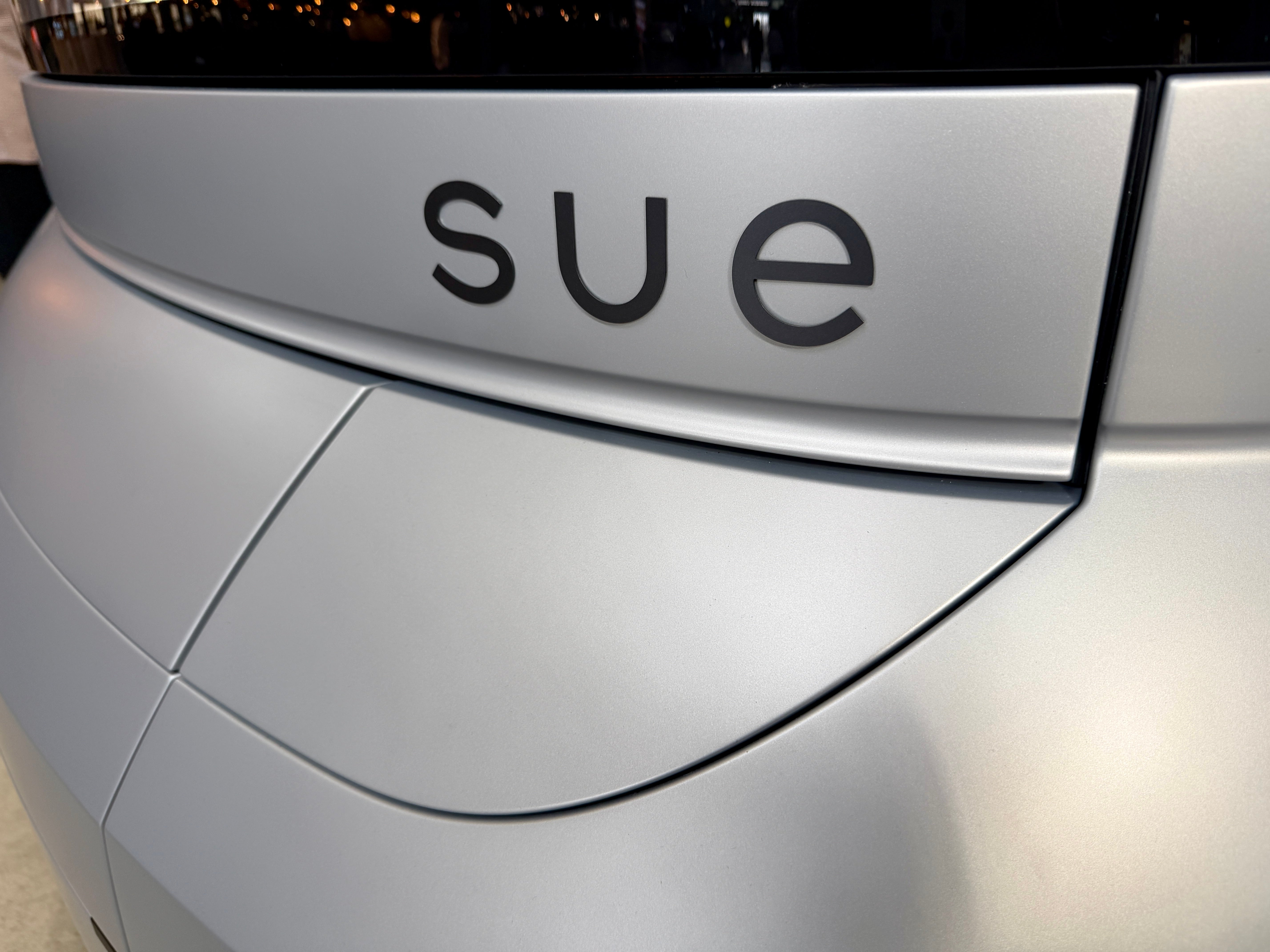
Sue stands for self-driving urban e-shuttle (Steve Fowler)
A key theme of the project is what the company describes as a human-centric, inside-out design philosophy. The vehicle is symmetrical front to rear, allowing shared components to reduce tooling and maintenance costs – similar to the Citroen Ami. Even the crash structures and interior elements have been designed to be mirrored.
From the outside, Sue deliberately avoids an aggressive or overly technical look. Large glass areas replace traditional A-pillars, creating a more open feel and clearer lines of sight between passengers and their surroundings. The designers describe the side of the vehicle as “the new front”, with the door treated like a welcoming house entrance with no sign of a traditional grille.
Much of the car’s computing systems are easily accessible behind coloured panels that sit between the doors that allow users to use the front or rear cabins. And those panels can be colour coordinated depending on the area that Sue is being used in – for example, red in London to tie in with London buses.
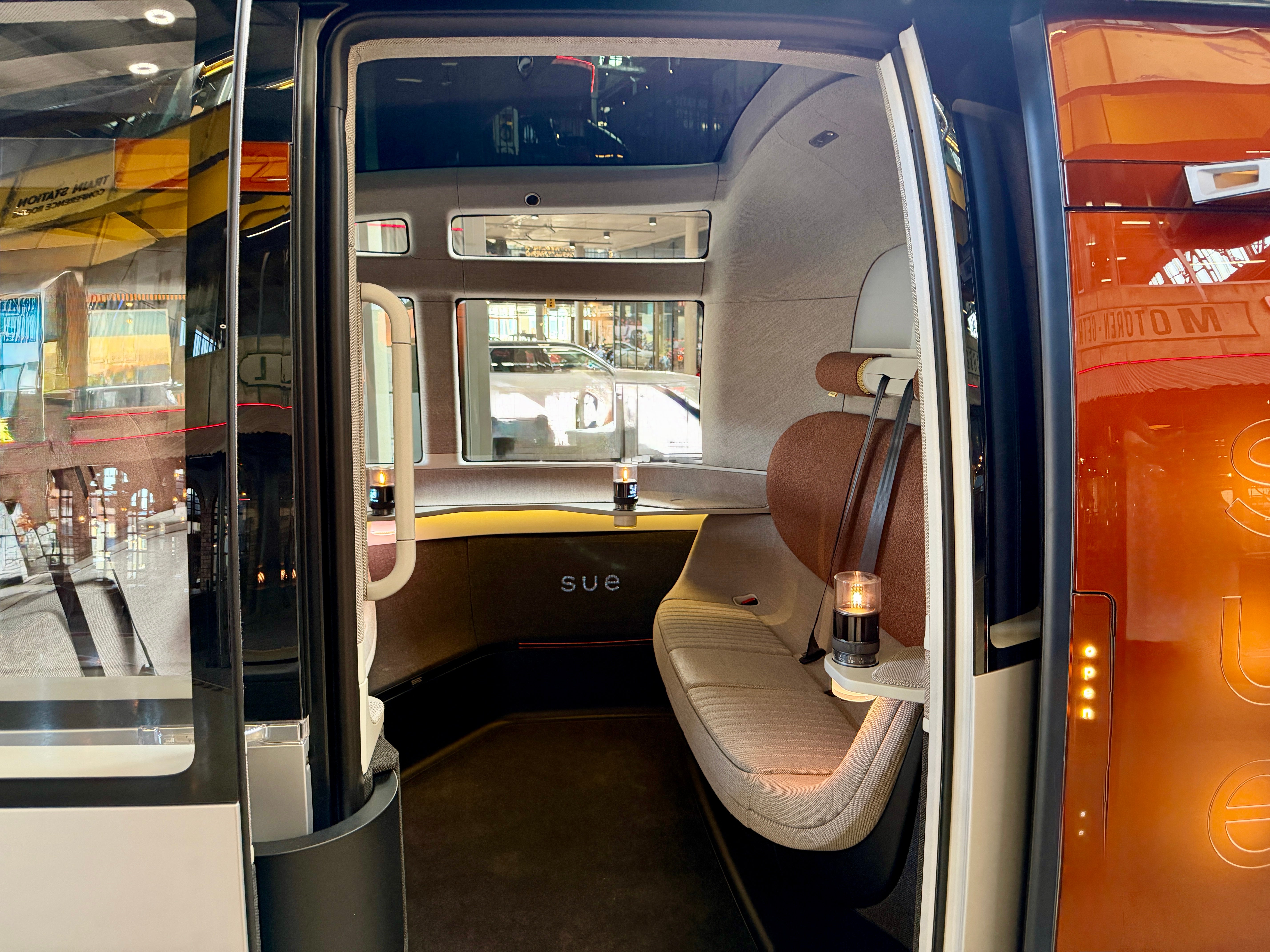
Inside, the shuttle is what the company calls “public space on wheels”. Two separate compartments are divided by electronically switchable glass panels, while a panoramic glass roof and large front and rear windows create a 360-degree view.
open image in gallery
Access to Sue is through welcoming doors, with the side of the vehicle designed as its front (Steve Fowler)
One of the most distinctive elements is Sue Ambience – described as a digital candle positioned at each seat. It acts as both an interface and atmospheric lighting, guiding passengers to their allocated place using colour and number cues that will be mirrored on the booking app on a user’s phone. There’s also a number displayed on the outside of the vehicle, making it easier for users to recognise their ride.
A mechanical-style minute indicator around the digital candle also shows remaining journey time, while most infotainment functions are expected to be handled via passengers’ own smartphones.
“We said that the music interface will be done with your phone. Everyone’s got a phone so you don’t need music or whatever in the car,” Uedelhoven said.
Materials have been selected with durability and recyclability in mind. Seats use 3D-printed TPU cushions instead of conventional foam, and the interior features Arfinio, a mono-material that is designed to be hardy, fully recyclable and easy to clean. The company says this approach also supports lower maintenance costs in high-traffic public transport use.
open image in gallery
Sue is fully drivable but needs a controller for now (Steve Fowler)
Under the floor sits a battery of just over 60kWh, developed within the project. Interestingly, Sue operates on a 48-volt system rather than the 400- or 800-volt architectures common in most electric cars. The aim is to simplify maintenance and make the vehicle more suitable for rural regions where specialist high-voltage training may be less accessible.
Autonomous sensors and computing hardware are housed within a central “vision belt” and modular rack system that sits around the top of the car like a headband, allowing cameras, LiDAR and processors to be upgraded independently of the main body structure. UE Studios says this reflects the faster development cycle of autonomous hardware compared with the longer life cycle of the vehicle itself.
For now, Sue remains a prototype and research vehicle, marking the conclusion of its funded development phase and the start of discussions about potential next steps. Whether it evolves into a production-ready shuttle will depend on partners, volumes and regulatory frameworks.
What is clear is that Sue has been conceived not as a private car or cab replacement, but as a complementary piece of public transport infrastructure – designed to fill gaps where existing bus and rail networks do not always reach.