Key Points
Nvidia (NASDAQ: NVDA) is one of the most impressive companies we’ve ever seen. It is dominating the computing hardware realm and has become the primary option to run all of the generative artificial intelligence (AI) workloads that are coming online. However, we’re still in the early innings of the buildout, leaving plenty of room for upside for Nvidia.
If projections pan out, Nvidia could transform into a massive company that is far larger than nearly every other company. This makes it a golden buying opportunity, but just how large can it get?
Will AI create the world’s first trillionaire? Our team just released a report on the one little-known company, called an “Indispensable Monopoly” providing the critical technology Nvidia and Intel both need. Continue »

Image source: Getty Images.
Nvidia believes AI spending will skyrocket over the next five years
Nvidia made a jaw-dropping projection that global data center capital expenditures will reach $3 trillion to $4 trillion annually by 2030. That’s a bold call, but what does it mean for Nvidia’s stock?
For 2025, the company projected global data center spending to be about $600 billion. For fiscal year (FY) 2026, ending Jan. 25, it generated $216 billion in revenue. That equates to a 36% spending share.
If we assume that the projection ends up on the high end and Nvidia sustains its 36% spending capture, that would project revenue of $1.44 trillion. Nvidia generated a 54% profit margin in FY 2026, and if it maintains that level, it will deliver $780 billion in profits. If we assign a 30 times trailing earnings multiple to that, we would get a stock that’s worth $23.4 trillion.
That’s an absurdly large company, especially considering Nvidia has a market cap of less than $5 trillion now. However, there is a financial basis behind it if projections go as expected and Nvidia maintains its market share.
It also brings up an interesting comparison: the “Magnificent Seven” cohort. The current combined market cap of the other Magnificent Seven stocks is $16.3 trillion.
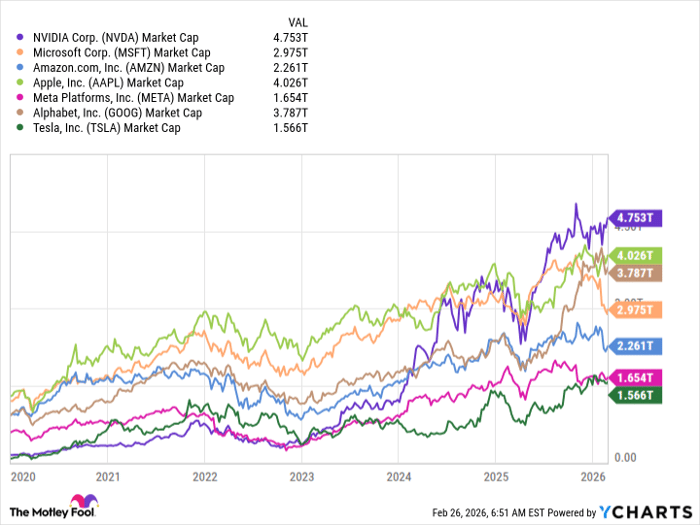
NVDA Market Cap data by YCharts
So, Nvidia has a chance to be worth a lot more than its peers combined right now by 2030. That’s huge value creation, and it’s all thanks to the spending from various AI hyperscalers. Nvidia is a once-in-a-generation investment opportunity, and investors can’t miss it. The odds of its living up to this exact projection are remote, but it shows that Nvidia will still be a fantastic stock to own, even if it falls short.
Nvidia will undergo some monstrous growth over the next few years, and I’m confident it will outperform every stock in the market. AI spending isn’t slowing down, so neither should your Nvidia investing.
Should you buy stock in Nvidia right now?
Before you buy stock in Nvidia, consider this:
The Motley Fool Stock Advisor analyst team just identified what they believe are the 10 best stocks for investors to buy now… and Nvidia wasn’t one of them. The 10 stocks that made the cut could produce monster returns in the coming years.
Consider when Netflix made this list on December 17, 2004… if you invested $1,000 at the time of our recommendation, you’d have $523,599!* Or when Nvidia made this list on April 15, 2005… if you invested $1,000 at the time of our recommendation, you’d have $1,118,640!*
Now, it’s worth noting Stock Advisor’s total average return is 951% — a market-crushing outperformance compared to 194% for the S&P 500. Don’t miss the latest top 10 list, available with Stock Advisor, and join an investing community built by individual investors for individual investors.
*Stock Advisor returns as of March 3, 2026.
Keithen Drury has positions in Alphabet, Amazon, Meta Platforms, Microsoft, Nvidia, and Tesla. The Motley Fool has positions in and recommends Alphabet, Amazon, Apple, Meta Platforms, Microsoft, Nvidia, and Tesla. The Motley Fool has a disclosure policy.
The views and opinions expressed herein are the views and opinions of the author and do not necessarily reflect those of Nasdaq, Inc.