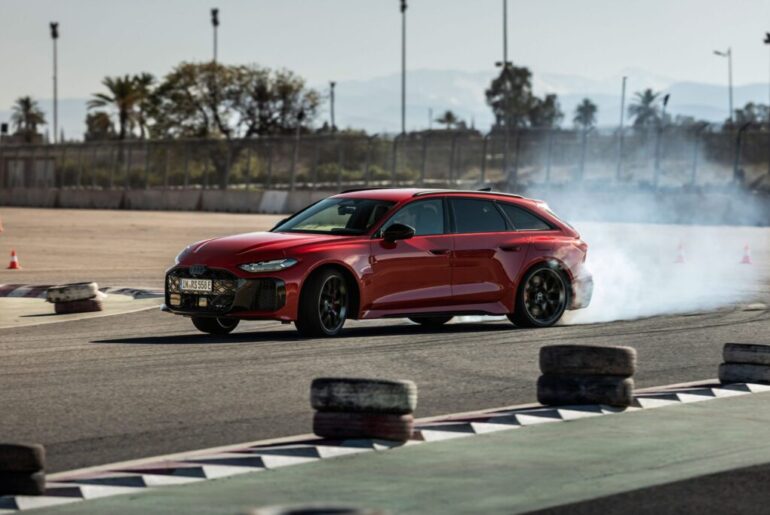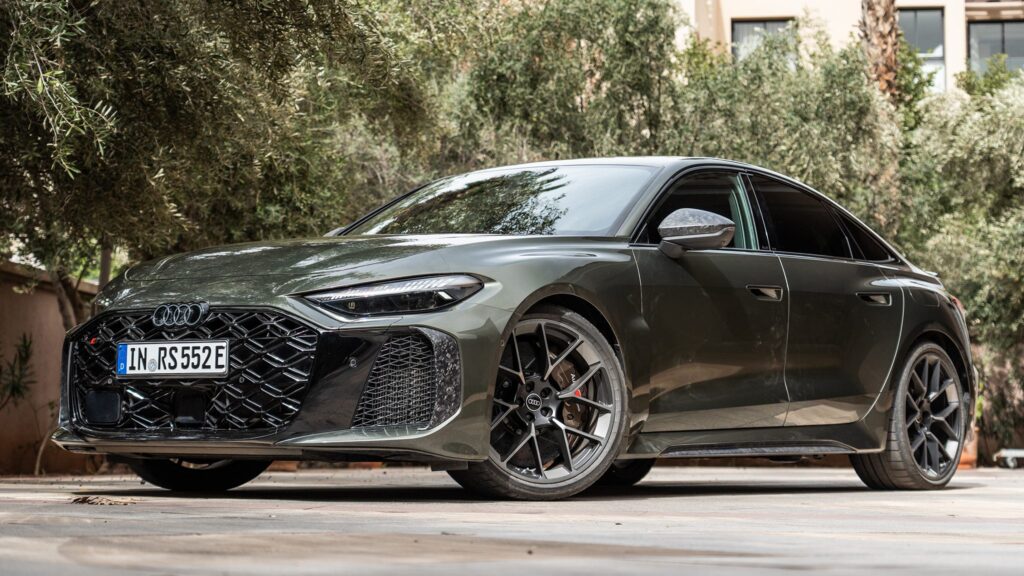
The central display gains a few RS-specific features, most notable being the new Audi Driving Experience. Here you can record your fastest times around any track, replay your laps to view G-forces and speeds in any corner, and even track your wildest of drifts.
Don’t Call It Drift Mode
The latest BMW M5 features a 2WD mode that disengages the front axle and turns it into a 717-hp tire-slaying monster. Audi takes a very different approach for its Torque Rear mode.
ADVERTISEMENT – CONTINUE READING BELOW
Unlike the M5, which has a clutch-type center differential, the new RS5 uses a variation of a Torsen in the middle. It’s purely mechanical, and its power distribution ranges from a maximum of 70 percent at the front to 85 percent at the rear. It’s a similar setup to performance-minded diffs on RSes past, now with a bit of preload to enable even faster locking.
That means the RS5 can’t shuttle all its power to the rear, but it does have a new trick that makes it feel far more tail happy. Audi calls it Dynamic Torque Control, an electronically actuated rear differential made possible by the high-voltage hybrid system here. A small electric motor is embedded in the rear differential, which is connected to both output shafts via planetary gearsets.
The motor itself is only rated for 30 lb-ft of torque, but thanks to the gearsets and the power coming down the driveshaft, Audi says this system can deliver an effective 1,475 lb-ft at the outside tire. This makes for a much livelier rear end and a wonderfully willing drift partner, not only capable of kicking itself sideways with little provocation but also able to reel back in over-exuberance quickly and easily.
ADVERTISEMENT – CONTINUE READING BELOW
 Grip Driving
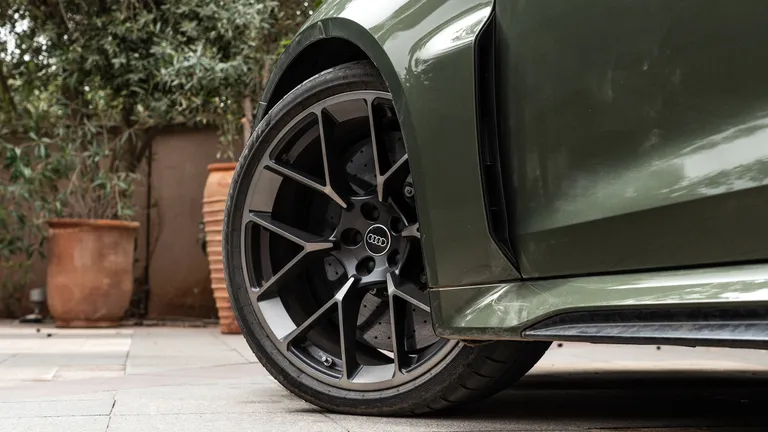
Drifting is fun and all, but given the cost of those massive Pirelli P Zero R tires, few RS5 owners will be engaging in such theatrics. Track days and performance on-road driving, however, are much more likely, and the rear differential helps there, too.
It makes for a car that feels substantially lighter when powering out of tight corners, all without the extra suspension complexity added by a rear-steering system. In fact, the suspension here is relatively straightforward: steel springs wrapped around adaptive dampers with variable compression and rebound.
When powering out of corners, the RS5 feels light and fun. On turn-in, a sharp 13:1 ratio (vs. 15:1 in the regular A5 and S5) helps things feel eager there, as well. However, it’s mid-corner where you can really feel that extra 1,000 pounds at play. Charge into a corner too hot, or stomp on those optional carbon-ceramic brakes too hard, and the RS5’s first inclination is to plow straight ahead, overpowering the front wheels.
Drive with a bit more nuance, though, and the RS5 is a willing partner. It has oodles of grip and, as you’d expect from an Audi, good poise. On the legendarily unpredictable roads in and around Marrakesh, Morocco, this big sedan never felt uncertain or nervous. It just wanted to go faster than common decency and respect for the locals and their laws would reasonably allow.
And the engine? The combination of a 2.9-liter twin-turbo V-6 and electric motor, mated to an eight-speed automatic, is fantastic. That electric motor helps sharpen up throttle response so that you won’t be bothered by the spooling of those turbos, and while you can only get that maximum 630-horsepower figure for 10 seconds when you push the Boost button on the steering wheel, that’s plenty enough to leave just about anything that’s troubling you in the rearview mirror.
Audi officially rates this for a 3.6-second 0–62-mph time, but it feels even quicker than that on the road.
ADVERTISEMENT – CONTINUE READING BELOW