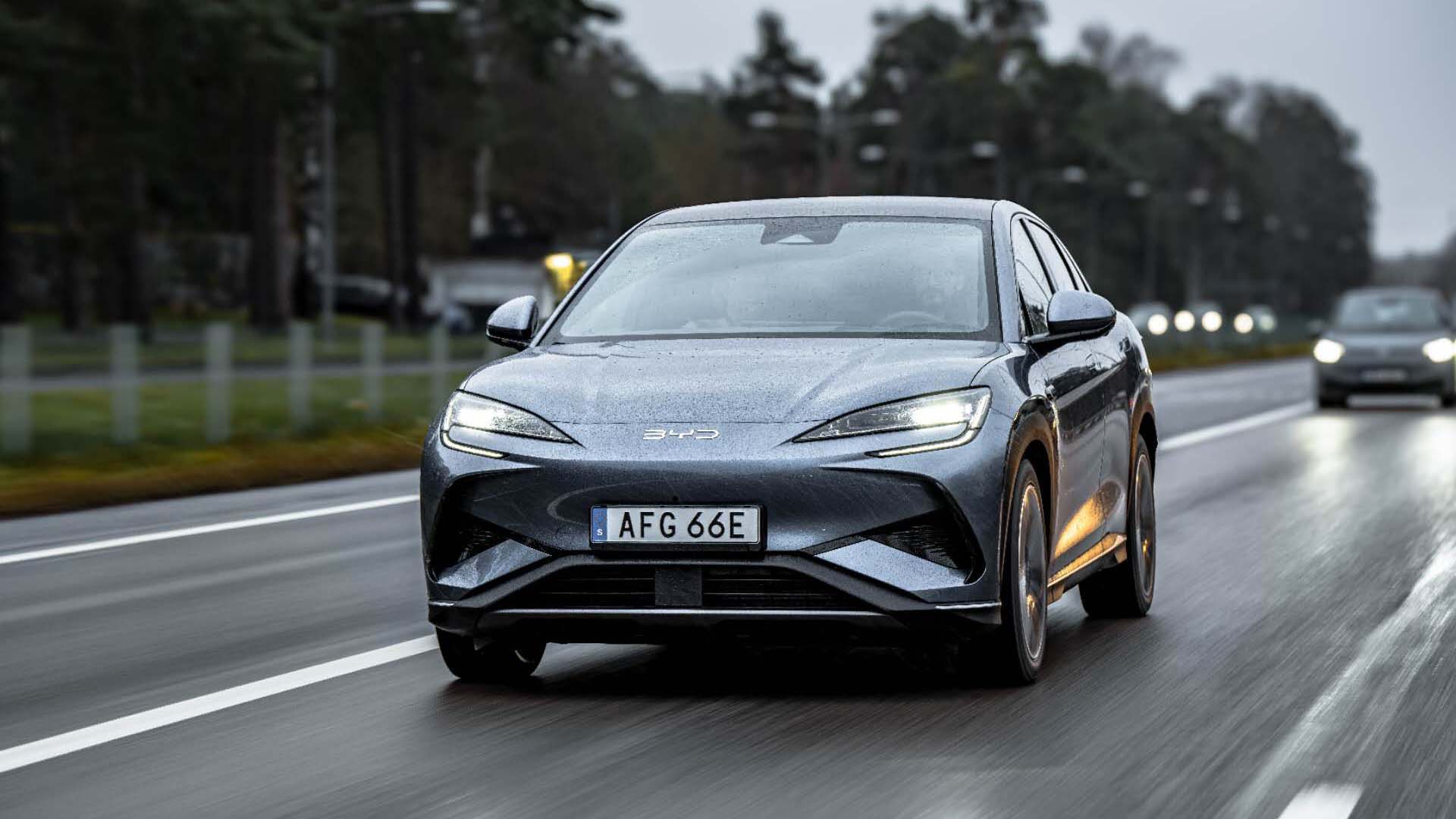
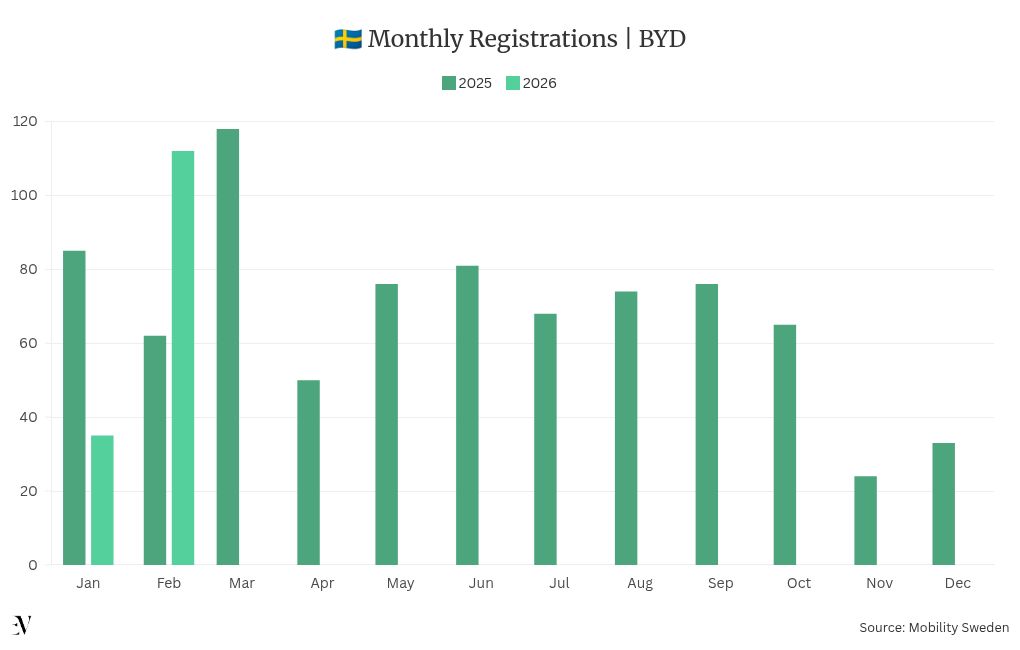
Chinese giant BYD delivered 112 plug-in hybrid and fully electric vehicles in Sweden last month, according to data released on Tuesday by Mobility Sweden.
Compared to February 2025’s 62 registrations, the figures surged 80.6%.
Last year, the Shenzhen-based brand sold a total of 1,019 units, down 21.3% — nearly 300 units — from 2024, when the company achieved 1,294 deliveries in the country.
Portfolio
BYD entered the Swedish market in late 2022 in a partnership with one of Europe’s largest dealers, Hedin Mobility Group.
The carmaker led by Wang Chuanfu also expanded into Germany simultaneously with the same partner.
Although both companies decided to adjust their cooperation in the German market last summer, Hedin Mobility Group remained “Dealer+” and retailer in Sweden.
BYD offers only three models in Sweden: the fully electric Sealion 7 SUV and two plug-in hybrids, the Seal U DM-i SUV and the Seal 6 DM-i Touring wagon.
The company’s Swedish website currently promotes 0% financing on the Seal U DM-i from 1,916 kronor ($207) per month and the Seal 6 DM-i Touring from 1,833 kronor ($198) per month, while the Sealion 7 is offered from 2,658 kronor ($287) per month at 0.95% interest.
A launch cash offer of 20,000 kronor ($2,162) is also available on the Sealion 7.
Best-Sellers
With a total of 2,160 registrations and a 26.8% market share, the best-selling brand in February in Sweden was Gothenburg-headquartered Volvo.
However, the automaker saw its sales drop year-over-year by 43.5%.
Tesla sold 553 vehicles last month, representing a 10% fall from February 2025, while Polestar saw its deliveries increase by 15% to 570 units.
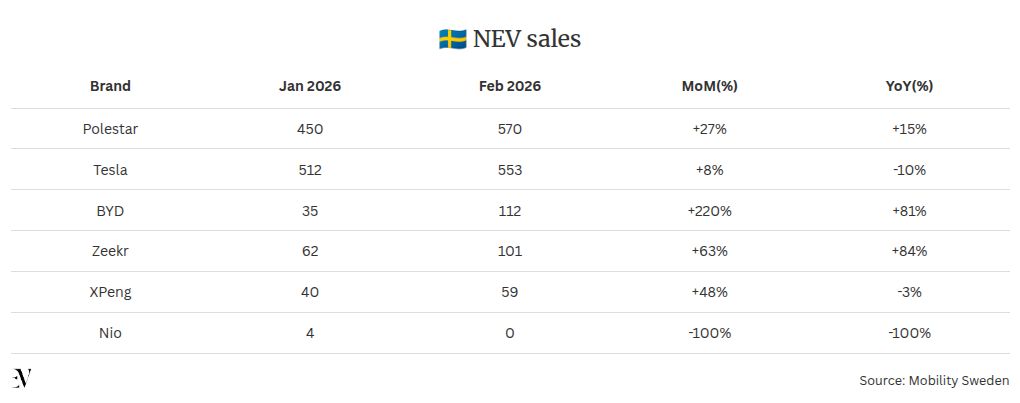
Chinese automaker XPeng‘s sales declined 3% to 59 units from a year ago. After selling just four vehicles in January, Nio did not register any units last month.
The Volvo EX40 fully electric SUV was the top-selling EV model with 1,184 units sold.
It was followed by the EX30 SUV with 583 registrations and the Tesla Model Y with 533.
EV Adoption
The latest data from Mobility Sweden showed that 19,341 new passenger cars were registered in Sweden last month, representing a 1.5% decline from a year ago.
Sales of battery electric vehicles grew 29% year-over-year to 7,650 units, achieving a market share of 39.6%.
Meanwhile, plug-in hybrid vehicles accounted for 4,810 units, or 24.9% of new passenger car registrations — a 5.2% increase from February 2025.
Combining these powertrains and fuel cell vehicles, NEVs represented 64.8% of new deliveries in the segment, accounting for 12,530 units, up 17.8% compared to a year ago.
Despite a dip in passenger car registrations last month, Sweden still has one of the highest EV adoption rates in the world, driven largely by government incentives. ´
In June 2024, Sweden proposed a climate bonus targeting rural and lower-income households, allowing eligible private buyers or lessees to receive 1,500 kronor ($162) per month for up to three years — with the amount gradually decreasing after mid-2028.
The EU approved the measure in December, with its Social Climate Fund providing the country a €532.8 million ($617.5 million) investment.
The program was originally set to launch on January 13 but was postponed to March 18, running through 2032.
In addition to the monthly benefit, households with the lowest incomes can receive a one-time bonus of 18,000 kronor ($1,946). Consumers can apply through the Swedish Environmental Protection Agency.