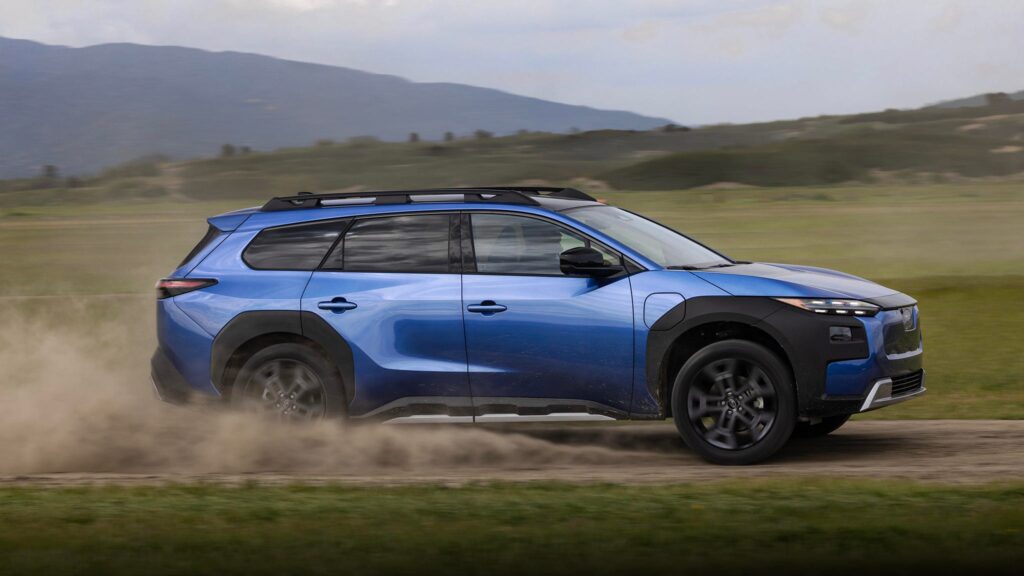
They don’t really like to talk about it, but Toyota and Subaru make pretty much the exact same EVs. The Toyota bZ4X (now bZ) and Subaru Solterra established the formula: shared architecture and hardware, separated through tuning, design details, and vibes.
This collaboration continues with the aligned automakers’ latest electric SUVs. There’s now the Toyota C-HR and equivalent Subaru Uncharted, a small and stylish fastback. Meanwhile, the Toyota bZ Woodland and Subaru Trailseeker arrive as something resembling a wagon.
ADVERTISEMENT – CONTINUE READING BELOW
A quick glance or drive makes clear that Toyota took the lead with these, and Subaru got what it could. That’s fine for the Solterra; a compact SUV like this is a sensible lineup addition for any automaker. The approach is less compelling for the Uncharted—with front-wheel drive standard—because of how misaligned it is with Subaru traits. Yet despite looking, functioning, and driving like a Toyota, the Trailseeker manages to come across as a good fit for Subaru.
ADVERTISEMENT – CONTINUE READING BELOW
Seeking a Trail in the Woodlands
To be clear, these are the same vehicle. The shared sheetmetal is obvious, with creased surfacing that aligns with today’s Toyotas and diverges from Subaru’s typical look. The main difference is the bumpers. Up front, the Trailseeker has headlight accents with six LEDs, whereas the bZ Woodland gets a curved-end light bar, each a signature of their respective brands. At the rear, both have a light bar, but the Trailseeker gets an embedded Subaru wordmark with a nifty mirror finish.
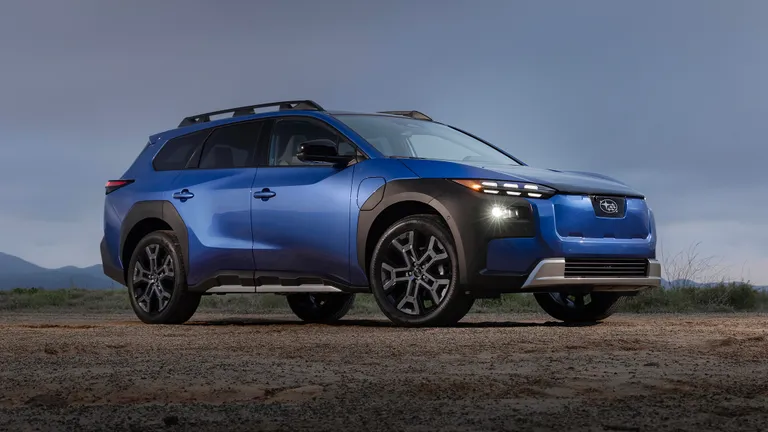
To Subaru’s credit, it manufactures the vehicles in its own factory regardless of which badge they wear. Exterior measurements are identical, except for a 0.6-inch length increase for the Trailseeker owed to its bumper design. Both have 8.5 inches of ground clearance.
ADVERTISEMENT – CONTINUE READING BELOW
Both share a strong standard powertrain, a 375-hp dual-motor AWD system. A 74.7-kWh high-voltage battery recharges at a mediocre maximum of 150 kW, allowing a best potential 10–80 percent time of about 28 minutes. Both have a Tesla-style NACS port, opening access to the Supercharger network.
Estimated driving range is as high as 281 miles for both with 18-inch wheels. The Trailseeker gets 274 miles in its Limited and Touring trims due to 20-inch wheels unavailable on the bZ Woodland. The bZ Woodland drops to 260 miles when equipped with all-terrain tires unavailable on the Trailseeker, at least until a potential Wilderness off-road version arrives.
ADVERTISEMENT – CONTINUE READING BELOW
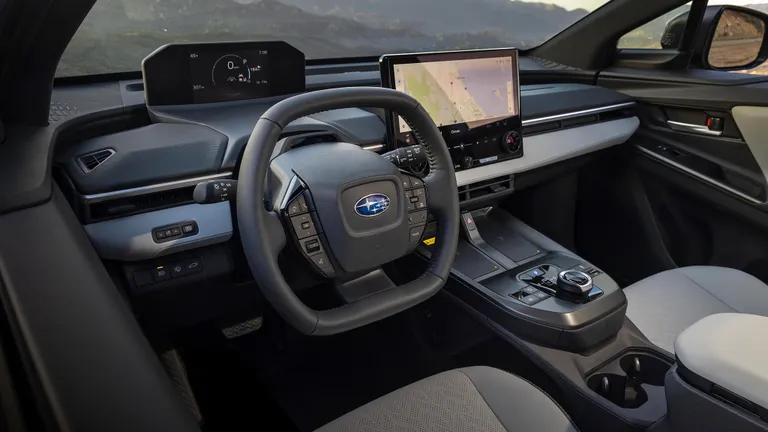
Inside, differences mostly amount to upholstery finishes, though like other Subaru-badged EVs, the Trailseeker gets a hexagonal steering wheel rim, while the bZ Woodland has a traditional circular rim. Otherwise, the space has familiar Toyota touchpoints—signal stalks, shift knob, buttons, and door handles—spread across the so-called Subaru’s dashboard.