This Week’s E-Bike News Headlines
Xtracycle launches the Swoop ASM, a cargo bike that can haul up to three kids.
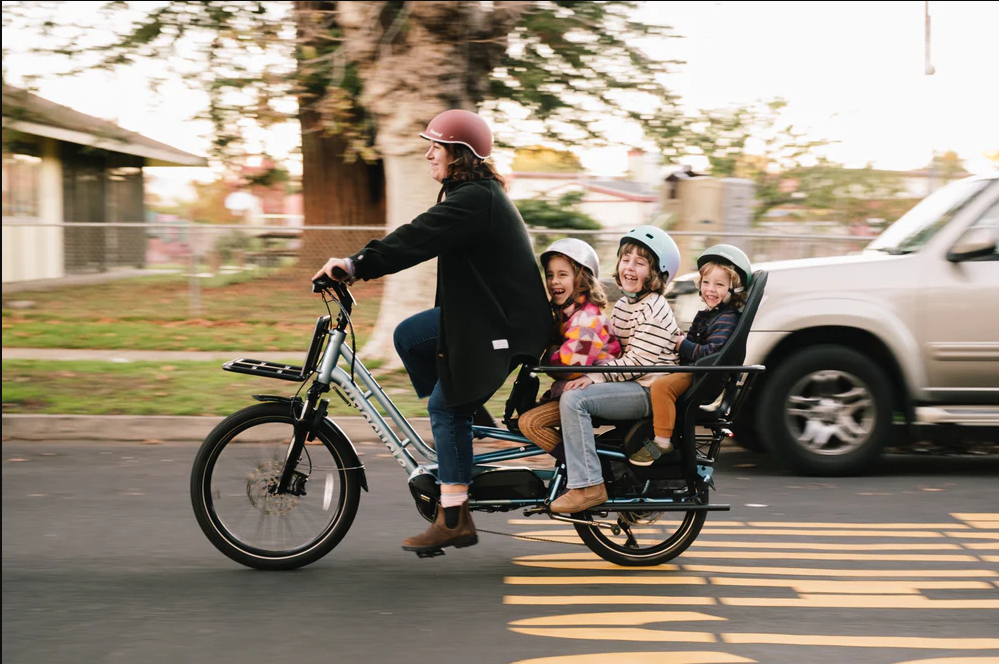
One of the most recognizable names in longtail cargo bikes, Xtracycle, just introduced the new Swoop ASM, or Automatic Smile Machine. It’s a mid-drive family hauler that comes fully kitted with the accessories you actually need for carrying passengers right out of the box.
Key features include:
Shimano EP6 mid-drive, with Class 1 or Class 3 configurations available
630Wh Shimano battery, rated for up to 60 miles of range
Shimano Di2 electronic shifting with Auto Shift mode (it can downshift for you when you come to a stop, which is a lifesaver if you forget when the bike is loaded)
Mixed wheel setup for stability: 24” front / 20” rear
Dropper seatpost
Hooptie kid carrier / handrails
Front rack
MIK HD rear rack
Wheel skirts
Passenger footrests
Wide-angle lighting
Xtracycle also lists a broad range of add-ons, baskets, and crates, plus a lifetime frame warranty and local professional assembly available.
Pricing starts at $4499, but they’re offering a $500 launch discount
Our take: This looks like a genuinely well-thought-out package. The Auto Shift and dropper post are both smart, practical choices for a bike that’s going to be doing lots of stop-and-go riding with kids onboard, especially when you’re trying to get stable at a stop and put a foot down confidently while perhaps forgetting to shift along the way.
I’m 6’1” with long legs, getting a foot or two feet down is something I take for granted. My wife cites this as a reason she doesn’t cycle as much, and is hesitant to try a cargo bike in case she can’t support bike weight + two kids on the back with sure footing underneath. The dropper post could change a lot of minds and open up possibilities for more people if they feel they’ll be able to operate the whole ride more confidently.
Prominent Cycling Brands Joining Thousands of Other Companies Seeking Tariff Rebates
On Feb 20, 2026, the U.S. Supreme Court ruled that the International Emergency Economic Powers Act (IEEPA) does not allow the president to impose tariffs. Since then, numerous companies’ legal teams have been suing to recoup what they paid in tariffs. Several cycling names are joining that growing list, including: Trek, Specialized, Shimano, Marin, Ibis, Bell Sports, Quality Bicycle Products (QBP), Yakima, and Tern. Retailers and adjacent outdoor brands are also involved, including REI, Patagonia, and Helly Hansen.
The suits are similar in nature, listing either the US government, Office of the President, and Customs and Border Protection as defendants in the suits, amongst other affiliated names.
Government officials have indicated legal action won’t be necessary to resolve tariffs; however, legal counsels suggest it could expedite the process for brands willing to pay for the legal fees.
Our Take: As far as the cycling industry goes, the tariff saga has been harmful. Many brands closed citing tariff pressures, several saw downturns in profits, and customers paid unnecessary increases on products when brands’ margins forced their hand, and prices were increased—the whole thing was just a mess.
Hopefully, with the Supreme Court’s ruling, brands can expect some stability. The damage is done; hopefully, some recovered costs can help, but this was a wildly unnecessary burden that did all harm and no good.
Without IEEPA Tariff Revenue, PeopleForBikes Warns Section 232 Steel and Aluminum Tariffs Will Be a More Significant Threat
In October 2025, Guardian Bikes along with aluminum trade groups, proposed adding bike frames to a list of products subject to a 50% aluminum and steel tariff list. This is under Section 232 law.
Now that the government cannot impose IEEPA tariffs, routes like this for collecting tariff revenue represent a more prominent threat to the cycling industry.
PeopleForBikes is said to be “actively pushing back against the proposed inclusion of bicycle and e-bike HTS codes under Section 232 tariffs. In the coming weeks, the Commerce Department will decide which products will be added under the latest round of tariff inclusion requests.”
The comment period is now closed, but reportedly over 600 comments came from cycling industry types opposing the inclusion of frames being added to that list. Now, the advocacy group is urging people to contact their local representatives to let them know the ways this will harm business and affect the cycling community at large.
Our Take: We strongly oppose to what Guardian is doing here. You can get a deeper breakdown of what they’re doing here. The short version is: They make their own frames instead of importing them. They’re one of the few larger-scale manufacturing options that exist in the States. That’s commendable, but their posturing to impose tariffs on all other bike frames benefits nobody but themselves. Guardian alone can’t satisfy all aluminum and steel bike frame needs, especially since the majority of what they sell is to kids. Factories for manufacturing can’t be set up quickly, so this seems like a way to hinder rival brands and force their prices up while keeping their own costs controlled. Consumers will just end up footing the bill, and bike sales will slow, which is bad for the industry as a whole.
PeopleForBikes is right to raise the alarm here; this is potentially the next thing to kick the industry if bikes and e-bikes are rocked by the full force of what the Section 232 tariffs could mean.
California and New York mull licence plate and registration requirements for e-bikes
Two high-population states are considering bills that would require e-bikes to be registered and display a plate.
In California, Assembly Bill 1942 (AB 1942) would require Class 2 and Class 3 e-bikes to be registered with the DMV and to display a special license plate mounted on the rear of the bike, visible and legible at all times.
In New York, Senate bill S2599A ( referred to as “Priscilla’s Law”) would require bicycles with electric assist to be registered and issued a number plate by the state, but the current language is targeted to a city of one million or more.
The aim of the goals is safety-focused. Advocates say it will help identify and crack down on repeat offenders who behave recklessly. Opponents feel this is bureaucracy that will harm those who already follow the rules, and it fails to address the larger culprits of e-motos that masquerade as e-bikes and that travel at excessively high speeds beyond the Class definition of e-bikes.
Neither proposal is final and is still working through its respective legislature. If passed, it would set a precedent for others to follow, as two of the most populous states in the nation.
Our Take: You’ll find no argument that we need safer streets, bike lanes, and multi-use paths. Much of that can be achieved through better infrastructure and education. Imposing forced registration will discourage e-bike adoption as a whole, which is problematic when you consider the transportation alternative it provides, the health benefits users get, and the good old-fashioned happiness that comes from feeling the wind in your face on a ride instead of staying at home or relying on cars.
Other laws, like California’s recent SB 1167, do more to clarify the differences between what is and what is not an e-bike. That would be a better way to do it, in our opinion. Let’s no longer allow overly powerful electric motos to pretend to be an e-bike just because they slap pedals on the machine. Those shouldn’t mix with cyclists and pedestrians, and are often the egregious offenders making the headlines. Registering these would be a good first step, then we can better discern how many e-bike riders are part of the problem with better labeling, before forcing bureaucracy on all e-bikers to register.