Source: BYD
BYD (HKG: 1211) will stage a dedicated technology launch event on March 5, 2026, where it is expected to unveil four core platform upgrades: Megawatt Flash Charging 2.0, a second-generation Blade Battery, the DM-i 6.0 plug-in hybrid system, and the DiPilot 5.0 intelligent-driving suite, according to multiple Chinese industry reports.
Advertisement – Continue scrolling for more
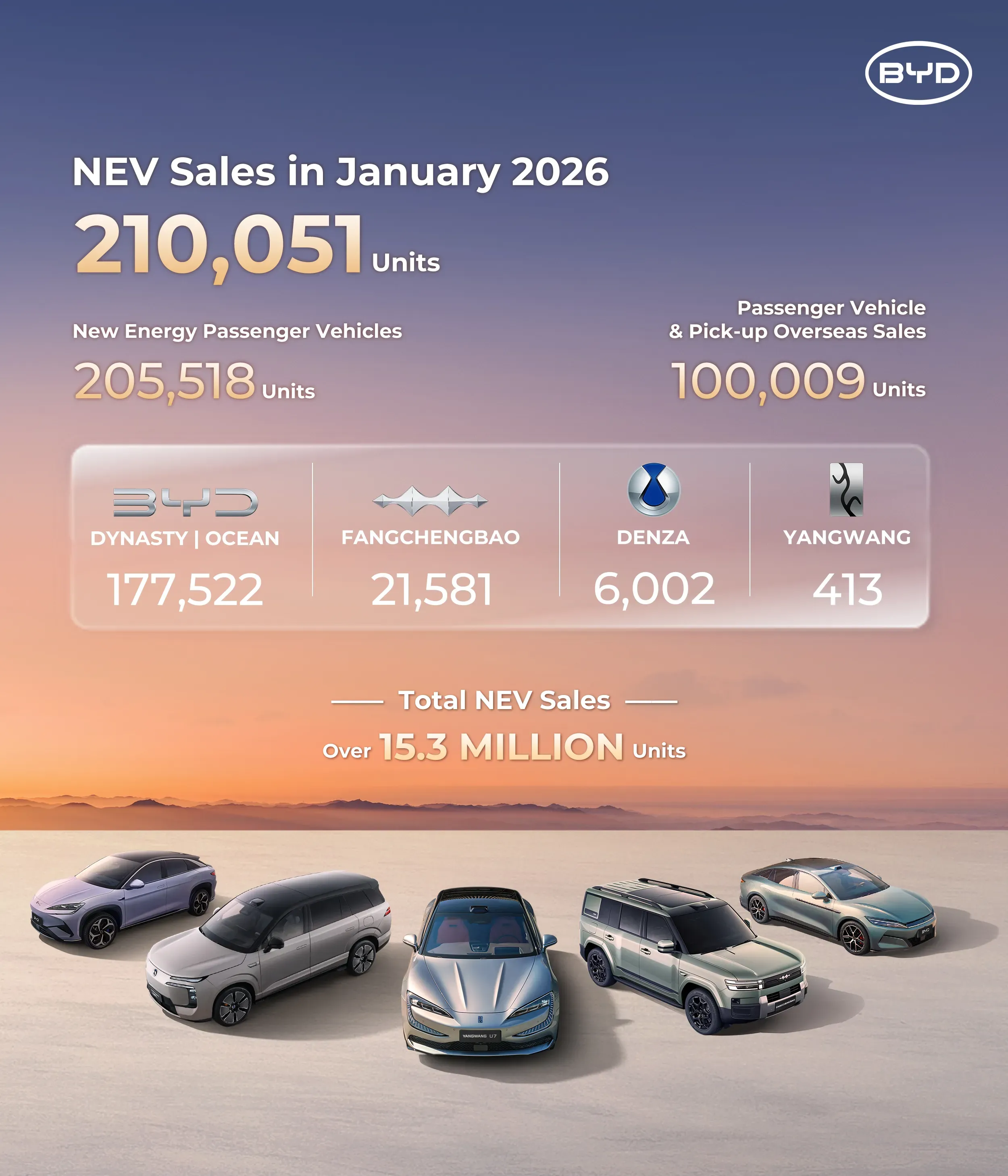
The event arrives at a delicate moment for the Shenzhen-based automaker. BYD reported 210,051 new energy vehicle sales in January 2026, a 30.1 percent year-on-year decline, as a halving of China’s NEV purchase tax exemption at the start of the year pulled forward purchases into December 2025. Exports held up better, reaching 100,482 units and rising 43 percent year-on-year.
 Source: BYD
Against that backdrop, a slate of next-generation technologies is widely viewed as BYD’s main lever for re-igniting domestic demand and reinforcing its position as the world’s highest-volume NEV seller — the company sold 4.6 million vehicles in 2025, surpassing Ford for the first time.
The centrepiece of the reveal is expected to be Megawatt Flash Charging 2.0. Leaked nameplate information circulating on Chinese online forums suggests the second-generation system could deliver up to 1,500 kW and 1,500 A, compared with the first-generation’s peak of 1,000 kW and 1,000 A introduced in March 2025. A separate report from Sina, cited by CnEVPost, puts the maximum input capacity of the new system at 2,100 kW. BYD has not issued an official confirmation of these figures ahead of March 5.
Advertisement – Continue scrolling for more
Large-scale deployment of the first-generation system is already under way, with distinctive cyan, T-shaped charging piles appearing at highway entrances and dealerships across China. The first-generation hardware — featuring dual liquid-cooled guns, a peak output of 1,360 kW, and battery-buffered grid support — can add approximately 400 km (249 miles) of range in five minutes under test conditions.
Deutsche Bank analysts, in a February 23, 2026 research note, said they had already observed Gen 2 systems at highway locations, and forecast that the rollout would be a primary driver of BYD’s projected 6 percent sales recovery to 4.9 million units in 2026. BYD has announced plans to build approximately 3,000 fast-charging stations across Europe by end of 2026.
Alongside the charging upgrade, BYD is set to formally present its second-generation Blade Battery. Industry reports point to two cell variants: a short-blade format targeting 8C–10C charge rates and a longer blade format with energy density reaching up to 210 Wh/kg, up from the current generation’s approximately 150 Wh/kg.
Advertisement – Continue scrolling for more
The upgrade keeps BYD’s lithium iron phosphate chemistry while pushing pack-level energy density toward the threshold needed for pure-electric ranges exceeding 1,000 km (621 miles) on the CLTC cycle. Several new BYD models appearing in China’s Ministry of Industry regulatory filings ahead of the event reflect physically more significant updates than last year’s intelligent-driving refresh — new batteries, motors, and platforms, rather than incremental sensor and software upgrades.
DM-i 6.0 represents the next iteration of BYD’s dominant plug-in hybrid architecture. The existing fifth-generation DM-i system already achieves combined ranges exceeding 1,500 km (932 miles) in models such as the 2026 Song Pro DM-i, with fuel consumption ratings as low as 3.2 L/100 km in hybrid mode under NEDC conditions. The sixth generation is expected to extend pure-electric range further while reducing fuel consumption, though BYD has not disclosed specific figures ahead of the event.
The fourth pillar of the March 5 reveal is DiPilot 5.0, an update to the God’s Eye intelligent-driving suite BYD introduced in February 2025. God’s Eye 5.0 builds on the existing three-tier structure — DiPilot 100, 300, and 600 — with targeted upgrades to automatic emergency steering and braking, sensor fusion across cameras, millimetre-wave radar, and ultrasonic sensors, and an end-to-end AI workflow from perception to vehicle action.
Advertisement – Continue scrolling for more
The underlying Xuanji architecture incorporates large-model AI. BYD has already launched God’s Eye 5.0 on the 2026 Xia model, with the March 5 event expected to formalise the rollout across a broader vehicle lineup. By the end of 2025, more than 2.3 million BYD vehicles had been equipped with earlier God’s Eye systems.
The original God’s Eye architecture, announced in February 2025, spread advanced driver-assistance across all BYD price points free of charge — a deliberate contrast to Tesla’s (NASDAQ: TSLA) subscription-based Full Self-Driving offering. Twenty-one models received God’s Eye software in a single update wave in early 2025, including vehicles priced below 100,000 CNY (c. $14,600). The March 5 event is expected to define how DiPilot 5.0 cascades through the existing and forthcoming lineup.
Whether four simultaneous platform upgrades are enough to shift the trajectory of BYD’s domestic volumes — or whether the structural headwinds of reduced subsidies and intensifying price competition prove more stubborn than any product offensive — is the question China’s EV market will begin answering in the second quarter.
Conversion rate: 1 USD = 6.84 CNY as of February 26, 2026.
Advertisement – Continue scrolling for more