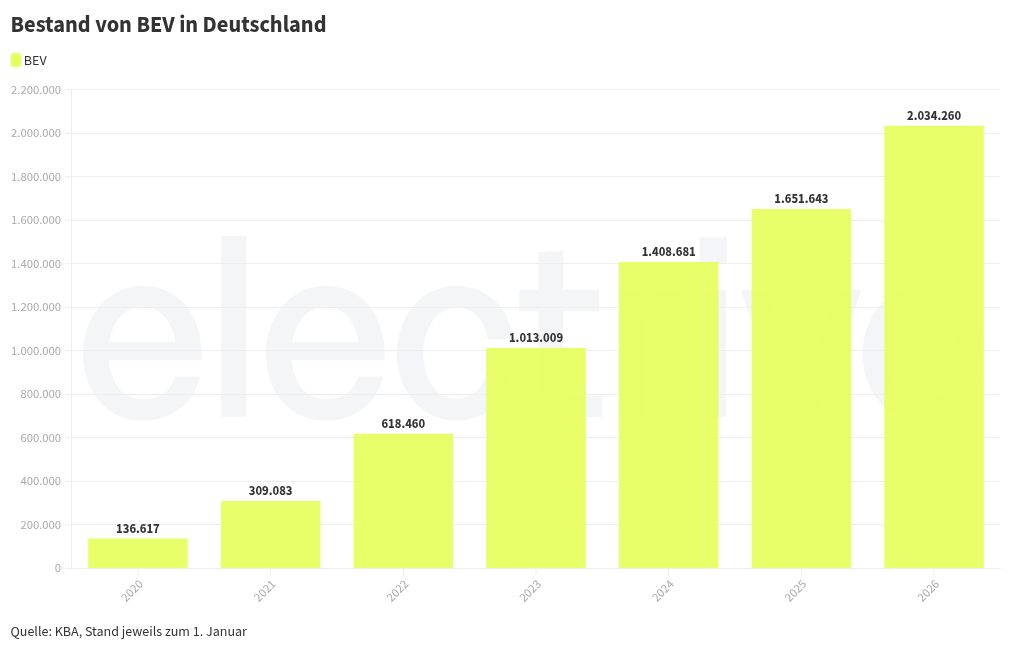
For the first time, the number of battery-electric passenger cars registered in Germany has surpassed two million. According to the country’s Federal Motor Transport Authority, the Kraftfahrt-Bundesamt (KBA), a total of just over two million fully electric cars were on German roads as of 1 January 2026.
The authority reports not only steady long-term growth but also accelerating momentum in recent years. The number of battery-electric cars has risen from just 34,022 vehicles in 2017 to more than two million in 2026 – an almost sixtyfold increase within nine years. A particularly strong upswing has been evident since 2020, with the one-million mark first crossed in 2023.
In 2025 alone, the German BEV fleet grew by 382,617 vehicles. For comparison, the stock stood at 1,651,643 units on 1 January 2025. The latest increase thus exceeds the growth recorded a year earlier (242,962 BEVs), although it remains slightly below the jump seen between 2023 and 2024, when the fleet expanded by 395,672 electric cars.
At the same time, the net increase of 382,617 battery-electric cars indicates that a considerable number of EVs left the fleet – whether due to write-offs or exports. This is because new registrations in Germany reached a record 545,142 battery-electric cars in 2025.
According to the KBA, the regional distribution of electric cars varies markedly across Germany’s federal states. The authority points to pronounced differences between regions.
North Rhine-Westphalia accounts for the largest stock, with 454,783 battery-electric cars. It is followed by Bavaria (395,271) and Baden-Württemberg (322,060). Lower Saxony (221,823) and Hesse (179,213) have also surpassed the 100,000 mark, while Rhineland-Palatinate is close to reaching that threshold.
Overall, most battery-electric cars are concentrated in the larger federal states in western and southern Germany. According to the KBA, the data show that electric mobility is now present across the country, even though regional disparities remain.
In eastern German states such as Saxony, Saxony-Anhalt, Thuringia, Brandenburg and Mecklenburg-Western Pomerania, the BEV share of the total passenger car fleet ranges between 2.0 and 2.3 per cent. This is still below the levels seen in the three city-states: Bremen (3.5 per cent), Berlin (4.0 per cent) and Hamburg (5.3 per cent).
In its latest communication, the KBA focuses exclusively on the more than two million battery-electric cars currently registered in Germany and provides further breakdowns for BEVs. It does not include updated stock figures for other powertrain types such as plug-in hybrids.
kba.de (in German)