February 25, 2026
By Karan Singh
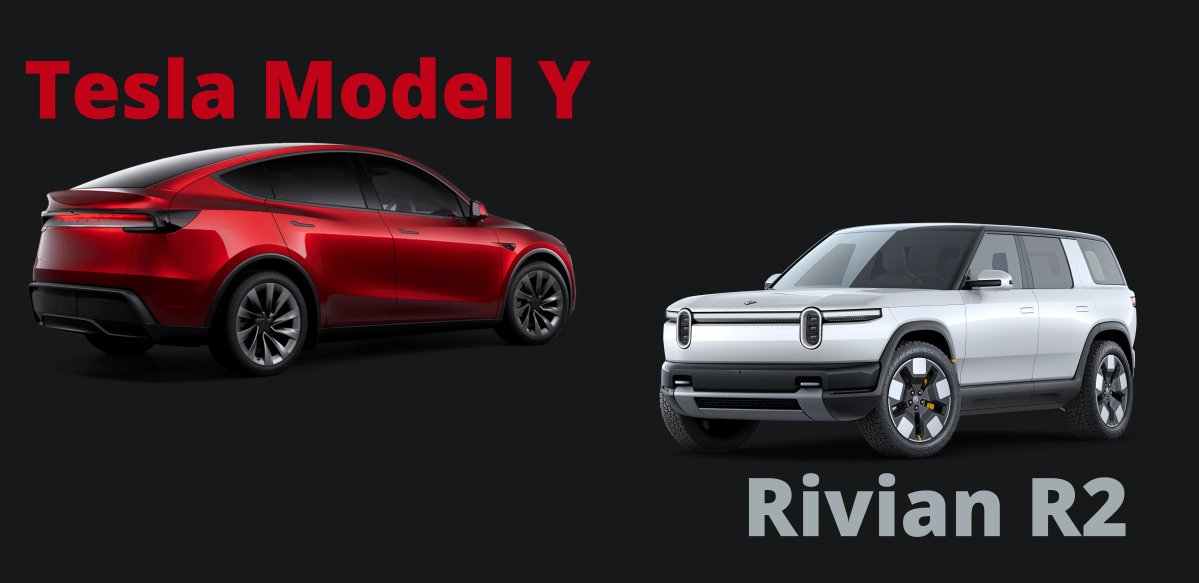
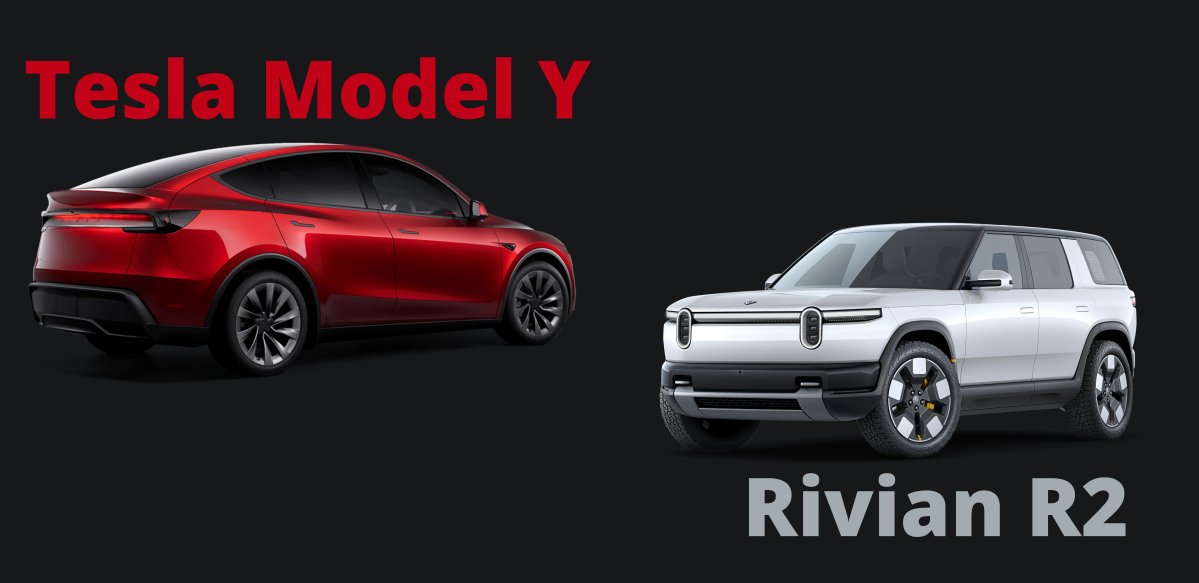
Since its launch, the Tesla Model Y has been the undisputed king of the midsize electric SUV segment – eventually becoming the best-selling car in the world. However, Rivian is finally aiming directly at Tesla’s crown. The upcoming 2026 Rivian R2 scales down the rugged, adventurous DNA of the R1 into a smaller, more affordable package designed for the mass market.
With Tesla having rolled out the refreshed Model Y last year and Rivian gearing up for R2 production, prospective buyers in the midsize SUV market are facing a difficult choice. Here is a definitive, spec-by-spec breakdown of how the highly anticipated R2 stacks up against the reigning champion.
Pricing & Trims
Price is the most important battleground for this segment. Tesla has heavily optimized its manufacturing process, and economies of scale work in its favor to let it offer an incredibly competitive starting price.
Rivian is aiming to eventually match that accessibility, but the initial Launch Edition models will be pricier off the bat. The single-motor model, aimed at the $45,000 price point, is expected to follow sometime in 2027.
Both vehicles are manufactured in the United States for American buyers – the Model Y in Texas, and the R2 is slated for Illinois. That means both vehicles should qualify for any state-level incentives in place.
For Canadian buyers, the Model Y will be imported from Germany or China, depending on the variant. Due to the pricing of both vehicles, neither will fall into the bracket for the new Canadian ZEV rebate, but they should meet requirements for certain provincial rebates.
Variant
Rivian R2 (Estimated) (USD)
Tesla Model Y (2026) (USD)
Starting Price (Base)
~$45,000 (Single-Motor RWD)
$39,990 (Standard RWD)
Long Range Price
~$55,000 (Dual-Motor AWD)
$48,990 (Premium AWD)
Performance Price
~$60,000+ (Tri-Motor AWD)
$57,490 (Performance AWD)
Dimensions
While they compete in the same midsize SUV segment, the design philosophies between the R2 and Model Y are wildly different. The Model Y is essentially a raised hatchback heavily optimized for efficiency and performance, while the R2 is a traditional, boxy SUV focused on internal storage space.
Surprisingly, the R2 is actually three inches shorter in overall length than the Model Y, making it easier to parallel park and drive in urban areas – but it does come in three inches taller, giving it a bit more presence on the road.
Dimension
Rivian R2
Tesla Model Y
Length
185.6 inches
188.6 inches
Width (w/o mirrors)
75.0 inches
75.6 inches
Height
66.9 inches
64.0 inches
Ground Clearance
9.8 inches
6.6 inches
Wheelbase
115.6 inches
113.8 inches
Performance, Battery, & Range
With Rivian using structural battery packs on the R2 and Tesla intending to bring them back with a 4680-variant Model Y, as well as native NACS, the battery and charging experience seems extremely similar – especially since both vehicles do 10-80% in approximately 30 minutes.
The Model Y remains the king of efficiency, squeezing massive range out of its motors, while Rivian is bringing quite a bit of extra horsepower to the equation – a difference in design and intent.
Specification
Rivian R2 (Dual-Motor Launch Edition)
Tesla Model Y (Long Range AWD)
0–60 mph
3.6 seconds (Tri-motor expected <3.0s)
4.6 seconds (Performance: 3.3s)
Estimated Range
300+ miles
327 miles
Power Output
656 hp / 609 lb-ft
~425 hp / 475 lb-ft
Battery Tech
87.4 kWh (4695 Cells)
81 kWh (2170 Cells)
Charge Port
NACS
NACS
DC Fast Charging
10% to 80% in ~30 minutes
10% to 80% in ~27 minutes
With Rivian fully adopting NACS, it can charge at any V3 or V4 Supercharger site without an adapter, just like a Model Y. This is a big win for 3rd-party vehicles, as that means they don’t have to hope that unreliable third-party networks like Electrify America are functional and available.
Interior Features & Utility
This is where the user experience diverges the most, away from the exterior looks.
Tesla’s most recent refresh of the 2026 Model Y refined the minimalist cabin, bringing back turn signal stalks and adding acoustic glass, customizable ambient lighting, a new, larger QHD touchscreen, and an 8-inch rear screen for back-seat passengers. Most controls are through the screen, simply and easily accessible in 1-2 taps.
Rivian’s R2, on the other hand, takes a more narrow approach to minimalism – it retains a dedicated driver’s display alongside the central screen, along with massive haptic scroll wheels to allow drivers to flick through the menus without needing to touch the screen.
The R2 also brings a lot of big interior features to its internal space – including dual gloveboxes, extensive door-card space for storage, and a drop-down rear hatch glass. It also has fold-flat seats not just in the rear, but also in the front, if you want to get a level sleeping surface.
Storage Space
While both vehicles are mid-size SUVs, the R2 is definitely the winner in terms of available interior cargo capacity, both in the frunk and cargo space in the back.
Storage Metric
Rivian R2 (Estimated)
Tesla Model Y (5-Seat)
Front Trunk (Frunk)
~5.0+ cu ft
4.1 cu ft
Rear Cargo (Behind 2nd Row)
~33.0 cu ft
30.2 cu ft
Max Cargo (Seats Folded)
TBD (Expect 80+ cu ft)
76.2 cu ft
Under-Floor Sub-Trunk
~4.6 cu ft
2.7 cu ft
Seat Folding Capability
1st & 2nd Rows Fold Flat
2nd Row Folds Flat
On-Road Dynamics vs Off-Road Capability
The vehicle you choose heavily depends on where you want to drive.
The Model Y is strictly a street vehicle, with just 6.6 inches of stock ground clearance. It is designed for efficiency, cornering stability, and highway cruising. The new adaptive suspension is a vast improvement for rider comfort, making it a stellar commuter or road-tripper. If you choose the Model Y Performance, it is an even slimmer 6 inches, but with even tighter handling controls for track days.
The R2, on the other hand, leans heavily into the same off-road pedigree of the R1. It boasts a massive 9.8 inches of ground clearance, dedicated all-terrain drive modes, and a flat underbody designed to take a few hits. The R2 is designed to easily tackle forest trails, deep snow, and beach sand by giving up some aerodynamic efficiency on the highway and streets to ensure you can adventure in one vehicle.
Today’s Autonomy vs. Tomorrow’s Promise
On the autonomy front, there is only one real winner – Tesla. FSD today can get you from point A to point B without intervention in most average road conditions – evidenced by the recent coast-to-coast FSD trip that lasted nearly 13,000 miles without a single human takeover.
FSD includes city streets, highways, rural roads, unmarked gravel paths, and everything in between – and is now exceptionally capable. With Unsupervised FSD potentially around the corner, it is a fantastic choice; however, it is now available only as a subscription.
Rivian, on the other hand, is forging its own path. Initial R2 deliveries will be capable of some level of autonomy, with today’s Driver+ highway assist available immediately. However, Rivian intends to introduce a forward-facing LiDAR into future R2 builds that will not be retrofittable, leaving us at an impasse as to what exactly their path to autonomy looks like.
RJ has committed Rivian to achieving L4 autonomy in the future, but with training, data, compute, and many other limitations, it could be years before they get anywhere close to today’s FSD performance.
The Verdict
The Tesla Model Y and the Rivian R2 are both compelling options in the extremely competitive mid-size SUV segment – especially as EVs. They both offer some of the best batteries, motors, and software you can get in a car today, and you can’t really go wrong selecting either one.
If you want to road trip and commute, the Model Y is the ideal option, especially with FSD being able to keep you safe and reduce your driving fatigue.
On the other hand, if adventure is in your blood, the R2 will likely speak to you – especially with the upcoming Treehouse Tent.
If you’re waiting to see which vehicle is right for you, go try out a Model Y today. Then, once the R2 launches, visit a Rivian Space and get a hands-on experience, and see which you like more.
We also covered the Model X and R1S in a similar Buyer’s Guide, if you’re interested to learn more about the bigger brothers of these two vehicles.
Ordering a New Tesla?
Use our referral code and get 3 months free of FSD or $1,000 off your new Tesla.
February 25, 2026
By Karan Singh
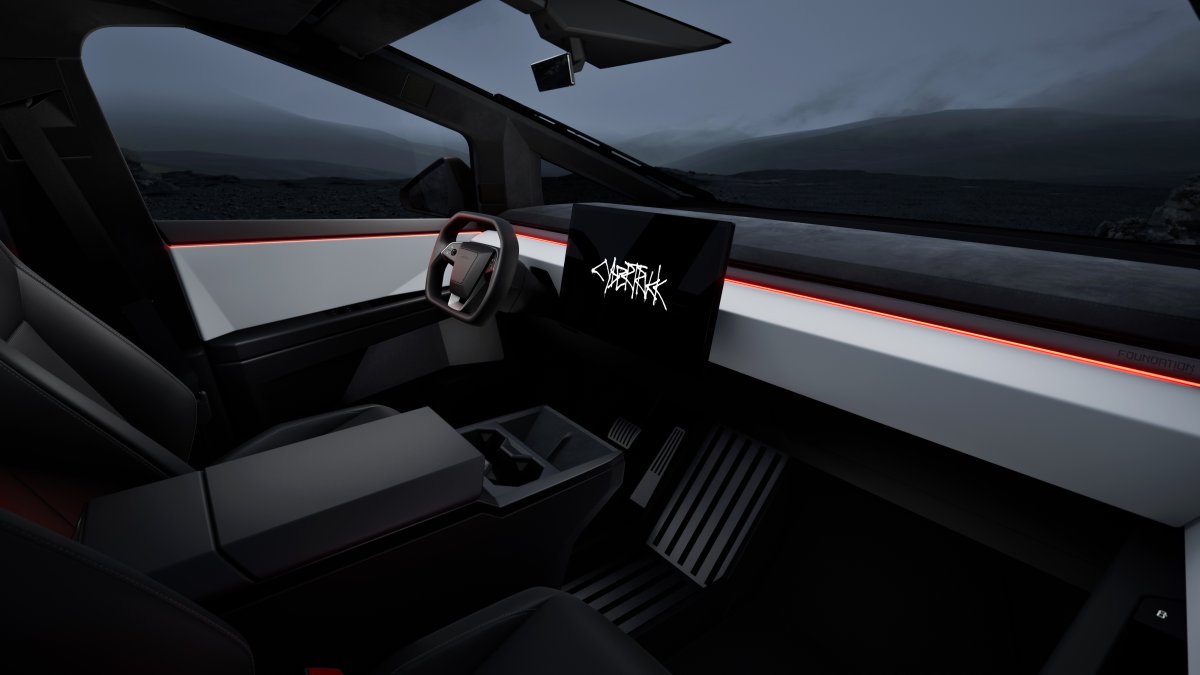
The launch of the new $59,990 Cybertruck has given us a lot of new information to dig through, but one of the most exciting details was hiding right in the middle of Tesla’s new trim comparison tool.
If you look closely at the audio specs for the Premium AWD and Cyberbeast, Tesla has officially listed Active Noise Cancellation (ANC) as a standard feature. Since ANC is currently disabled on all Cybertrucks on the road today, its sudden appearance on the spec sheet is an indication that a software update will enable it soon.
Hardware is Already There
If you have been following along, you know that the Cybertruck actually shipped from the factory with the hardware required for Active Noise Cancellation.
Earlier this year, a deep dive into the Tesla Service Toolbox revealed that the Cybertruck features the same basic ANC hardware architecture found in Tesla’s other flagships – the Model S and Model X. However, the service tool explicitly notes: “ANC software is not enabled on Cybertruck even though the hardware is installed.”
While the Model S and Model X use six microphones in the cabin to achieve this effect, the Cybertruck will be doing the same using just four.
The likely reasons for the delay are related to the Cybertruck’s unique acoustics. Between the massive glass roof, the echoing cavities within the aluminum castings that Tesla uses to project sound, and the road noise from the heavier all-terrain tires, Tesla’s audio engineers are likely finding massive challenges in tuning ANC to effectively cancel out the specific frequencies of the Cybertruck’s road noise.
How ANC Works
Once a future OTA update drops and enables the feature, it will operate similarly to a pair of noise-cancelling headphones.
Using microphones placed throughout the cabin, alongside accelerometers near the wheels, the ANC system constantly monitors the low-frequency rumble of the road and the hum of the tires. The system then generates anti-noise, which is essentially inverted sound waves, that are pushed through the 15-speaker setup into the cabin to effectively erase the background drone and create quiet zones.
Who Will Get It?
Based on the new comparator, ANC will be exclusive to the two premium trims – Premium AWD and Cyberbeast. The new base Dual Motor AWD will not include ANC, as it reduces the number of speakers to achieve its low price point.
If you’re a current owner of a Cybertruck, you can look forward to ANC finally getting enabled soon.
February 25, 2026
By Karan Singh
When SpaceX first announced its Direct to Cell Starlink program, the general expectation was that the service would primarily serve as a basic emergency backup. It would provide SOS texts and slow messaging when you ventured completely off the grid, as a lifeline and means to maintain connectivity.
According to new details shared by SpaceX, it is now aiming to beam high-speed 5G connectivity directly to unmodified cellular modems from space, bypassing terrestrial cell towers entirely. If successful, this breakthrough could change the telecom landscape – and also unlock an even better version of Premium Connectivity for Tesla.
Link Budget
Speaking this week at the International Telecommunication Union’s Space Connect conference, SpaceX satellite policy lead Udrivolf Pica outlined the ambitious new benchmark being set for Starlink Direct to Cell.
“We are aiming at peak speeds of 150Mbps per user,” Pica stated. “So something incredible if you think about the link budgets from space to the mobile phone”.
To put that in perspective, the current iteration of cellular Starlink tops out at an estimated 4 Mbps per user. That’s barely enough for low-resolution video and basic web browsing. Jumping to 150 Mbps doesn’t just improve the service; it elevates it to a true competitor against terrestrial telecommunications networks. For context, median download speeds for terrestrial 5G networks currently sit at 172 Mbps for AT&T and 309 Mbps for T-Mobile.
To achieve this massive leap in capacity, SpaceX is preparing to leverage newly acquired radio spectrum from EchoStar. This broader spectrum acts as a larger data pipeline, enabling true broadband use cases like high-definition video streaming straight from Low Earth Orbit.
Enhancing Premium Connectivity
While this is a game-changer for smartphone users in rural areas, the implications for Tesla’s ecosystem are equally as large.
Currently, Tesla relies on partnerships with traditional terrestrial cell carriers (such as AT&T in the United States) to power its Premium Connectivity features, including live traffic visualization, music streaming, and more. Because these carriers rely on physical cell towers, Teslas are still subject to frustrating dead zones in rural or mountainous regions.
If SpaceX can consistently deliver 150 Mbps to a standard cellular modem without a dedicated, bulky Starlink dish, Tesla could theoretically integrate this exact Direct to Cell technology directly into future vehicles, likely with little to no changes from current vehicle modems.
Plus, migrating the Tesla fleet’s cellular data expenses from third-party contracts over to SpaceX would keep millions of dollars in recurrent subscription revenue entirely within the Elon Musk ecosystem – netting another big win for SpaceX and Tesla both.
Looking Over the Horizon
SpaceX aims to launch this upgraded cellular Starlink service in late 2027, coinciding with the finalization of the EchoStar spectrum deal. While legacy carriers aren’t going extinct tomorrow, the prospect of 150 Mbps beaming directly from space brings Tesla one step closer to building a truly untethered, fully connected autonomous vehicle.