It’s a remarkable development. While electric motorcycles have long been allowed to start alongside combustion engine vehicles in France, Great Britain, Scandinavia, and Australia, the door remains closed in Germany. Not for technical reasons – at least not exclusively. But on principle.
The conflict between the DMSB and Stark Future is far more than just a matter of rules. It’s a textbook example of how motorsport politics works when innovation clashes with administration.
The FIM argument – and its expiration date
For years, a key argument from Germany was that they adhered to the rules of the world governing body. As long as there was no corresponding FIM approval, mixed racing could not be permitted nationally.
That was consistent – as long as it was true.
The FIM now permits Stark electric motorcycles to compete internationally. Participation in series such as the World Supercross Championship and the FIM SuperEnduro World Championship is a reality.
Nicolas Therouin, CTI Coordinator of the FIM, confirms: “Since December 2024, mixed racing between electric motorcycles and motorcycles with combustion engines has officially been a reality. The FIM Board has approved this for the SuperEnduro World Championship.”
“The 2025/2026 season is already the second SuperEnduro season with this concept. In addition, we also started with mixed racing in November 2025 as part of the World Supercross Championship,” Therouin continued.
The previous justification – the lack of an FIM basis – is therefore effectively obsolete. If one invokes the FIM, one must also align oneself with its development.
The official argument: Torque is unfair
The DMSB’s core argument is that a direct sporting comparison is not possible. Even with power reduction, the Stark VARG has a “significantly higher torque” and therefore a competitive advantage.
Jonas Konrad, communications officer at the DMSB, states: “The Stark VARG cannot be compared to combustion engine motorcycles in terms of sporting performance. Even though there is a possibility of restricting the power output, the Stark VARG has many times higher torque than all combustion engine motorcycles and therefore a clear competitive advantage.”
That sounds technically sound. However, motorsport regulations are traditionally based on engine displacement classes, not torque curves. Even heavily modified 250cc or 450cc combustion engines differ significantly in power delivery and characteristics – only modifications homologated within the class are permitted.
Reality instead of theory: A look at other associations
In the French MX Elite Championship, under the umbrella of the Fédération Française de Motocyclisme (FFM), electric motorcycles regularly compete in the MX1 and MX2 classes. If the competitive advantage suggested by the DMSB actually existed, it would have to be evident there.
But he doesn’t.
Such a competitive advantage is not yet apparent there. The top drivers are operating in the midfield. No dominance, no structural superiority, no consistent holeshots that would distort the championships.
The torque argument is therefore at least debatable. The findings are based on experience.
A similar assessment is now coming from the German amateur motorsport scene. Thomas Raab from Motor-Sport-Ring (MSR) explains: “We cannot confirm the DMSB’s assessment that the electric models from manufacturer Stark VARG offer a decisive competitive advantage. With drivers Jan Horst and Daniel Wewers, we have two quite serious opponents in the MSR Masters class, who also regularly place in the top ten.”
At the same time, Raab downplays the importance of the motorcycle itself:
“Ultimately, a multitude of factors will determine the results for both of these vehicles – whether they are good, bad, or even very good. Ultimately, I would expect the overall performance of both vehicles to be the same as in 2025, even if they start with combustion engines.”
In other words, the decisive factor remains the driver – not the type of drive.
Control as a killer argument
Another key argument of the DMSB concerns monitoring. Jonas Konrad explains: “To guarantee fair competition, permanent live monitoring would be necessary. However, monitoring on such a scale is currently not possible.”
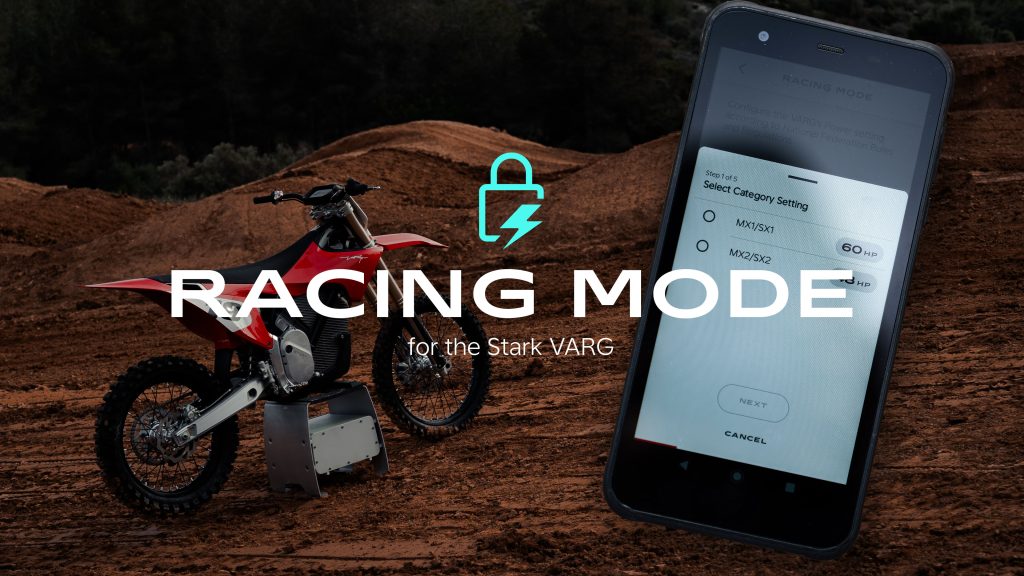
Stark, however, points to the Race Mode with fixed performance characteristics and a sealable activation during technical inspection, which is also used in the MSR. “Once activated, Race Mode cannot be deactivated for at least 24 hours and is indicated by a continuously illuminated white LED. It is checked during vehicle inspection, again before the start, and randomly after the race,” says Thomas Raab.
Sébastien Tortelli, Race Director of Stark Future, says on this topic: “We invited the DMSB to visit our factory to examine the technology in detail and to openly discuss all technical aspects. I also personally offered to come to Germany to have a direct technical exchange.”
According to his account, however, this was not desired: “We were told that no support was needed and that decisions would be made independently.” Regarding the performance debate, Tortelli adds: “More torque does not automatically mean more performance. What matters is how efficiently power is converted into traction.”
The FIM takes a slightly different approach with its own control system in the World Supercross Championship and the SuperEnduro World Championship. Nicolas Therouin explains: “Before the start of the season, we conduct extensive tests – including data collection, dyno runs, race simulations, and launch tests. Based on this data, we create an EOT/BOP document that defines the balance between electric and combustion engine motorcycles.”
Furthermore: “After each session, data is recorded via mandatory FIM loggers and sensors and subsequently analyzed by a specially responsible FIM engineer.”
If the organizational effort of control is cited as the central argument against approval, it seems at least justified to question this point, since there are various possibilities for monitoring.
The open letter: Traders as a systemic indicator
The German Stark dealer network summed up the current tensions in an open letter.
Benjamin Cobb, Director of Brand Communications at Stark Future, states: “End customers are becoming increasingly frustrated because they are not allowed to participate in regular competitions with their motorcycles. We are doing everything we can to accommodate the DMSB and the riders.”
And further: “A purely electric class makes little sense if there is virtually no model diversity.”
The brand cup as a compromise?
The DMSB currently sees this as the only option. Jonas Konrad: “A one-make cup would, provided all safety-related requirements are met, currently be the only way to offer motorcycles a platform within the framework of championship series.”
However, in light of international practice and the French results, this approach seems more like an isolation solution than an integration one.
The structural question
So what is the DMSB afraid of? Unfair advantages, loss of control, a precedent – or the need to fundamentally rethink existing control and class logics?
France is collecting data. International series are gathering experience. Even in German amateur motorsports, there is already practical experience with electric motorcycles.
However, another factor is rarely openly addressed in this discussion: the economic structures of motorsport. Major series and their promoters are heavily dependent on manufacturers, importers, and their marketing budgets. These brands invest in teams, series partnerships, advertising, and event structures – thus securing part of the financial foundation of many championships.
The question therefore arises, at least theoretically: What impact would a new technological competitor have on this structure?
Electric motorcycles are not currently part of the classic off-road portfolios of established manufacturers. Should this technology become established in the sport, the balance of power in the market could shift in the long term. This would be particularly relevant for series promoters who rely on the support of major motorcycle brands. could Such a development could at least be a strategic factor.
Whether and to what extent such considerations actually influence decisions cannot be proven from the outside. However, the economic dimension is as much a part of motorsport as technology and regulations.
The real risk
The risk may not lie in the electric motorcycle at the starting gate. The risk lies in Germany’s regulatory limbo – caught between international openness and national resistance.
Perhaps in the end it’s not about torque at all.
Perhaps it’s about the power to interpret events.
And perhaps that is precisely why a transparent dialogue – between DMSB, FIM, promoters and manufacturers – would be the most objective next step.
Post navigation