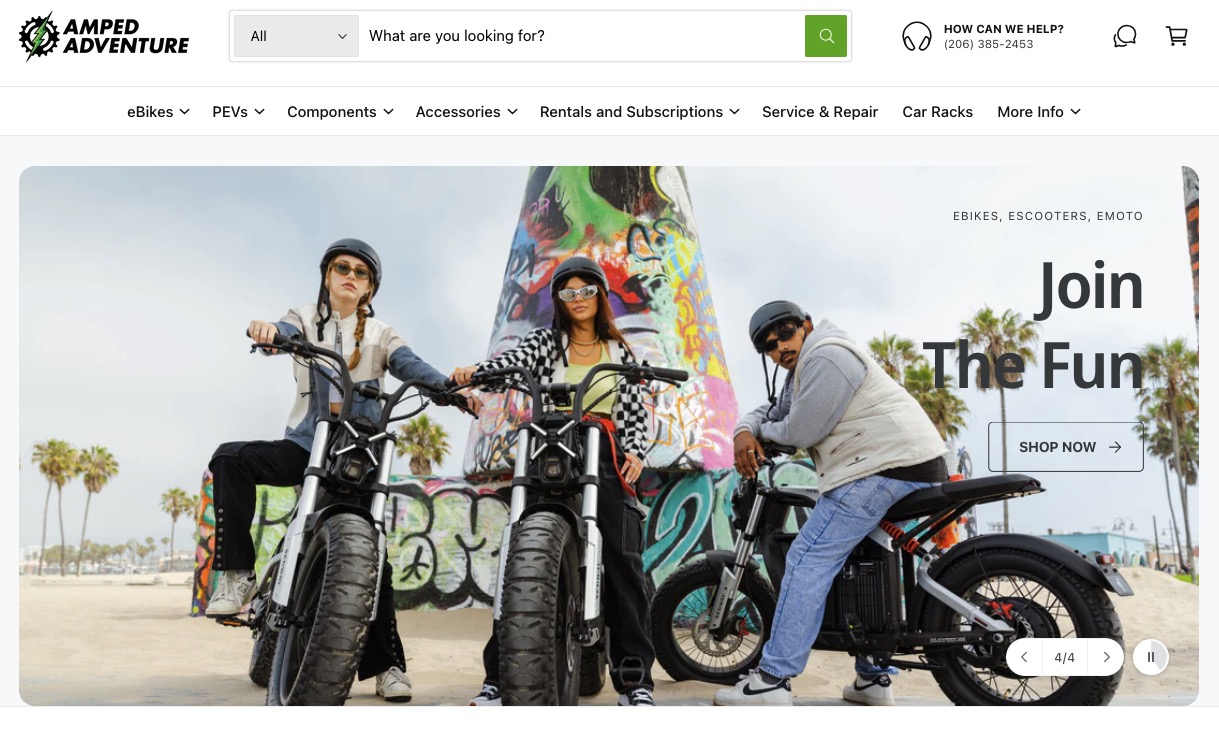
 From the Amped Adventure website.
So far, the legislature has heard from bike and trail organizations as well as cities and engaged high school students about the problems caused by the proliferation of high-powered electric two-wheelers that are often confused for or are masqueraded as e-bikes. Especially in the hands of kids too young for a driver’s license, high-speed e-bikes can be very dangerous. There’s a very good reason why we don’t let children ride motorcycles.
Gordon Smith, one of three partners behind the locally-owned Amped Adventure shop in Lake Forest Park, told Seattle Bike Blog that even though two bills going through the Washington state legislature “will definitely hurt sales” for some of their products, he supports rule changes to clarify the difference between e-bikes and e-motos. He also confirmed something I suspected: There is no organization that he is aware of that is advocating on behalf of e-motos or their riders. The bike orgs “hate” e-motos, he said, and the motorcycle orgs have also been slow to embrace them. So that leaves them without anyone to stand up for the potential good that e-motos can provide to our state.
“Being a shop that sells both of them, we welcome this sort of legislation,” he said. “They are so powerful and have a really high-end top speed” that many of these devices have more in common with off-road-only dirt bikes or ATVs. “It will help parents because they feel pressure from their kids and their neighbors to get them.”
— Advertisement —
People riding dirt bikes and ATVs on public roadways is a longstanding problem, but the proliferation of high-power electric two-wheelers, which are quieter and may even look similar to legitimate Class 1, 2 or 3 e-bikes, has brought the issue to legislator’s attention. Cities also have trouble regulating these e-motos because there is no state-level definition for them, which makes it difficult or impossible to write local codes that affect them. E-motos exist in a sort of legal gray area that HB 2374 – 2025-26 and, to a lesser extent, SB 6110 – 2025-26 are designed to illuminate. As we reported previously, both bills would clarify that any device with a motor capable of outputting more than 750 Watts or is capable of going faster than 20 mph without pedaling or that does not have working pedals (not pegs) is not an e-bike. Devices that make it easy for users to bypass power and speed limits would also not be considered e-bikes. Both bills also task the Department of Licensing with convening a work group to develop agency and legislative policy ideas ahead of the 2027 legislative session, setting up further action.
The primary difference at the moment is that the House version would also add a definition for an “electric motorcycle,” and then adds them to the existing sections regulating “motorcycles.” The Senate version would instead leave such a change to the work group to figure out ahead of the next session. Cities led by Mercer Island that are looking to add rules (potentially including bans) on e-motos prefer the House version and lobbied the Senate to add the definitions to their version, though they did not do so before passing it. The House bill is now waiting on action from the Senate Transportation Committee while the Senate bill already has a hearing in the House Transportation Committee at 1 p.m. Thursday (February 26). Only one of the bills needs to pass both chambers before it is sent to the governor to be signed into law.
But my conversation with Smith from Amped Adventure suggested that perhaps a more nuanced definition would be more appropriate. He was inspired by a recent trip to China in which he saw huge numbers of people riding electric sit-down scooters similar to a Vespa or moped. These are quiet, energy efficient, zero-emission vehicles, which are all good things the state typically wants to encourage. “You should absolutely be able to make these street legal,” he said, though he noted that in many cases it might require manufacturers to offer kits to bring the bikes in line with state motorcycle regulations.
— Advertisement —

Especially for the bikes that can go at or near freeway speeds, a motorcycle endorsement on a driver’s license is a way to “prove you know what you’re doing.” However, “I think there’s definitely room for” an in-between class, he said. Existing rules for mopeds, which are defined according to their engine cylinder displacement and therefore are not applicable to any e-bikes, exclude the vehicles from limited-access highways but allows them to be operated by someone with a regular driver’s license. This would require riders to be at least 16 and to have passed a driver’s test. It also requires registration, though at a lower cost. Other rules, such as regulating where they can be parked or how a dealer can offer legal test rides, may also need to be ironed out. The state’s moped laws also define the top speed as 30 mph on flat ground, but perhaps something closer to 35 or 40 would make sense for a device intended to travel on city streets and rural roads but not on limited access roads. These are questions I hope the work group explores.
Being able to register an e-moto as an e-moped or e-motorcycle does require costs and regulatory hoops, but it also comes with significant benefits and legal protections for riders. Right now, even if an e-moto rider is doing everything right and someone else’s driving error causes a collision, the e-moto rider is likely to be considered at least somewhat at fault because they are riding an illegal vehicle. With a legally-registered vehicle, they would have all the rights and privileges of any other road user. They would also have access to insurance. I don’t think any insurance company would sell a policy for an illegal motorcycle. Enforcing e-moto use is going to continue to be a low priority for police, and big police crackdowns can easily have negative consequences of their own. Instead, the state should encourage going legit by making the process painless and worthwhile.
Smith also noted that there are super fast electric foot scooters and unicycles that seem to be totally missing from the current legislation but that could use a similar state guidance. State laws allow these devices so long as they are limited to 20 mph, but there seems to be a similar legal gray area for devices that go faster than 20.
Washington should be careful both in passing a bill this session and in developing future policy to ensure that they are not effectively banning higher-speed electric devices. Instead, the focus should be on defining acceptable use. When is a driver’s license required? When is a motorcycle endorsement required? What safety equipment is required? The state also needs to do whatever they can to make sure it as straightforward as possible for riders to get their vehicles registered. The worst case would be a clumsy law that leaves e-moto owners with no practical way to comply, leading to continued illegal use and effectively no change.