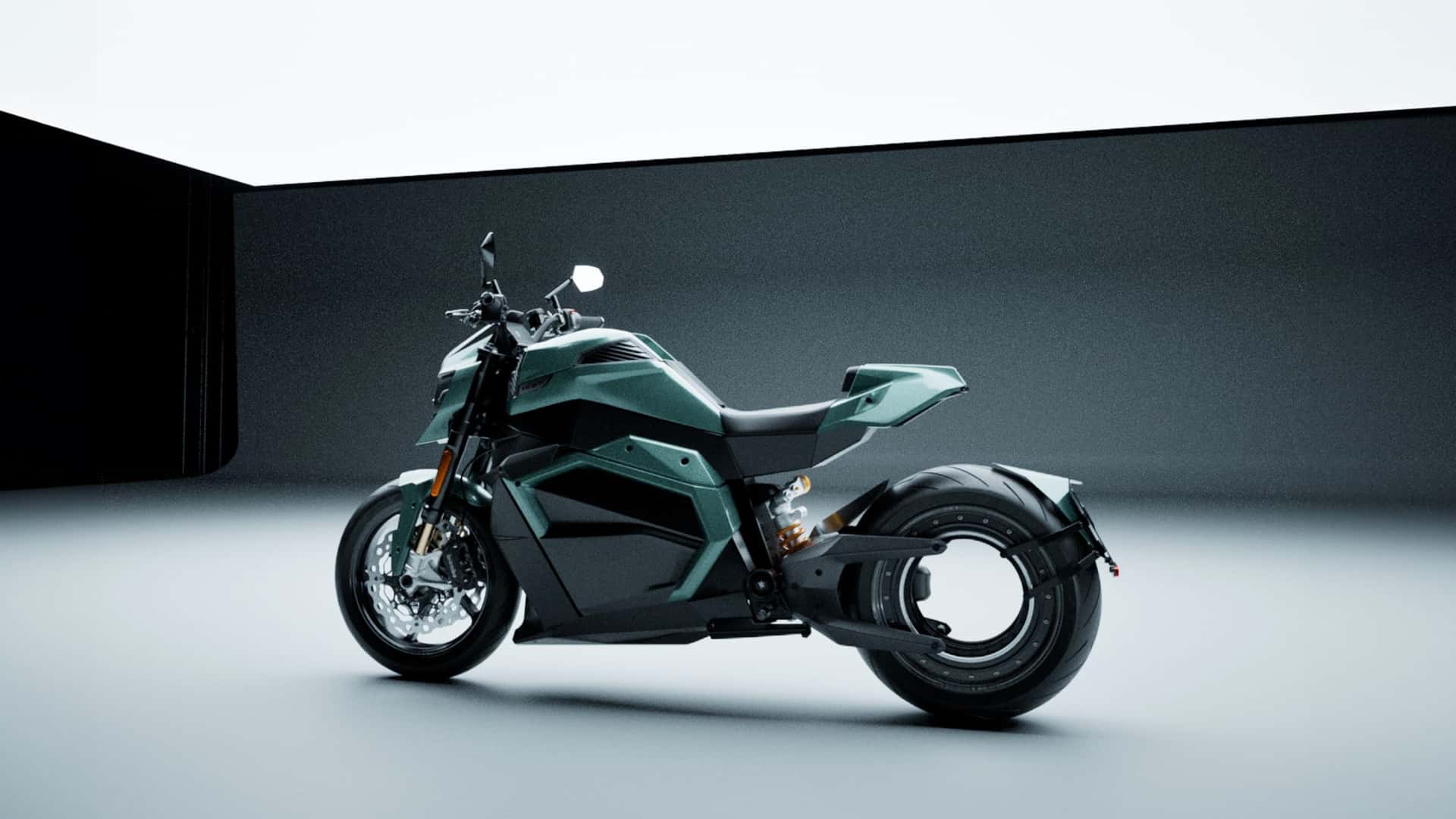
A few weeks ago, Donut Labs and Verge Motorcycles debuted what they call a game-changing motorcycle. It is, according to the companies, the first-ever solid-state battery-powered bike. And big promises were peppered throughout the announcement.
Unheard of charging speeds. Insanely large battery capacities that enable long-range riding. And fewer components, to boot. The battery seems like the Philosopher’s Stone of the EV world, as it’s something that everyone’s trying to build ahead of each other. But like the aforementioned alchemic material, the battery’s specs seemed too good to be true. Especially after you consider Verge’s prior validation demonstrations.
The internet agreed, too, and much was said of Verge and Donut’s claims.
Now, the companies are back, having dropped off a solid-state battery to an independent, third-party testing lab in Finland, and stating that the lab has begun releasing its results that back up their claims. I, however, am still skeptical that’s exactly what the lab is saying, along with giving a healthy amount of side eye to how the tests were done.
So let’s talk about these test. According to Donut Labs and Verge Motorcycle’s press release, the pair commissioned Technology Research Centre VTT of Finland to perform a series of independent tests on the group’s new solid-state battery. The first results of said tests are now being released, the first of which is in the form of charging speeds.
“The tests, conducted by Technology Research Centre VTT, evaluate the Donut Battery’s charging speed and thermal behaviour during charging,” states the release, adding, “It simulates a worst-case scenario, in which the battery cell lacks active temperature controls and its temperature can rise freely at extremely high charging rates.”
And according to the tests, “Under the specified testing conditions, the cell was successfully charged at 5C for over nine minutes. At this charging power, the battery cell reached an 80% state of charge in about 9.5 minutes and a full 100% state of charge in just over 12 minutes. When discharged after charging, 100% of the charged capacity was available from the cell.The battery cell was then recharged rapidly at the extreme speed of 11C. Charging from 0 to 80% was achieved in 4.5 minutes and a full 100% state of charge in just over seven minutes. When discharged after a full charge, 98.4 to 99.6% of the battery capacity was available for use.”
For those who’ve never encountered the “C” measurement before, as I hadn’t prior to this release, C refers to Charge Rate, which the site Quantumscape defines as, “The C-rate is the unit battery experts use to measure the speed at which a battery is fully charged or discharged. For example, charging at a C-rate of 1C means that the battery is charged from 0-100% in one hour. A C-rate higher than 1C means a faster charge; for example, a 3C rate is three times faster, so a full charge in 20 minutes.”
Donut’s solid-state battery is capable of ultra-fast charging, i.e., a higher C-rate. And in the lab tests, its battery was able to be charged at 11C with minimal degradation. But minimal isn’t none, and the test itself wasn’t done in real-world conditions, nor in a vehicle.
Let’s first talk about the minimal degradation, as that’s an important stat. Think about your iPhone or Android, and how it slowly loses its battery life over the course of your ownership. Depending on how you charge it, how you use it, and what your settings are, you’re likely to encounter about 1-8% drop in total battery capacity over a few years. Ultra-fast charging, however, has the ability to make that degradation far faster, even with today’s modern 800V systems in cars, trucks, and motorcycles. Loading and unloading fast wears out the batteries faster. In the test as presented, the lab charged, discharged, charged, and then discharged again rapidly over just a few cycles, but already saw degradation.
It wasn’t minimal, either, as the span was 2.2%. Moreover, none of this was real-world conditions.
“The measurement was done using two passive cooling configurations: in the first, the cell was surrounded by two lightly compressed aluminium cooling plates, and in the other the cell was attached to only one bottom cooling plate,” states Donut, adding, “Even though the testing conditions did not directly simulate cell behaviour in a battery pack, the measurement demonstrates the benefits of the Donut Battery as part of a pack as well.”
Honestly, lab tests like this are great for validation of concepts. They’re great for testing new ideas, theories, and whether or not parts will work in the end product. But this “test” has all the hallmarks of Donut and Verge’s prior range test where they scooted around London at 12mph and stated emphatically that their battery pack could go nearly 200 miles on a single charge. It’s disingenuous at best.
Now, I do think that EVs are the future. And I think that solid-state batteries have the possibility to redefine the space. But this type of PT Barnum pomp hurts the cause. Either test things in reality, and in real situations, or just don’t.
We want your opinion!
What would you like to see on Rideapart.com?
– The RideApart Team