Key Points
Tesla is expanding Robotaxi, but the company is still early in proving the economics at scale.
Management expects capital expenditures to exceed $20 billion in 2026 — a major spending step-up.
At today’s valuation, investors are paying a premium for high-margin revenue streams well beyond the core car business.
Shares of electric-vehicle and energy specialist Tesla(NASDAQ: TSLA) are back below $400 as of this writing. Additionally, the stock is down about 12% year to date, even as Tesla keeps leaning harder into autonomy and a shift toward a more software- and services-driven model.
A pullback like this can look tempting given that Tesla is investing aggressively in promising growth initiatives. Its Robotaxi service, in particular, could morph into a major business for the company over the long haul. But the question is whether the economics of Tesla’s newer, higher-margin initiatives will show up quickly enough — and with enough durability — to justify today’s valuation.
Will AI create the world’s first trillionaire? Our team just released a report on the one little-known company, called an “Indispensable Monopoly” providing the critical technology Nvidia and Intel both need. Continue »

Tesla Cybercab. Image source: Tesla.
Robotaxi: A key catalyst for Tesla stock?
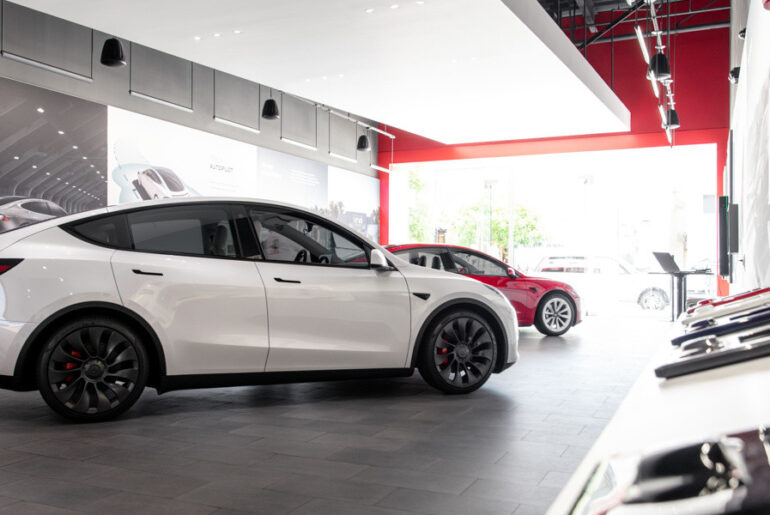
Robotaxi is an autonomous ride-hailing platform using Tesla’s technology and vehicles. Launched in June 2025, the service currently operates primarily with the company’s Model Y vehicles, and is expected to increasingly rely on its upcoming, purpose-built autonomous Cybercab over time.
Interestingly, with the stock trading at a price-to-earnings ratio of about 370, investors seem to already be pricing in a successful launch of Robotaxi at scale. In other words, the current valuation prices in not just an automaker with a successful energy storage business (the Tesla we know today), but also newer initiatives. Put another way, the current valuation is arguably asking investors to underwrite a company that can build and run a scaled fleet-based service business while also selling self-driving software.
Of course, Tesla has been making notable progress on these newer initiatives. So it makes sense for investors to start considering them. In 2025, for instance, Tesla’s self-driving software capabilities dramatically improved, and it began installing production lines for Cybercab. Additionally, in its fourth-quarter update, the company outlined a planned Robotaxi coverage roadmap that starts in Austin and expands to additional U.S. metros in the first half of 2026.
Execution of its plans, of course, will be the hard part. Robotaxi may prove to be more complex than investors expect. Running a ride-hailing network requires operational infrastructure that a pure software company never has to touch. In its recent annual report, Tesla itself called out the work behind the scenes, including vehicle cleaning and maintenance, charging, security, teleoperations, and fleet management. Those are real costs, and they tend to scale with miles driven, not just with software subscriptions.
Even more, the company’s current growth initiatives are capital-intensive.
“We currently expect our capital expenditures to be in excess of $20 billion in 2026,” Tesla said in its 2025 annual report, pointing to AI initiatives like compute infrastructure and data centers, manufacturing and R&D expansion, and growth in its company-operated AI-enabled asset fleet.
That is a dramatic step-up. For context, Tesla’s capital expenditures were $8.5 billion in 2025. In other words, management is guiding toward a year in which capital spending more than doubles.
Is it time to buy Tesla stock?
So, yes: the company is investing in some exciting growth initiatives. But it’s easier said than done. Tesla is trying to scale autonomy, AI infrastructure, and fleet operations simultaneously. Those initiatives may create a larger profit pool later, but they require heavy spending now.
But as hard as it may be for Tesla to succeed in these new initiatives, their initial success is already being priced into the growth stock. With a price-to-earnings ratio approaching 400, investors have priced in the expectation that profits will expand sharply as autonomy and software scale, while the core vehicle business returns to growth.
There is also a timing risk that arguably doesn’t get enough attention in bull cases. Tesla can be right about the long-term direction and still be early. Regulation, consumer adoption, safety performance, and the practical cost of operating a fleet can all slow the timeline — and a valuation like this gives investors little cushion if the timeline slips.
Tesla is doing ambitious work. I’m just not buying the stock below $400 today, because the spending ramp and the valuation together make for an unattractive setup in my opinion.
Don’t miss this second chance at a potentially lucrative opportunity
Ever feel like you missed the boat in buying the most successful stocks? Then you’ll want to hear this.
On rare occasions, our expert team of analysts issues a “Double Down” stock recommendation for companies that they think are about to pop. If you’re worried you’ve already missed your chance to invest, now is the best time to buy before it’s too late. And the numbers speak for themselves:
Nvidia:if you invested $1,000 when we doubled down in 2009,you’d have $492,341!*Apple: if you invested $1,000 when we doubled down in 2008, you’d have $50,381!*Netflix: if you invested $1,000 when we doubled down in 2004, you’d have $424,262!*
Right now, we’re issuing “Double Down” alerts for three incredible companies, available when you joinStock Advisor, and there may not be another chance like this anytime soon.
*Stock Advisor returns as of February 23, 2026.
Daniel Sparks and/or his clients have positions in Tesla. The Motley Fool has positions in and recommends Tesla. The Motley Fool has a disclosure policy.