Veterans of the corridors of power in Jerusalem still remember the square, solid convoys that drove to the capital until the late 1990s. In a time when historical memory did not yet allow Israeli government ministers to be seen in German cars, the Volvo 240 up to the S80 was the exclusive hallmark of the ministerial fleet. They were invulnerable, safe, and understated.
Today, Volvo’s importer (Mayer) completes the circle with the launch of the new ES90, Volvo’s first all-electric sedan, its answer to the BMW i5 and Audi A6 e-tron. The platform is the same one used by the large seven-seat EX90 crossover and the Polestar 3. It still prioritizes safety and solidity but replaces the smell of 95-octane gasoline with an advanced 800-volt architecture, allowing extremely fast charging and a longer driving range than any previous Volvo electric car. The S90 successor is manufactured in the same way – in China, as part of Geely’s ownership of Volvo.
The ES90 is a design hybrid combining sedan elegance with fastback practicality thanks to a fifth door to the rear trunk, although the trunk itself is not particularly large at 424 liters plus 27 liters in the front trunk. With a generous 3.1-meter wheelbase, it offers enormous rear legroom. Its flowing roofline is not just for aesthetics – it contributes to an exceptionally low drag coefficient of 0.25 Cd, enhancing aerodynamic efficiency. A length of 5 meters, width of 2.05 meters, height of 1.55 meters, and 3.1-meter wheelbase place it squarely in the segment.
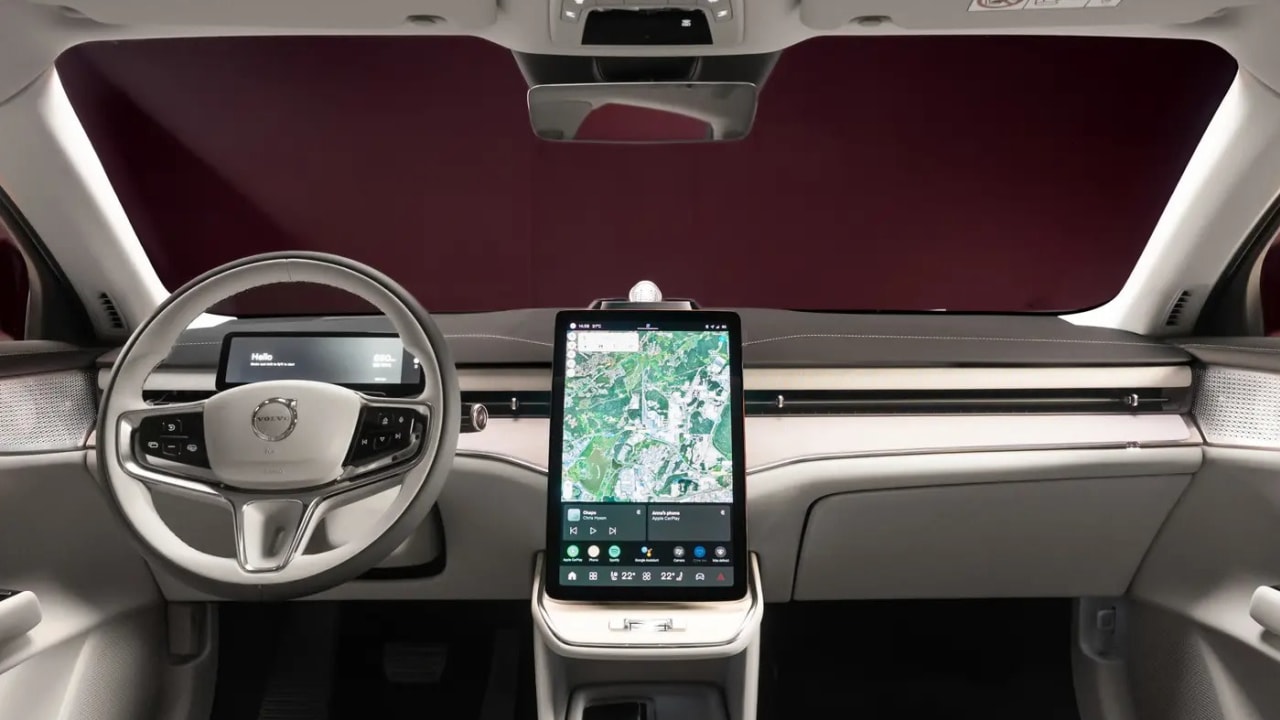
Interior and Technology: Inside, you’ll find the Scandinavian design philosophy reinforced with premium materials. The dashboard is dominated by a 14.5-inch screen with built-in Google system and 5G connectivity. There is also an option for a Bowers & Wilkins sound system with 25 speakers, Dolby Atmos® support, and a panoramic roof with electrochromic coating allowing control over glass transparency at the touch of a button.
Performance and Charging: Only the rear-wheel-drive version is available locally, with 333 hp and 49 kg·m of torque, 0-100 km/h in 6.6 seconds, and a manufacturer-limited top speed of 180 km/h. A 92 kWh battery allows a range of up to 650 km. Fast charging is possible at up to 310 kW, while slow charging is limited to 11 kW.

Safety: As expected from the brand, the ES90 is equipped with an array of sensors including LiDAR, five radars, and seven cameras. It features a “driver understanding” system that detects lack of focus, a door-opening warning to protect cyclists, and a system to prevent leaving children behind.
Trim Levels and Prices:
Core (from NIS 420,000): Entry-level trim includes a 9-inch digital instrument cluster, 14.5-inch multimedia display, wireless phone charging, 20-inch wheels, panoramic roof, synthetic leather upholstery, and electrically adjustable front seats.
Plus (from NIS 460,000): Adds ventilated front seats, Bose sound system, head-up display, electric steering adjustment, upgraded upholstery, and more.
Ultra (from NIS 540,000): Upgrades to 21-inch wheels, adds adaptive suspension and soft-close doors, panoramic roof with adjustable transparency, LED matrix headlights, optional B&W sound system, and more.
Competitors: The base ES90 is NIS 100,000 cheaper than a basic Audi A6 e-tron and NIS 200,000 less than a comparable BMW i5, which could help it in a market that has shrunk significantly since Volvo’s days in government fleets.