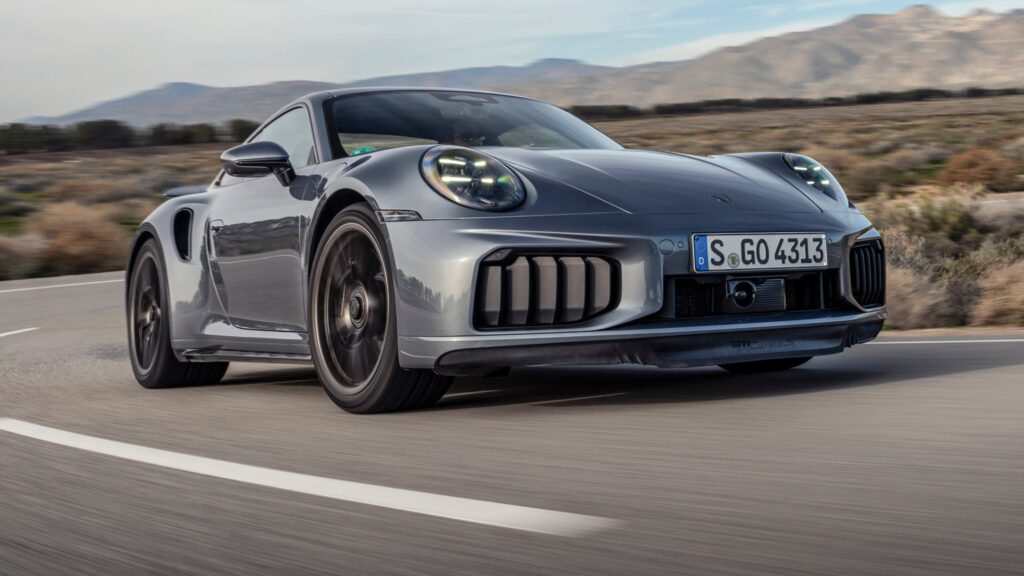
Hypercar Speed Achieved
In chilly air and on a slightly dusty launch pad (we do not run the cars we test on a prepped surface), the 2026 Turbo S struggled to put its power down at first, spinning all four wheels. Once it found traction, however, its acceleration was breathtaking.
It hits 60 mph in 2.2 seconds, tying the 2021 Turbo S Lightweight as the quickest 911 we’ve ever tested—and besting the 918 Spyder’s 2.4-second mark. It slices through the quarter mile in 9.9 seconds at 138.9 mph, making it the first gas-powered Porsche we’ve tested to do a sub-10-second pass. The 918 Spyder did it in 10.0 seconds dead, albeit at 145.2 mph.
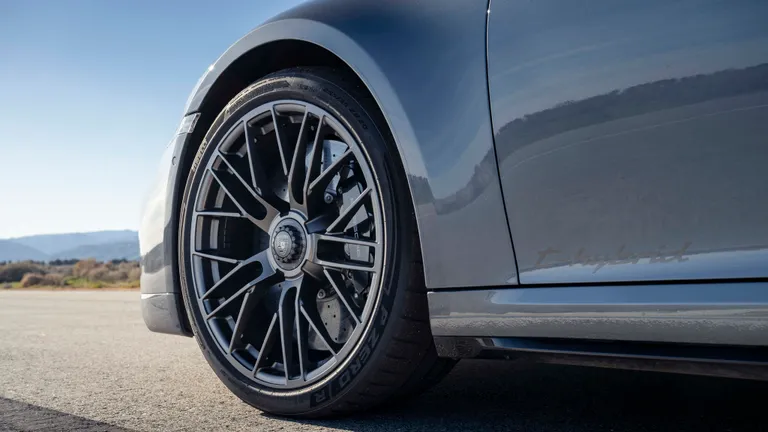
With the largest carbon-ceramic brakes ever fitted to a 911, the 2026 Turbo S stopped from 60 mph in 95 feet, 1 foot behind the 918 Spyder. At 1.11 g average on the skidpad, it’s also close to its hybrid ancestor’s 1.12 g. Notably, the common 992.2 Carrera S and GTS T-Hybrid both match it in braking and skidpad grip. Weight may be a factor; at 3,820 pounds, the Turbo S hybrid is heavier than those 991s, though the Turbo S Lightweight needed 98 feet despite weighing 270 pounds less.
ADVERTISEMENT – CONTINUE READING BELOW
A figure-eight lap of 22.0 seconds at 1.03 g average for the Turbo S is very close to the 918 Spyder’s 22.2-second, 1.06 g result. But nothing can touch the GT3 Touring’s 21.6-second, 1.04 g lap, the best ever in MotorTrend testing.
Porsche making exceptionally fast and dynamically capable cars is nothing new, and others still top the new Turbo S in specific measures: Some Taycan models launch harder, GT cars stop shorter, and the sharpest RS variants generate more grip. Yet on real roads, where feel matters more than decimal places, the Turbo S hybrid backs up its test results with stunning—potentially excessive—speed.
 Fast, Fast, Fast
The way this car delivers power is almost difficult to describe. Tangible is that the engine has some kind of assistance; it lacks the pure responses and absolute linearity of the GT3’s clockwork 4.0-liter mill. But this shouldn’t imply that the Turbo S is laggy or its electrification is too apparent. Rather, the car’s unrelenting acceleration scrambles neurons such that there’s little mental capacity to sense these nuances. It’s a sensation that overwhelms cognition.
ADVERTISEMENT – CONTINUE READING BELOW
Power—everywhere, always—defines the Turbo S. Torque also abounds as the turbos and motors pile on with near-imperceptible integration. It all comes in perfect synchrony with the right-side pedal’s position, keeping things controllable. But under full load, the tachometer absolutely rips to its 7,500-rpm limit through each smooth, instant upshift. It never stumbles or runs out of breath, at least not up to the depraved speeds we were bold enough to probe.
Experiencing what it can really do requires big space, total focus, and bravery—or, perhaps, irreverence for the possible consequences of going full throttle. Because of this, the world often seems too small for the Turbo S. Push it, and the next corner arrives like the car shrank the road rather than traversed it. The brakes, fortunately, are undefeatable, but strong presses are critical to counteracting the car’s massive and immediate forward momentum.
In tight, technical sections, the Turbo S feels constrained. There, it’s like other 911 models, demonstrating precise handling through brilliantly cohesive controls. Fantastic, sure, but too confined to do what it’s built for. That applies to normal driving, too, where the car’s capability is wasted. It makes you wonder whether some other 911 variant would be more exploitable and therefore more enjoyable, even if not as ballistically fast. But when compared to the endlessly exciting and manic GT3, at least, the Turbo S might make a better daily driver.