Electric Mountain Bike Market Growth Potential
Key Highlights
Study Period 2021 – 2032
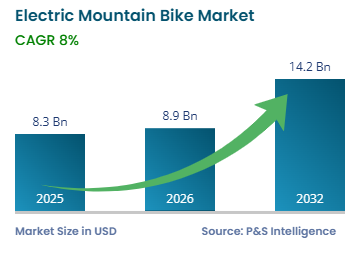
Market Size in 2025USD 8.3 Billion
Market Size in 2026USD 8.9 Billion
Market Size by 2032USD 14.2 Billion
Projected CAGR 8%
Largest RegionEurope
Fastest-Growing RegionAsia-Pacific
Market Structure Fragmented
Market Size
Explore the market potential with our data-driven report Get Sample Pages
Electric Mountain Bike Market Overview
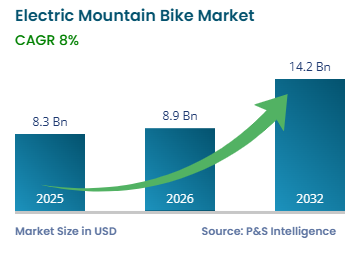
The electric mountain bike market size was USD 8.3 billion for 2025, and it will grow by 8.0% during 2026–2032, to reach USD 14.2 billion by 2032.
This sustained expansion is propelled by rapid advances in lithium-ion battery technology offering extended range and fast-charging capability, and the growing integration of pedal-assisted propulsion systems that make challenging terrain accessible to a wider demographic. The parallel development of lightweight aluminum and carbon fiber frame architectures is reinforcing consumer confidence and expanding adoption across recreational and performance-oriented rider segments.
Expanding participation in outdoor recreation and adventure tourism, particularly across Europe and North America, is further strengthening demand for high-performance electric mountain bikes as consumers seek technology-enhanced trail riding experiences. For instance, according to the 2024 Outdoor Participation Trends Report by the Outdoor Industry Association (OIA) and the Outdoor Foundation, 175.8 million Americans, representing 57.3% of the U.S. population aged six and older, participated in outdoor recreation in 2023, highlighting the expanding base of adventure-oriented consumers.
Key Market Insights
The pedal-assisted category holds the largest market share, of 60%, in 2025, driven by its alignment with traditional mountain biking dynamics, regulatory compliance in key markets, and wider acceptance on off-road trails.
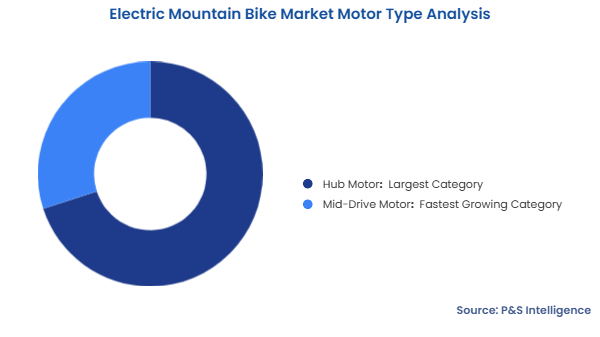
The hub motor category holds the largest market share, at approximately 70%, in 2025, driven by its lower integration cost and compatibility with standardized frame designs across entry-level and mid-range models.
The lithium-polymer category will register the highest CAGR of 8.4%, driven by its lightweight pouch-cell design and greater integration flexibility in premium e-MTB frames.
The aluminum category holds the largest market share, at 45%, in 2025, supported by its strong durability and cost efficiency at scale.
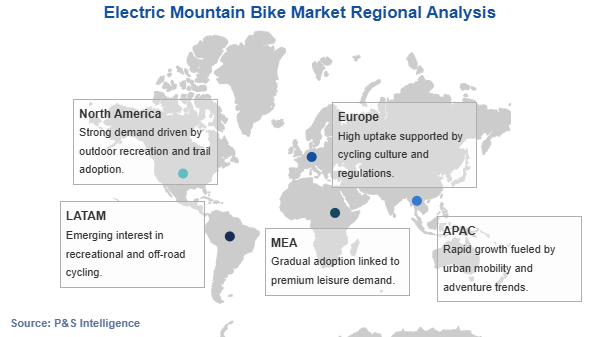
Europe holds the largest market share, at 40%, in 2025, supported by its strong cycling culture, developed trail infrastructure, and favorable regulatory framework for pedal-assisted e-bikes.
Electric Mountain Bike Market Emerging Trends
Smart Technology and Connectivity Are Key Trends
The integration of intelligent electronics, real-time connectivity, and data-driven motor management systems is fundamentally reshaping the design philosophy and consumer value proposition of electric mountain bikes. Modern e-MTBs increasingly incorporate torque-sensing motor controllers, GPS-based tracking and smartphone-integrated navigation features, mobile app interfaces, and performance analytics platforms that allow riders to customize assist levels, monitor battery consumption, and track trail metrics in real time. According to the German Bicycle Industry Association (ZIV), 800,000 e-bikes were sold in Germany between January and April 2024, underscoring the sustained scale of demand in mature connected e-bike markets, which also supports broader adoption trends in segments such as electric mountain bikes.
This shift from mechanically assisted bicycles to connected outdoor devices is expanding the addressable consumer base beyond traditional mountain bikers, attracting tech-oriented recreational riders, adventure tourism operators managing fleet inventory remotely, and fitness enthusiasts seeking quantified outdoor experiences. Manufacturers are responding by layering smart ecosystem features onto powertrain architectures: Bosch’s Smart System platform, Shimano’s E-TUBE connectivity, and DJI’s Avinox drive system all integrate proprietary digital interfaces that create brand-locked user ecosystems, increasing switching costs and reinforcing premium OEM positioning. Bosch’s Smart System is commercially deployed across more than 100 e-bike brands globally and supports over-the-air software updates, integrated anti-theft tracking, and app-based ride analytics. This trend is expected to deepen through the forecast period as over-the-air software updates, predictive battery management, and advanced adaptive assist algorithms expand across mid-range and premium segments. The latest generation of drive systems increasingly integrates advanced sensor arrays; for instance, in September 2024, Bosch introduced its fifth-generation Performance Line CX motor (BDU384Y), incorporating multi-axis sensor technology to optimize torque modulation and terrain-adaptive assist performance.
Battery Technology Improvements and Cost Decline Are Biggest Drivers
Rapid advances in lithium-ion battery performance and the corresponding reduction in pack-level costs are contributing to downward pressure on retail price thresholds, improving accessibility for mainstream recreational consumers. According to the report, the global average lithium-ion battery pack price declined to approximately USD 139 per kWh in 2023, compared to more than USD 1,000 per kWh in 2010, reflecting long-term structural cost compression across the battery industry. Improvements in energy density, fast-charging architecture, and thermal management are enabling manufacturers to deliver higher-range e-MTBs within increasingly competitive price bands, reducing the cost-performance gap that has historically constrained mass adoption.
For e-MTB manufacturers, this structural input cost reduction provides greater gross margin flexibility, enabling either premium feature addition at stable price points or entry into lower-cost market segments without compromising powertrain quality. According to the International Energy Agency (IEA), global battery (cell) manufacturing capacity grew nearly 30% in 2024 to exceed 3 TWh, supporting supply-chain scale and cost efficiencies across electric mobility technologies.
Aging Rider Demographic and Inclusive Access Shifts Are Key Opportunities
A significant growth opportunity in the electric mountain bike market lies in the expanding population aged 45 and above, particularly in developed economies where outdoor recreation participation remains high. This demographic typically possesses higher disposable income and prioritizes quality, comfort, and reliability over entry-level pricing. Electric assist systems directly address the primary participation barrier for older riders, physical strain on steep climbs and long trail distances, thereby converting latent interest into active purchasing behavior.
Demographic data reinforces this opportunity. According to the United Nations World Population Prospects 2022, the global population aged 65 and above is projected to increase from 771 million in 2022 to 994 million by 2030, significantly expanding the addressable base for low-impact recreational mobility solutions. Additionally, Germany’s Federal Statistical Office reports that more than 22% of Germany’s population is already aged 65 or older, highlighting the scale of aging in one of the world’s largest e-bike markets.
Electrically assisted mountain bikes reduce cardiovascular and joint stress while preserving the outdoor experience, enabling older riders to extend ride duration, access more technical terrain, and participate in group riding. This inclusive access dynamic supports premium product demand, as older consumers often favor high-specification mid-drive systems, full-suspension comfort platforms, and strong after-sales service infrastructure.
Electric Mountain Bike Market Segmentation Analysis
Propulsion Type Analysis
The pedal-assisted category holds the largest market share, of 60%, in 2025, driven by its alignment with traditional mountain biking dynamics, regulatory compliance in key markets, and wider acceptance on off-road trails. In the European Union, pedal-assist e-bikes limited to 250W with assistance cut off at 25 km/h are classified as bicycles under EU Regulation 168/2013, exempting them from registration, insurance, and licensing requirements. This classification architecture has steered OEM product development and consumer purchasing behavior firmly toward pedal-assist platforms for over a decade. The EU’s updated EN 15194:2017+A1:2023 safety standard, which came into full enforcement in August 2025, further reinforced pedal-assist systems as the certified compliance benchmark for EPAC-class e-bikes in the European market.
The dual-mode category will have the highest CAGR, of 8.6%, driven by increasing consumer demand for ride versatility, enhanced low-speed control on technical terrain, and broader usability across varying rider skill levels in markets where throttle-enabled configurations are legally permitted. In the United States, federal e-bike regulations define a Class 2 e-bike as a dual-mode pedal-assist and throttle-enabled configuration with a maximum speed of 20 mph (32 km/h), creating a clear compliance category that supports OEM development of dual-mode platforms.
The propulsion types analyzed in this report are:
Pedal-Assisted (Largest Category)
Throttle-Assisted
Dual-Mode (Fastest Growing Category)
Motor Type Analysis
The hub motor category holds the largest market share, of approximately 70%, in 2025, reflecting its long-standing market presence, lower integration costs, and compatibility with standardized wheel geometries that enable broad OEM adoption across entry-level and mid-range price tiers. As hub motors require minimal frame structural modification, manufacturers have historically been able to electrify existing hardtail and full-suspension platform architectures without full drivetrain redesign, a supply chain efficiency that supported volume dominance during the market’s early growth phase. The U.S. Department of Energy (DOE) notes that a 10% reduction in vehicle weight can improve energy efficiency by approximately 6–8% in light-duty vehicles, a mechanical principle that underscores the importance of weight distribution and mass centralization in performance-oriented e-MTB motor placement.
The mid-drive motor category will have the highest CAGR, of 8.5%, driven by OEM consolidation around configurations that optimize mass centralization, suspension performance, and downhill control, design criteria fundamental to technical trail and enduro riding. Additionally, mid-drive systems provide superior torque transfer through the drivetrain, enabling more efficient power delivery on steep and uneven terrain.
The motor types analyzed in this report are:
Hub Motor (Largest Category)
Mid-Drive Motor (Fastest Growing Category)
Deployment Type Analysis
The lithium-ion category holds the largest market share, of approximately 85%, in 2025, supported by its established manufacturing scale, mature global supply chains, and high energy density that effectively balances weight, range, and lifecycle durability under demanding off-road conditions. Its dominance reflects both technological maturity and sustained cost efficiency improvements. According to the International Energy Agency’s Global EV Outlook 2025, lithium-ion battery pack prices declined by approximately 20% in 2024, the steepest annual drop since 2017, driven by lower critical mineral prices, expanding production capacity, and intensified competition across China, Europe, and North America.
The lithium-polymer category will have the highest CAGR, of 8.4%, driven by lightweight pouch-cell format and design flexibility, flexible cell form factor, and reduced electrolyte leakage risk, characteristics that directly address the strict weight minimization requirements and irregular frame integration geometries of premium lightweight e-MTB designs.
The deployment types analyzed in this report are:
Lithium-Ion (Largest Category)
Lithium-Polymer (Fastest Growing Category)
Lead Acid
Others
Suspension Type Analysis
The hardtail category holds the largest market share, of 65%, in 2025, driven by structural simplicity, lower production cost relative to full-suspension platforms, and inherently higher pedaling efficiency, which translates into extended battery range per charge cycle, a practical advantage that resonates with cross-country riders, fitness-oriented users, and commuter-crossover consumers prioritizing longer electric assistance windows over technical descent capability. The European Commission allocated EUR 1.7 billion in cycling-specific investments through National Recovery Plans, developing accessible paved and gravel trail networks particularly well-suited to hardtail e-MTB use cases, supporting broader cycling participation across accessible trail networks in Europe.
The full suspension category will have the highest CAGR, of 8.3%, propelled by expanding bikepark infrastructure, the rising popularity of enduro riding formats, and growing demand from older recreational cohorts seeking maximum trail comfort across technically demanding terrain. Furthermore, advancements in rear shock design and frame kinematics are improving ride stability and impact absorption, enhancing performance on aggressive downhill trails.
The suspension types analyzed in this report are:
Hardtail (Largest Category)
Full Suspension (Fastest Growing Category)
Frame Material Analysis
The aluminum category holds the largest market share, of 45%, in 2025, reflecting the material’s optimal balance of structural strength, corrosion resistance, manufacturability, and cost accessibility at volume price points. Aluminum alloy construction supports the additional static and dynamic load demands of integrated battery packs, motor housings, and wiring harness routing without the structural weight penalty of steel, while remaining substantially more cost-efficient than carbon fiber composite architectures at scale. The U.S. Department of Energy (DOE) Vehicle Technologies Office has documented that replacing conventional steel structural components with aluminum alloys reduces component weight by 10–60%, a material efficiency reflecting a general lightweighting principle in structural design where battery and motor mass create a structural counterbalancing imperative for maintaining acceptable total bike weight across consumer price tiers
The carbon fiber category will have the highest CAGR, of 8.2%, driven by accelerating demand from the premium performance segment where sub-20kg complete bike specifications are becoming a competitive benchmark among leading OEMs. Carbon fiber’s unique capacity for directional stiffness engineering enables frame designers to independently optimize torsional rigidity and compliance zone characteristics, a capability unavailable in isotropic metal alloys, delivering superior power transfer efficiency and vibration attenuation on technical terrain.
The frame materials analyzed in this report are:
Aluminum (Largest Category)
Carbon Fiber (Fastest Growing Category)
Steel
Others
Drive strategic growth with comprehensive market analysis Preview With a Free Sample
Electric Mountain Bike Market Geographical Analysis
Europe Electric Mountain Bike Market Size
Europe holds the largest market share, of 40%, in 2025, driven by the region’s deeply embedded cycling culture, extensive trail and path infrastructure, and a regulatory environment that classifies pedal-assisted e-bikes under standard bicycle provisions, eliminating licensing requirements. However, trail access remains subject to national and local land-use regulations rather than uniform EU-wide guarantees. In the EU, pedal-assist e-bikes up to 250W and 25 km/h are classified as bicycles under EN15194 and do not require licensing or registration. However, broad trail access depends on national and local land-use regulations and is not uniformly guaranteed across all EU countries.
Germany, United Kingdom, France, Switzerland, and Austria collectively represent the core demand base, with premium consumer segments prioritizing high-performance hardtail and full-suspension e-MTBs from established European OEMs. The European Commission, through its 2021–2027 Structural Funds cycle, committed approximately EUR 3.21 billion to cycling infrastructure projects across member states, a 30% increase over the preceding funding period, directly expanding trail connectivity and supporting the ecosystem in which e-MTBs operate.
Germany Electric Mountain Bike Market Size
Germany is the largest individual country market for electric mountain bikes within Europe in 2025, driven by the country’s combination of premium consumer purchasing power, world-class e-bike manufacturing infrastructure, and one of the most extensive cycling network systems globally. German consumers demonstrate a strong preference for performance-oriented mid-drive e-MTBs, supported by a high density of specialist cycling retailers who provide expert fitting, motor calibration, and after-sales service, a channel dynamic that particularly benefits premium brands such as CUBE, Canyon, and Haibike. This demand dynamic is reflected in market data. For instance, in 2024, Germany sold approximately 2.05 million e-bikes, representing about 53% of total bicycle sales in the country, with e-mountain bikes accounting for nearly 40% of the e-bike segment.
Asia-Pacific Electric Mountain Bike Market Size
Asia-Pacific will have the highest CAGR, of 8.1%, driven by rising disposable incomes, rapid urbanization, expanding recreational cycling participation, strong regional manufacturing capabilities, and increasing consumer shift toward electric mobility solutions across China, Japan, South Korea, and emerging Southeast Asian markets. China anchors the region through its commanding position in e-bike manufacturing, battery production, and domestic consumption, while India and South Korea represent high-growth secondary markets benefiting from rising recreational cycling adoption and urban infrastructure investment. In India, electric bicycles with motor power not exceeding 250W and a maximum assisted speed of 25 km/h are exempt from registration and licensing requirements under the Central Motor Vehicle Rules, significantly reducing regulatory barriers for compliant electric mountain bike adoption.
Adventure tourism operators across Japan, South Korea, and Australia are increasingly integrating e-MTB fleet rentals into guided tour packages, creating a parallel commercial demand stream that complements direct-to-consumer sales. In Japan, electrically power-assisted bicycles are legally classified as standard bicycles under the Road Traffic Act when assist ratios and speed limits comply with national standards, allowing operation without moped registration and supporting mainstream recreational adoption.
China Electric Mountain Bike Market Size
China is the largest country market within Asia Pacific in 2025, underpinned by its globally unmatched e-bike manufacturing scale, comprehensive domestic supply chain for lithium battery cells and mid-drive motor systems, and the government’s active deployment of consumer incentive programs. The Chinese government’s national e-bike trade-in program resulted in approximately 8.47 million new electric bicycles sold to replace old models across the country in the first half of 2025 alone, 6.1 times the replacement volume recorded during the corresponding period in 2024, demonstrating the scale of policy-driven demand stimulation within the broader electric bicycle market. China issued GB 43854-2024, a mandatory national safety standard for lithium-ion batteries used in electric bicycles, effective November 2024, establishing stricter safety and testing requirements for e-bike batteries sold in the country.
While China’s domestic e-bike market has historically concentrated on urban commuter models, the accelerating adoption of adventure recreation among middle-class consumers and the entry of high-performance motor brands such as DJI Avinox are progressively elevating the e-MTB segment. China’s trajectory through 2032 is expected to be shaped by premium segment premiumization, higher-torque motor adoption, and continued export expansion into European and Latin American markets.
The regions and countries of the market are as follows:
North America
U.S. (Larger Country Market)
Canada (Faster-Growing Country Market)
Europe (Largest Regional Market)
Germany (Largest Country Market)
U.K.
France
Italy
Spain (Fastest-Growing Country Market)
Rest of Europe
Asia-Pacific (Fastest-Growing Regional Market)
China (Largest Country Market)
India (Fastest-Growing Country Market)
Japan
South Korea
Australia
Rest of APAC
Latin America
Brazil (Largest Country Market)
Mexico (Fastest-Growing Country Market)
Rest of LATAM
Middle East and Africa
Saudi Arabia (Largest Country Market)
South Africa (Fastest-Growing Country Market)
U.A.E.
Rest of MEA
Electric Mountain Bike Market Competitive Landscape
The market is fragmented due to the combination of premium performance manufacturing requirements and region-specific regulatory and distribution structures. Numerous established global bicycle brands compete alongside emerging specialist e-MTB manufacturers, each targeting distinct price segments, riding disciplines, and geographic markets. Product differentiation remains high, driven by variations in motor systems, suspension configurations, battery integration strategies, and frame materials. In addition, key component suppliers such as motor and drivetrain manufacturers significantly influence brand positioning and competitive dynamics, creating a layered ecosystem of competition. Additionally, strong regional players across Europe, North America, and Asia-Pacific limit consolidation, while rapid innovation cycles and evolving consumer preferences prevent concentration among a small number of dominant firms..
key Electric Mountain Bike Market Companies:
Trek Bicycle CorporationSpecialized Bicycle Components, Inc.Giant Manufacturing Co. Ltd.Merida Industry Co., Ltd.Accell Group N.V.Scott Sports SAYT Industries GmbHCanyon Bicycles GmbHCUBE GmbH & Co. KGCannondale (Pon.Bike)Robert Bosch GmbH (Bosch eBike Systems)Shimano Inc.Rocky Mountain BicyclesYamaha Motor Co., Ltd.Orbea S. Coop
Electric Mountain Bike Market News
In May 2025, Bosch eBike Systems launched the Performance Line CX-R Race motor with 100 Nm torque and 750 W peak power, featuring a titanium crank spindle, ceramic bearings, and OTA upgrade support via the eBike Flow app for compatible fifth-generation CX units.
In March 2025, Giant Manufacturing Co. Ltd. partnered with Siemens AG at Hannover Messe 2025 to showcase the Trance X Advanced E+ Elite 0 e-MTB developed using Siemens’ Designcenter, Teamcenter, and Simcenter digital-engineering platforms, demonstrating integrated digital manufacturing capabilities from design simulation through production validation.
Frequently Asked Questions About This Report
What is the current global market size of the electric mountain bike market?+
The electric mountain bike market was valued at USD 8.3 billion in 2025.
Which region dominates the electric mountain bike market?+
Europe dominates the electric mountain bike market.
What are the key growth drivers of the electric mountain bike market?+
Major growth drivers include increasing interest in outdoor sports, expansion of mountain biking tourism, technological improvements in lightweight motors and high-capacity batteries, and rising consumer preference for performance-oriented premium bicycles.
Who are the leading companies in the electric mountain bike market?+
Leading companies include major bicycle manufacturers and performance brands that offer full-suspension and hardtail e-MTBs, along with drive system providers supplying mid-drive motor platforms used across global markets.
What is the forecast growth rate (CAGR) of the electric mountain bike market?+
The electric mountain bike market is growing at CAGR of 8.0% during 2026-2032.