
After getting acquainted with the latest electric cars Volvo EX 30 and Volvo E X 90 in the past 2025, suddenly at the very beginning of 2026 I had the opportunity to test the Volvo XC 90 – in an updated version and with a Plug – In hybrid under the hood. So, has its time passed? Or as it often happens: an old ox will not spoil the furrow? Now I will tell you everything!
Design: Hello, old friend! You’ve refreshed yourself…
The second-generation Volvo XC 90 has already been around for a decade, and we first met it almost ten years ago. So the successor was released, preparing for a new, electric era – yes, I’m talking about the Volvo E X 90. But suddenly it turned out that many customers still want to get the usual internal combustion engine. Which gave the Volvo XC 90 a chance to continue its career; only the car had to be updated to meet the realities of new times. And, in my opinion, it turned out just great!
The classic silhouette of a classic crossover – with this large hood, horizontal lines, chrome around the windows, branded curved lights – all this is perfectly combined with the new front part. It would seem: only a radiator grille with sloping lines, new headlights with a contour line of “Thor’s Hammer” and plus a modified front bumper – but the car has immediately become fresher! Of course, there are other changes. For example, a new rear bumper hides the exhaust pipes, new wheels have been added, and the lights are now slightly tinted. However, no matter how you say it, all the attention is drawn to the “face” of the car!
The large Volvo XC 90 crossover successfully combines the familiar classic body profile and a new expression of the “face” in the style of the brand’s most modern models. The word “large” is said for a reason: length – 4.95 meters; width – 1.93 meters; height – 1.77 meters; wheelbase – 2.98 meters. A small hatch in the front wing (under which the Mennekes “Type 2” charging port is hidden) immediately hints to Volvo fans: here is a high-tech Plug – In hybrid. But first – what’s in the cabin?
Mm-m-m, I recognize this interior too. I like all these large massive panels, smooth lines and transitions, I like the Volvo brand font and buttons and switches. At one time, the Volvo XC 90 T8 crossover became a kind of model of what the company achieved in the 2000s and with what it moved into the 2010s; however, the new transition to the 2020s brought a new portion of changes. I’m talking about the integration of Google services and a new multimedia system with an enlarged display: it used to be 9.2-inch, and now it’s 11.2-inch. The increase in size has led to the display going beyond the front panel; the central ventilation deflectors have been “redrawn” under it; plus the center console has changed somewhat – they usually talk about adding cup holders, but I remember the now absent, but once so convenient Drive Mode switch…
And I also remember the original multimedia system menu. After all, from now on, the multimedia menu in the Volvo XC 90 resembles the menu in the Volvo EX 30 and Volvo EX 90 electric cars: overall, it’s not bad, but before everything was more personalized and thought out. Now I most often see a map and a few widgets on the start page, and to get to more precise settings and change the driving mode (which are important for such a technologically advanced hybrid car) I have to dive deep into the menu. The dashboard is even more noticeable: small indicators on the right and left, and a Google map in the center. And all the most interesting things are collected on the right indicator – hybrid operation, engine speed, selected driving mode, body height on air suspension – which is literally squeezed to the edge of the dashboard. For what? For Google maps? That’s how I know my daily route! Moreover: sometimes the electronic warfare system worked and this map got lost – I was driving either somewhere in South America, or in an empty field. I don’t really like to complain in this style, but it really is “better before”. The individual digital dashboard from Volvo and the multimedia system from Volvo, thought out and “drawn” with an understanding of the capabilities of Volvo cars and the need to transmit certain information – this is better than generalized Google solutions for cars.
Thank you, everything else is in place. I’m talking about the engine starter drum, the crystal transmission shifter, the open-pore wood, the mesh speaker panels, the perforated leather on the thin seats with incredibly curved bolsters – as if Volvo’s ergonomists didn’t just study the anatomy of the human body, but sculpted it together with the gods of Valhalla! It’s in such little things that you can recognize the high class of a car.
I’m talking about the front of the cabin now, and there are also the rear seats of the second and third rows. Moreover, the rear sofa is a real transformer: it moves forward/backward, allows you to adjust the angle of the backrest, an armrest is hidden in the center of the backrest, and a child booster is hidden in the center of the sofa. Plus “climate” adjustment and heating, plus window blinds and branded ventilation deflectors in the side pillars. And even plus two additional seats in the trunk – because the Volvo XC 90 offers a 7-seater interior. I’ll give the dimensions later, but for now I’ll briefly state: the third-row seats open easily, have a plus-minus comfortable shape (they are clearly not flat benches), ventilation and a couple of cup holders and a niche for small things are also provided for third-row passengers. What can you say: well done Volvo ergonomists, they made the third row with attention to detail, and not just “for show”.
A similar feeling arises in the trunk: here you have side niches, hooks for bags, a hidden place for the charging cable, and the ability to “squat” to facilitate loading things. And even a mini-compressor station (I’m afraid to imagine how much the repair can cost if the rear of the car is damaged). By the way, the trunk volume is 298 liters with a 7-seater configuration of the cabin, or 650-977 liters with a 5-seater configuration of the cabin (depending on the loading method), or a maximum of 1941 liters with a 2-seater configuration of the cabin. And if you have already folded the third row of seats when you don’t need it, then the lifting panel will help limit the movement of bags in the giant trunk. So I say: well done Volvo ergonomists!
A beautiful and pleasant interior that tries to combine the “classics” (general forms, wood and metal in the decoration, crystal automatic transmission lever) with the modern techno-world (new multimedia system and digital instrument panel) – this is how you can describe the interior of the updated Volvo XC 90 crossover; at least its front part. But behind, nothing much has changed – and that’s good, because everything was great there before: a second row with transformation capabilities, many options for comfort, an additional third row of seats, a well-thought-out trunk. And what about the space?
The answer is given by a cycle of measurements of the interior, which I usually start from the front. For example, the length of the driver’s seat cushion can vary within 46-52 cm thanks to a retractable roller from below. The distance from the edge of the driver’s seat cushion to the accelerator pedal varies within 42-68 cm depending on the longitudinal adjustment of the seat. The headroom in height reaches a maximum of 107 cm (measured along the backrest and headrest, the seat lowered as much as possible, the backrest set at an angle of about 110 degrees, measured from the base of the seat to the ceiling).
Now about the second row sofa. The leg/knee room in the back is 63-90 cm (measured from the base of the sofa to the back of the front seat, depending on the adjustment of the front seat, the second row sofa is moved as far back as possible). The head/torso room is 98 cm (measured from the cushion of the second row sofa to the ceiling, along the back and headrest of the second row sofa, the back is at an angle of 110 degrees).
Next, about the third row of seats for rear passengers. So, the leg/knee room is 56-67 cm (measured from the base of the third-row seat to the back of the second-row sofa, depending on the adjustments and position of the second-row sofa). The head/torso height is 86 cm (measured along the backrest and headrest).
Finally, about the trunk. The width of the latter between the wheel arches is 113 cm, taking into account the side niches, we can count on 139 cm. The depth of the trunk from the edge to the stop in the back of the third row of seats is 58 cm. If the third row of seats is folded, we have a trunk depth of 126 cm; if the second row is folded, the trunk depth will be 190 cm (measured to the edge of the folded seat back) or a maximum of 216 cm (measured to the stop in the back of the front seat).
It is interesting to compare the space of the Volvo XC 90 with its electric relative, the Volvo EX 90 – and it turns out that the space in the cabin and trunk is almost the same, the difference is a few centimeters in favor of one or the other crossover. Moreover, the EX 90 is longer than the XC 90 by a noticeable 10 centimeters. Well, once again: well done Volvo ergonomists, they worked out the cabin very well!
Technology: well-known platform, plug-in hybrid update
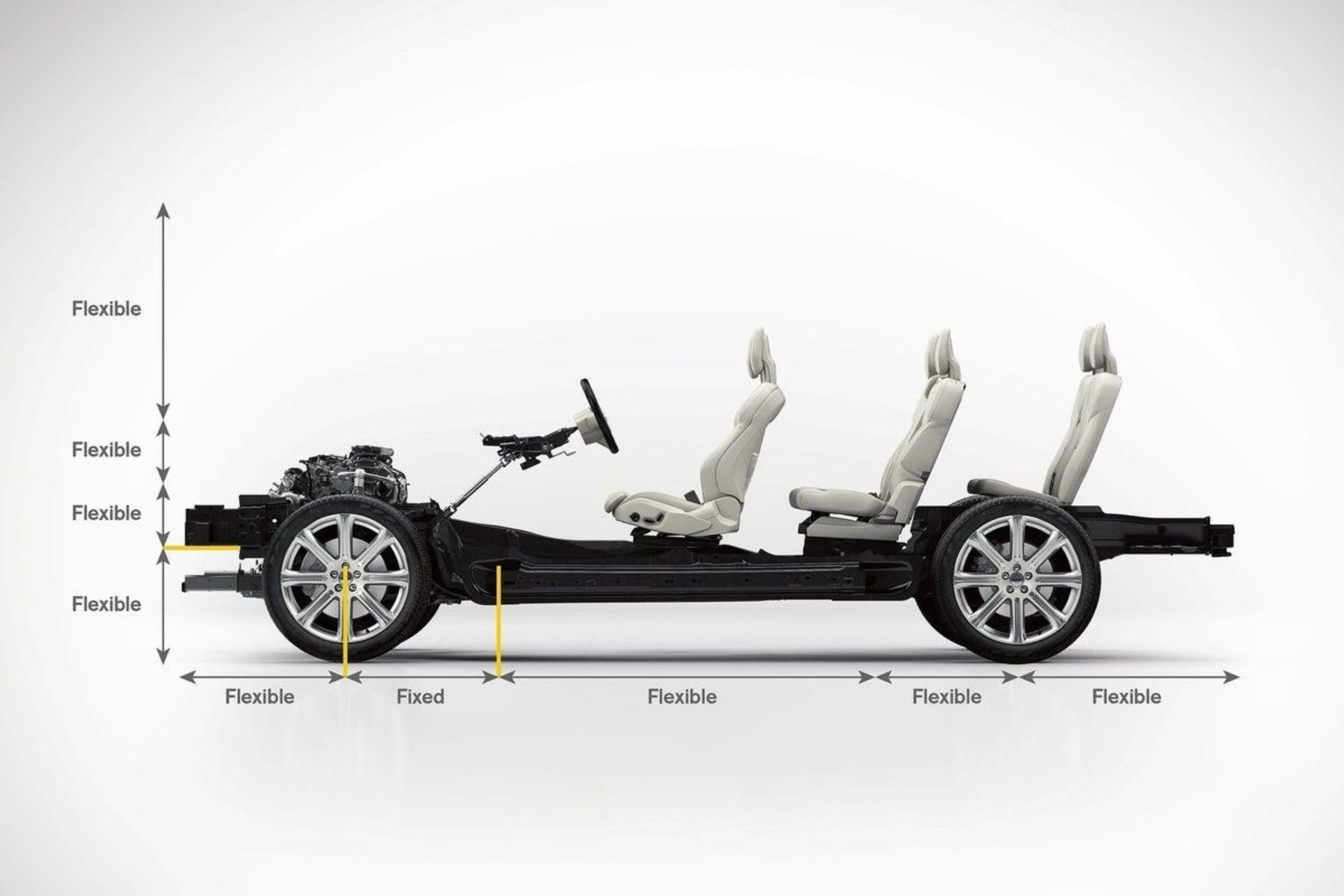
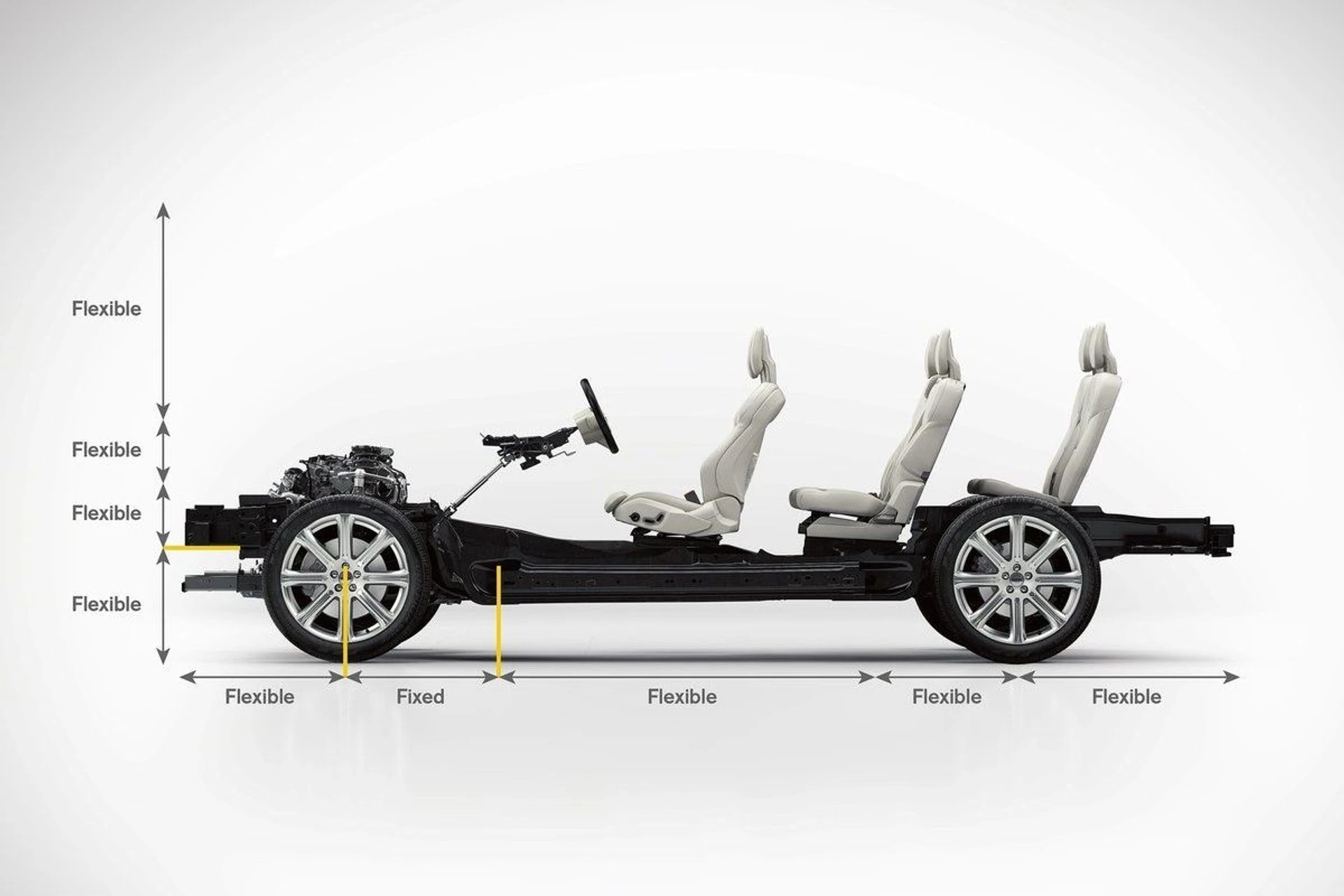
The Volvo XC90 crossover is built on the SPA platform, which has become the basis for all mid- and large-sized Volvo cars. This platform allows for flexible size changes, independent suspension and the integration of air bags, front- or all-wheel drive; and a range of 4-cylinder 2-liter gasoline and diesel turbo engines has been created for this platform.
The SPA platform also allows you to create a Plug – In hybrid, which is also quite interesting: a 2-liter gasoline turbo engine is installed in front paired with a traditional 8-speed “automatic”, an electric motor with its own gearbox is installed in the back, and the battery is placed in the central tunnel. Thus, it is possible to implement all-wheel drive (when both motors are working), achieve high power/torque indicators (when both motors are working), and minimize the impact of the battery on the interior space (after all, it actually takes the place of the cardan shaft).
The second-generation Volvo XC90 has had this Plug – In hybrid technology since the beginning of its career; however, during the update to the 2025 model year, almost all the components of the hybrid have been improved. As before, the basis is a 2-liter 4-cylinder gasoline turbo engine from the Drive – E family , which develops 310 hp. power and 400 Nm of torque. This engine works in tandem with a traditional hydromechanical 8-speed “automatic” AW TG -81 SD and is responsible for driving the front wheels. Although, depending on the driving mode, it is also responsible for driving the generator and charging the battery. Next to it are various voltage converter units: from direct current of one voltage to direct current of another voltage (for powering on-board systems), from alternating current to direct current (for charging the battery).
As for the high-voltage lithium-ion battery itself (operating at a voltage of 369 volts), during the car’s update it has increased significantly – by about 1.5 times – and now its capacity is about 19 kilowatt-hours. This should be enough for a range in electric mode of up to 70 km in the combined cycle or even up to 87 km in the urban cycle. Finally, there are changes regarding the electric motor, which is installed at the back and is responsible for driving the rear wheels. Its output has also increased: if previously there was 88 hp and 240 Nm, now we have 145 hp (107 kW) of power and 309 Nm of torque.
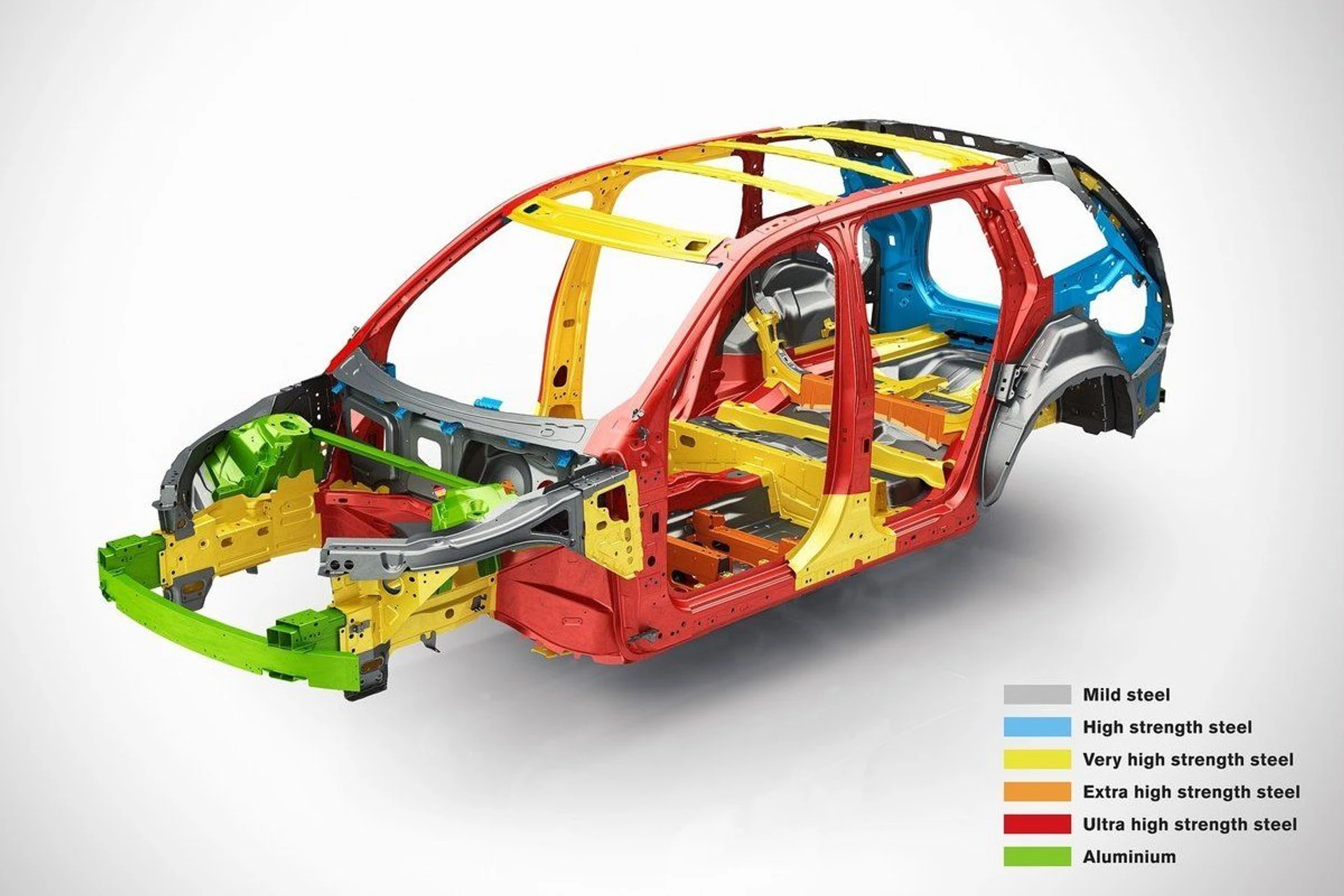
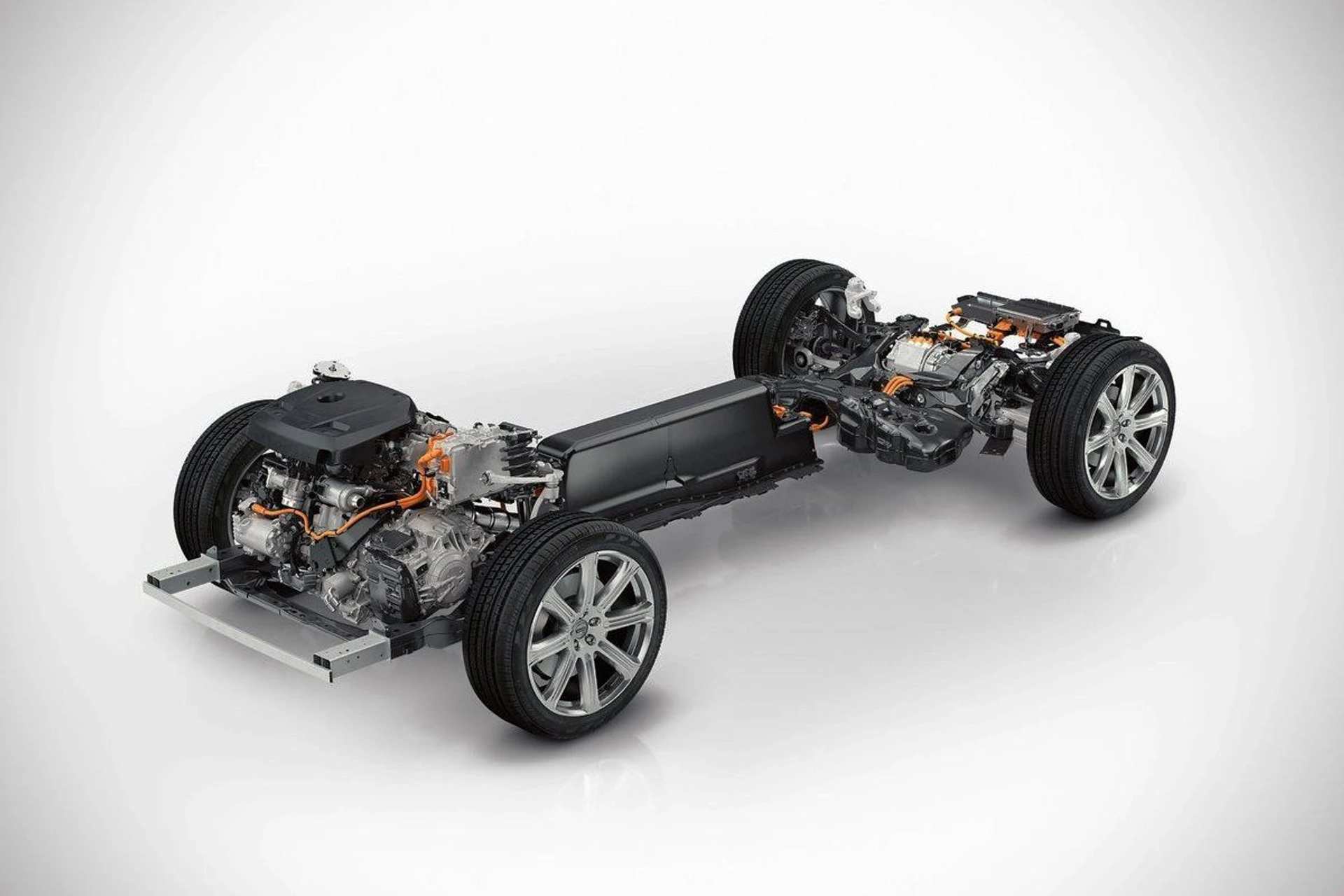
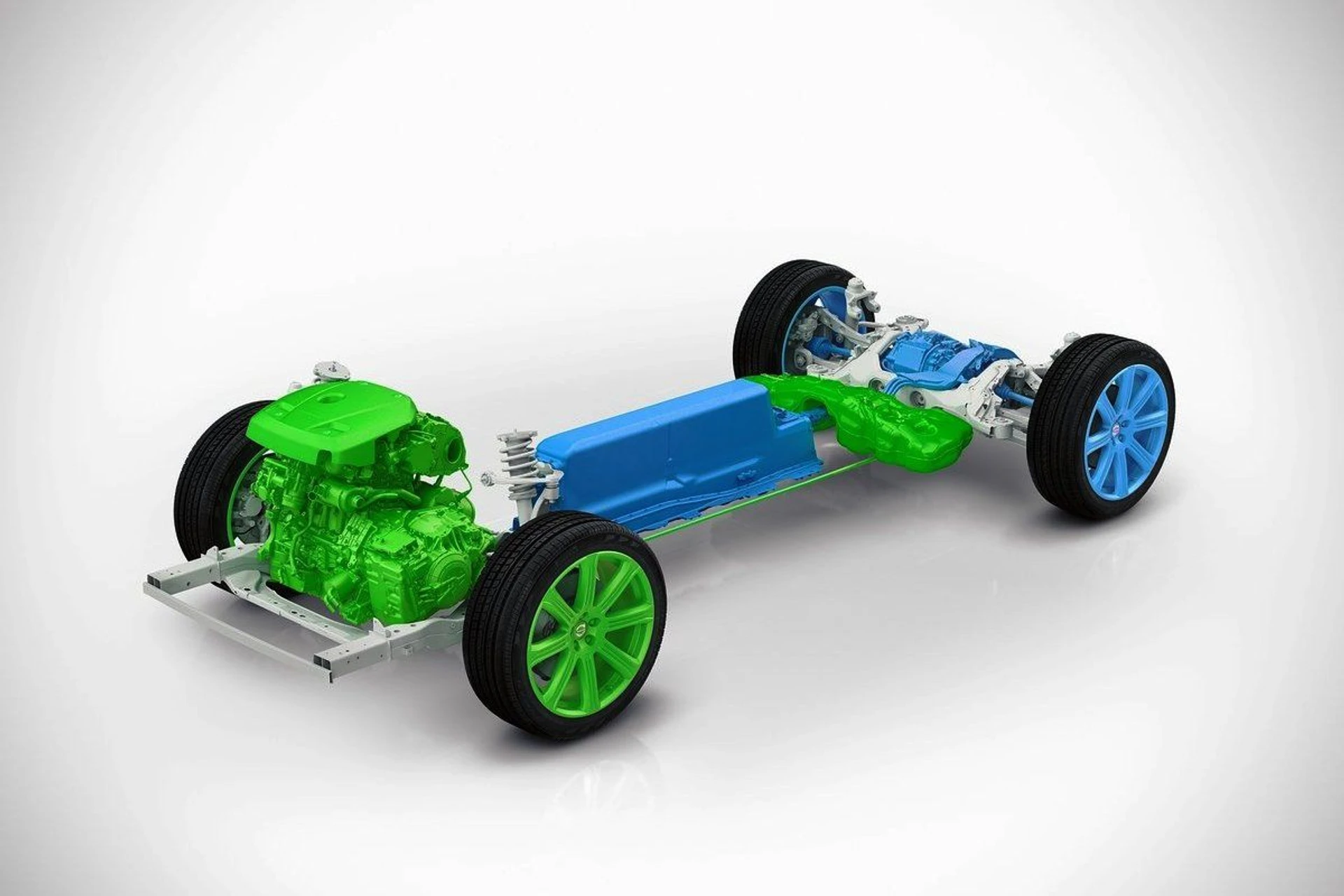
The basis of the Volvo X C90 is the SPA platform and the supporting body; from the former wide range of engines, only a pair of 2-liter 4-cylinder gasoline turbo engines with “mild hybrid” technology and the designation B5 (250 hp, offered in Ukraine) or B6 (320 hp, not offered in Ukraine) remain. And also – the unique Plug – In hybrid version T 8 remained, which became the hero of the material. Pay attention to the color division in the diagram: the gasoline component is painted green, the electric component is painted blue. When the gasoline engine and electric motor work together, the total power should reach 455 hp, and the torque is declared at the level of 709 Nm. Also claimed is acceleration from 0-100 km/h in 5.4 seconds (not bad for a crossover with a curb weight of 2365 kg) and a maximum speed of 180 km/h. Fuel consumption in the combined cycle is claimed at 3.7 liters per 100 km; but the extreme figures are more eloquent – a minimum of 1.3-1.6 liters per 100 km (when constantly charging the battery and driving on electric power to the maximum; measured according to the rules of the combined WLTP cycle); or a maximum of 7.7-8.6 liters per 100 km (this is when driving in the style of “how it works”; measured according to the rules of the combined WLTP cycle). So…
Behind the wheel: lots of comfort, power, dynamics – lots of possibilities in general
I’ll start by describing my impressions of the running gear and chassis in general, because these questions are easier. Yes, the Volvo XC 90 crossover is perceived as quite comfortable, it is very soft on the go, resembles a boat floating on the waves of asphalt irregularities. And I would say that it rocks, but no – everything is within normal limits, it won’t shake you in the cabin, but you will definitely remember the comfort of this car. And what is especially interesting is this working out of deep single holes or seams-grooves on the road: usually they give a lot in the cabin, it is usually customary to write this off to low-profile tires – but the test Volvo XC 90 crossover on Michelin Pilot Alpin 5 SUV winter tires with dimensions of 275/40 R 21 even in these conditions was remembered for its good comfort: it can! At the same time, while providing comfort on the go, the car does not provoke active driving at all (except for one case, which I will tell you about below). Most of the time, most kilometers, most turns, you will drive with light steering, moderate body roll, and also with a characteristic desire to slip out with the nose (although sometimes you can “turn” and the back thanks to the active intervention of the electric motor). Typical calm and confident behavior, as you would expect from a Volvo car.
However, could you expect such stunning dynamics? The “hundred” is achieved in 5.5 seconds – and this is provided that winter tires are installed and the battery is charged to 70-80% of its full capacity. Moreover, even if you discharge the latter almost to zero, the dynamics will not drop much: my measurements gave about 5.7 seconds. And if you also select the Polestar Engineered mode, the Volvo XC 90 crossover will be pressed to the ground, the suspension will become stiffer, and the responses to the accelerator pedal will be almost instantaneous. It seems that even the sound from the engine changes somewhat. Maybe it is synthesized? If it were not there, then in this mode the Volvo XC 90 becomes surprisingly collected and dynamic – unexpectedly!
After all, in all other modes, the car is emphasized comfortable and soft, it does not radiate dynamics-sportiness, but rather a feeling of confidence on the road. Especially when it comes to winter roads, completely covered with snow and ice. Then the AWD mode will help you: the behavior of the all-wheel drive is clear, where all wheels are driven. And despite the fact that the rear electric motor is nominally inferior to the front one in terms of power and torque – in fact, according to the sensations, the car behaves as if it were an all-wheel drive system with symmetrical distribution of traction: everything is clear, everything is predictable. Plus, softness in reactions to pressing the accelerator pedal and the desire to prevent excessive wheel slippage.
Similar impressions are also from the Off Road mode, only in this case, a tightening is added with switching to a higher gear and raising the body above the road to a level higher than usual. Only in this position, the suspension travel is quickly selected and on off-road with bumps you can get an unpleasant knock from below. Moreover, as soon as the speed reaches 30-40 km/h – the car immediately switches from Off Road mode to AWD mode, and the body lowers to a normal position. In principle, it is logical: if you have already gained such speed – then, probably, the road under the wheels has already become more or less normal. By the way, memories from the past: I once complained that the power of the electric motor was not enough to confidently move the heavy Volvo XC 90 T 8 crossover off-road; however, in the updated version, the power of the rear electric motor was increased – and this remark was resolved. By the way, “number two”: in all three of the above modes (Polestar, AWD, Off Road), a full-fledged tachometer appears.
However, most often you will drive in Hybrid mode, which is selected by default. In this mode, the car first tries to drive using the electric drive, and if this is not enough – for example, during dynamic acceleration or when the battery is completely discharged – the gasoline engine is automatically connected. An interesting nuance is that when driving on an electric motor, you are actually driving a car with rear-wheel drive; when driving using an internal combustion engine, you are driving a car with front-wheel drive; when driving in hybrid mode, the rear electric motor and internal combustion engine are constantly switching, and sometimes the crossover “turns” backwards under the traction of the electric motor. Strange mixed sensations; that is why the AWD mode helps you on slippery winter roads. However, as long as it is not slippery under the wheels, as long as everything is stable with traction – Hybrid mode really turns out to be optimal for general conditions of use: electric, internal combustion engine, all together. The moment of connecting the internal combustion engine is easy to monitor either by sound or by the combined indicator on the virtual instrument panel: the electrical part is marked with a lightning bolt, the operating zone of the internal combustion engine is indicated by a droplet, the place of such a transition constantly “floats” depending on the driving conditions, acceleration intensity, and battery charge level.
By the way, what about the battery charge. In general, the manufacturer promises 70 km on electric power, but according to my impressions, it turned out about 50 km (Pure mode, movement exclusively on electric power, so you can gain 120-130 km/h) – however, consider the difficult winter conditions of the test drive. Then, to fully charge the battery, you can use either an external power source (it takes three hours to fully charge the battery), or a special function when the internal combustion engine works both to move the car and to drive the generator – thus, charging the battery. It is better not to mention fuel consumption at these moments… Or why not, let me mention it!
On average, in the city I managed to consume 10-11-12 liters of fuel per 100 km of the road – this is if you drive in hybrid mode “as it turned out”, trying to preserve the battery charge or when it is completely discharged. Of course, you can get 0 liters per 100 km – this is when you have a full battery and you move exclusively on electric power. And you can get 17-18-20 liters per 100 km of the road in the city – this is when you try to go somewhere and charge the battery at the same time. Depending on the speed of movement, you can gain +1 km of electric range for 2-5 km of the distance traveled. Therefore, when you drove 20 km around the city with a fuel consumption of 20 liters per 100 km (i.e., the car conditionally consumed 4 liters of fuel), in fact, at that moment you have accumulated in your electric piggy bank +4-5-8-10 kilometers on electric power – and then you can drive all these kilometers without consuming fuel. In general, I do not think that 1-2 liters of fuel somehow worries the owner of a Volvo XC 90 for $ 100 thousand (this is approximately how much this test car costs, taking into account options); the point is not in 1-2 liters of fuel, but in the ability to then cover a certain distance on a “pure” electric drive. Yes, this is required somewhere in Europe; but it will not be superfluous in some Ukrainian elite town of private cottage houses.
As for consumption on the highway, when driving at a speed of 100 km/h, on average you can get 8-8.7-9 liters per 100 km of the road – again, this is in the usual hybrid mode, when the internal combustion engine or electric drive is periodically used. If you need to charge the battery on the go, then get ready to consume 10-12-14.5 liters per 100 km of the road; only charging will be slower – approximately +1 km of electric drive for 7-8-10 km of highway. And in general: it is more like an optional. But suddenly you need it – then the Volvo XC 90 T 8 crossover can do it!
Thoughts in general: that’s how much this car can do! It all starts with its Plug – In hybrid based on a gasoline engine in front and an electric motor in the back, continues with all-wheel drive and readiness to overcome snowy roads or mud; then I will mention the air suspension (standard ground clearance of 205 mm, plus 40 mm up or minus 20 mm down); and finally, I will note the spacious 7-seater interior with wide transformation possibilities. Now you understand why I wrote in the title “a master of all engines, drive wheels, seats in the interior”? But how much will you have to pay for such versatility?!
Price: how much does the Volvo XC90 cost and who are its competitors?
As of now, the Volvo X C90 is offered in Ukraine with two powertrain options (B 5 gasoline turbo engine with “mild hybrid” technology or T 8 Plug – In hybrid), in both cases there will be an 8-speed “automatic” and all-wheel drive, plus three basic configurations (Core, Plus, Ultra) and the ability to order additional options.
The model range is opened by the Volvo X С90 Core, which offers the following: matrix headlights, 20-inch alloy wheels, 7-seater interior, electric driver’s seat adjustment with memory function, heated front seats, aluminum interior trim, Nordico seat trim (biomaterial), multimedia system with 11.2-inch display, digital 12.3-inch instrument panel, comfortable chassis with FSD shock absorbers, front and rear parking sensors, rear view camera, adaptive cruise control, rear collision warning, BLIS system (blind spot mirror control) and cross traffic alert function, oncoming lane departure warning system, Pilot Assist system for semi-automatic highway driving, lane keeping function, front and side airbags, inflatable side curtain airbags, knee driver’s airbag, dual-zone climate control, electric tailgate, wireless charging, Android Auto Apple CarPlay support, etc. The price of the Volvo X С90 B 5 Core is from 2.71 million UAH or almost $63 thousand.
The Volvo X С90 Plus is located one level above, where the following is added: Harman Kardon audio , heated steering wheel, heated rear seats, 21-inch alloy wheels, a gearshift lever with a crystal handle, etc.; plus here you can choose between different power units. The price of the Volvo X С90 B 5 Plus is from UAH 2.93 million or almost $68 thousand; the price of the Volvo X С90 T 8 Plus is from UAH 3.64 million or almost $84 thousand.
The maximum option is the Volvo X С90 Ultra, which is additionally distinguished by the following: 360-degree cameras, a projection display, four-zone climate control, air conditioning for the third row of seats, sun blinds on the windows, a panoramic glass roof, etc. The price of the Volvo X С90 B 5 Ultra is from UAH 3.21 million or $74.4 thousand; the price of the Volvo X С90 T 8 Ultra is from UAH 3.95 million or almost $91.5 thousand.
The Volvo XC 90 test car was provided in the maximum version of the T 8 Ultra : this is a round view and a panoramic glass roof, a crystal handle for the “automatic” and four-zone climate control; however, this is far from the end. Yes, the following options were added to the test car: Nappa leather seat trim with ventilation and wood inserts (very nice backlighting, an incredible feeling of home comfort), a massage function on the front seats, Bowers & Wilkins audio , laminated side windows, active air suspension. Yes, the expensive “pneumatic” (almost 2.5 thousand euros) must be added separately – and this is somewhat strange. After all, I believe that “pneumatic” is needed already by the status of the model, plus it expands the maximum-versatile character of the car; however, for some reason it is an option even for the maximum version of the Volvo X C90. I admit: I would even give up the mandatory 7-seater cabin (even if it were an option) in order to have air suspension on the list of mandatory equipment. But what will the competitors offer? Multi-cylinder engines and advanced all-wheel drive systems? Air suspension and 7-seater cabins?
So, in conclusion, a few words about competitors. And a competitor can be any large premium crossover or SUV of a well-known brand. First of all, it is worth noting the Audi Q 7 (if you are not embarrassed by the age of this car, but you want to get good V 6 engines and permanent all-wheel drive via a Torsen differential) and Volkswagen Touareg (if you do not need a 7-seat interior, but you want to get good V 6 engines and permanent all-wheel drive via a Torsen differential; yeah, I repeated). The next pair of competitors are the Mercedes GLE and BMW X 5, but in these cases you need to be prepared to pay more. And as a somewhat unexpected alternative, the Jeep Grand Cherokee (good all-wheel drive capabilities, but only one engine option), the new Lexus RX (economical and powerful hybrids, but no air suspension or 7-seat interior). In addition, Toyota Land Cruiser Prado, Land Rover Discovery and Land Rover Defender can be partial competitors – this is if you are willing to exchange some of the Volvo’s refinement for improved off-road capabilities (and in the case of Land Rover, you are also willing to pay extra). As you can see, there are competitors; however, the Volvo XC 90 is also ready to compete for the buyer’s wallet. So, the results!
MEZHA SCORE
What we liked
Able to do many things – a true “jack of all trades”
Always a 7-seater cabin
High level of equipment, including (traditionally for Volvo) safety systems
Good comfort on the go
What we didn’t like
Limited choice of engines, no turbodiesel
It would be highly desirable to add “pneumatic” for all versions
Multimedia system and instruments give the impression of “it used to be better”
The conclusion about this car begins with one question: what would I choose – the electric crossover Volvo EX90 or the hybrid Volvo XC90? If I lived in a calm Europe – then, probably, I would choose the Volvo EX90: it gives a feeling of modernity and a new generation, and the idea of an electric drive perfectly overlaps with the idea of the Volvo brand in general. But I live in our beautiful Ukraine (this is without sarcasm) – and therefore I would choose the Volvo XC90: let it not be perfect in everything, but as versatile as possible and created for different conditions and tasks.
Car provided by Volvo Importer in Ukraine