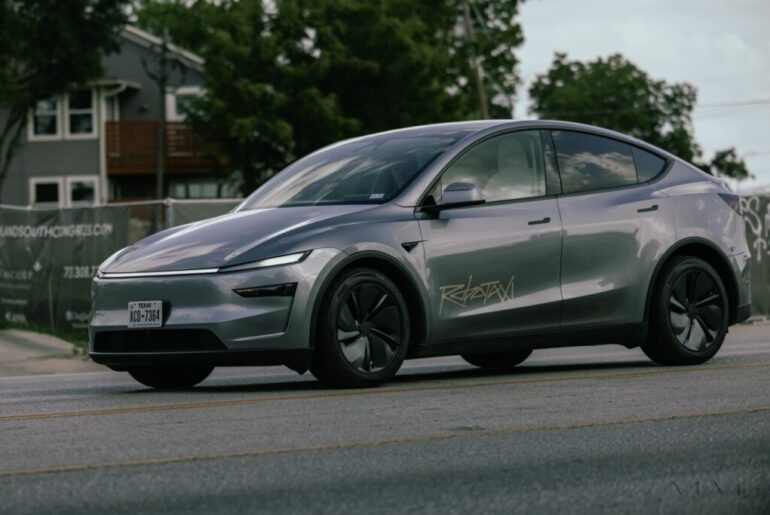
The ostensible point of robotaxis is that they’re supposed to be safer drivers than humans.
Tesla, apparently, didn’t get that memo.
According to updated filings from the National Highway Traffic Safety Administration examined by Electrek, the Elon Musk-owned automaker has reported another five crashes involving its capital-R “Robotaxis,” for a total of 14 documented collisions since the service began operating in Austin, Texas last June.
The newly reported crashes were submitted by Tesla last month and occurred between December 2025 and January 2026. They include a collision with a fixed object at 17 miles per hour, a crash with a bus while the Robotaxi was stationary, a crash with a truck at four miles per hour, and two incidents in which the Tesla backed into a pole or tree.
Because Tesla heavily censors its crash reports, it’s impossible to get a clear idea of what happened in any of these incidents. No amount of blank ink, however, can cover the fact that the Robotaxis are getting into accidents at a high rate — a rate, Electrek calculates, that’s not only worse than its competitors, but the fallible human drivers it’s supposed to outmode.
Based on the mileage data shared in Tesla’s Q4 2025 earnings, the EV blog estimates that the Robotaxi fleet accumulated roughly 800,000 miles by mid-January. Divide that by fourteen, and that works out to a crash once every 57,000 miles. Compare that to Tesla’s Vehicle Safety Report, which claims that the average American driver experiences a minor collision every 229,000 miles, and it means the Robotaxis are crashing at a rate four times higher than human motorists.
It looks even worse when you compare Tesla’s fleet to Waymo’s, a company that Musk constantly tries to pick fights with, insisting that his self-driving cars are superior. Across over 127 million fully driverless miles, Waymo averages an accident around every 98,000 miles.
Even this already sizable gap may slightly flatter Tesla. In reality, Waymo’s fleet comprises over 2,000 robotaxis, while Tesla has less than fifty. Waymo operates in several major US cities, while Tesla is limited to a small area of just one. And though it’s been vague about how much it relies on remote teleoperation, Waymo cars are considered fully driverless, meaning there’s no human driver or safety monitor inside the vehicle. Or for that matter, outside it: Tesla reportedly resorted to having a human-driven car tail its Robotaxis to fulfill a Musk boast that the service would start giving rides with no supervisor in the cabs.
In short, Waymo and Tesla aren’t in the same league.
The new crashes weren’t the only alarming takeaway in the updated NHTSA data. Tesla also quietly revised a report for a July 2025 crash that was originally described as causing “property damage only.” Now, a new version submitted in December said that the injury severity was “Minor W/Hospitalization.” It took Tesla nearly half a year to properly report that someone was hurt by one of its cars.
The delay isn’t an isolated incident. The NHTSA previously launched an investigation into Tesla for repeatedly failing to report crashes in time, sometimes several months after the accidents occurred. It also heavily censors its reports by redacting crucial details like crash narrative under the guise of protecting “confidential business information.” The practice is legal, but shady. As Electrek notes, it’s the only robotaxi company that systematically censors these details in all of its NHTSA filings.
More on Tesla: FSD Tries to Drive Straight Into Lake