
Jim’s Tech Talk
By Jim Langley
For many years now I have received the newsletters sent out by Lon Haldeman and his crew at PAC Tour. In case you haven’t heard of PAC Tour, they put on supported rides across the USA, and shorter ones in different areas of the country.
I attended their Desert Tours in Arizona, affectionately dubbed “Dessert Tour” for all the tasty treats Lon makes sure we find out on the road. And I also did the Wisconsin tour, where we covered some of the nicest car-free roads I’ve ever ridden. Here’s one of their photo galleries from last year’s Wisconsin tour to get an idea how much fun everybody has.
The thing that made these adventures so great for me was how carefully the routes were planned. There are lovely roads with plenty of sights to see, just the right amount of climbing and stops for refueling precisely when you need them and with full support too from the PAC Tour sag wagon, the best equipped I’ve ever experienced. If this sounds like your type of ride, you can learn more about their tours for 2026 and sign up at https://www.pactour.com/.
In their most recent newsletter, Lon Haldeman of PAC Tour and Fred Matheny, co-founder of RoadBikeRider.com did an extensive article for riders joining PAC Tour rides on e-bikes. Considering that two of their tours cross the USA, they’re quite a test for e-bikes. When I read the article, I learned a lot, so I requested and got Lon and Fred’s permission to share it with you today.
Considering an e-Bike for PAC Tour?
by Lon Haldeman & Fred Matheny
Lon’s Experience with e-Bikes
Within the next five years, the average age of a PAC Tour rider could be close to 70 years old. Many riders are considering using an e-bike (electric bicycle) on PAC Tour as a way to continue riding more miles each day. Last summer, I tested an e-bike on the Southern Transcontinental.
I think there is a place for e-bikes on PAC Tour if we can accommodate the battery range concerns. In a rough calculation, an e-bike offering 50% of watts of power of a rider’s body weight is about a 3 mph boost in speed. For example, if a 180-pound rider was getting 90 watts of power, that would increase their speed by 3 mph. That is a significant boost from 14 mph to 17 mph. The trade-off is that more speed needs more watts, which shortens battery life. A rider over 200 pounds is going to get a third less battery life or distance than a 150-pound rider.
During my testing last summer, it was fun to zoom up a hill on max power, but my battery life was cut in half. During a typical PAC Tour day, a battery range of 125 miles is needed. Add in some headwinds and steep climbs, and 25% more battery life is needed. For most 175-pound riders with an e-bike and a battery range of 50 miles per battery, they would need a frame battery plus two external batteries to make it through the day. After testing my bike on several hilly days, it seems like a 100-watt boost was a good compromise of speed and battery life.
The main disadvantage of e-bikes is the cost and battery range. There are some nice roadworthy e-bikes with aluminum frames available for under $5,000, which is comparable to many current elite standard regular road bikes. The Cervelo e-bike I rode last summer cost $6,500 with a carbon frame, cable shifting, and carbon wheels. It had a frame battery range of 70 miles for a 200-pound rider. A 150-pound rider would probably go 100 miles. It still rode well without battery power. The downside is that external batteries are not available. I hear Cervelo is working on making an external battery available soon.
TREK and Specialized have some nice e-bikes with external batteries. Each battery can cost several hundred dollars and should be included in the base price of the bike. For PAC Tour, shipping e-bikes and batteries to the start and finish is another logistical concern. The power settings on most e-bikes can be customized for low, medium and high power. Remember, less power means longer battery life and more miles per charge.
Here are a few e-bike etiquette rules that riders should also consider:
E-bikes are welcome on PAC Tour if riders can manage charging their batteries and carrying their bike to second-floor rooms without an elevator. Don’t expect special hotel treatment because you have an e-bike.
E-bike riders should carry enough batteries to make it through the day. A rack-pack is handy for carrying extra batteries. The extra weight is not noticeable on an E-bike. You could stash one battery in a sag van or at lunch, but the vehicle rotation could change. Vehicles are not responsible for servicing e-bikes beyond typical rest stop needs. Don’t expect the support vans to come back to pick you up if you run out of batteries.
E-bikes are a boost to a rider who no longer wants to ride a standard bike. An e-bike rider should not be the fastest rider off the front of the group.
E-bikes climb faster than standard bikes. E-bike riders should control their pace to stay behind the slower riders of the group on a climb.
E-bikes are great for pulling a pace line into a headwind. E-bike riders should do their share of work taking the lead. Don’t break up the group if other riders are struggling to keep up.
If e-bike riders can mix well with others on standard bikes, they are welcome on PAC Tour.
Fred Matheny’s Thoughts on Riding an E-Bike
Three years ago, when I turned 77, an e-bike wasn’t on my radar. I was happy riding my traditional steel Rivendell Roadeo outfitted with modern components on PAC Tours and Desert Camps. Then my cycling performance deteriorated quickly. I did the 2023 Tour of Wisconsin and couldn’t keep up with other riders.
My physician thought it was simply the aging process. But a blood test and bone marrow biopsy revealed myelodysplastic syndrome or MDS, a form of chronic leukemia, that caused anemia. Faulty oxygen-carrying red blood cells explained my poor endurance performance.
MDS is caused by a random mutation, not by riding too hard on PAC Tours! But I wanted to keep up on the local group ride and had hopes of doing another PAC Tour so suddenly an e-bike looked like a great option.
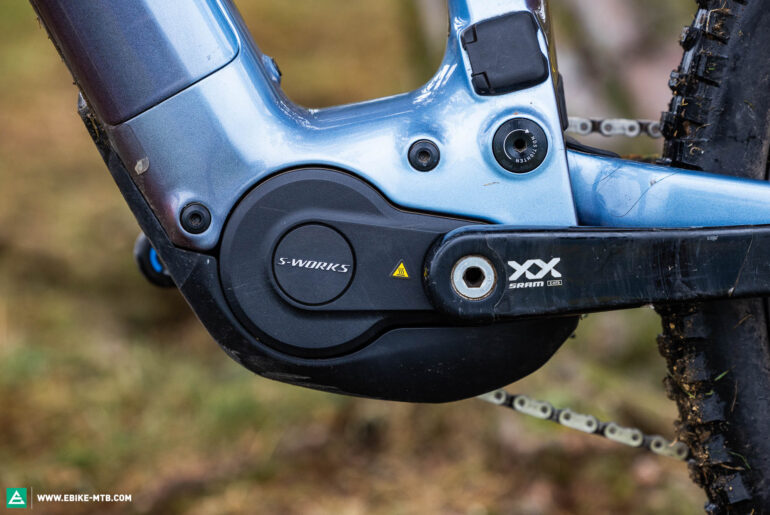
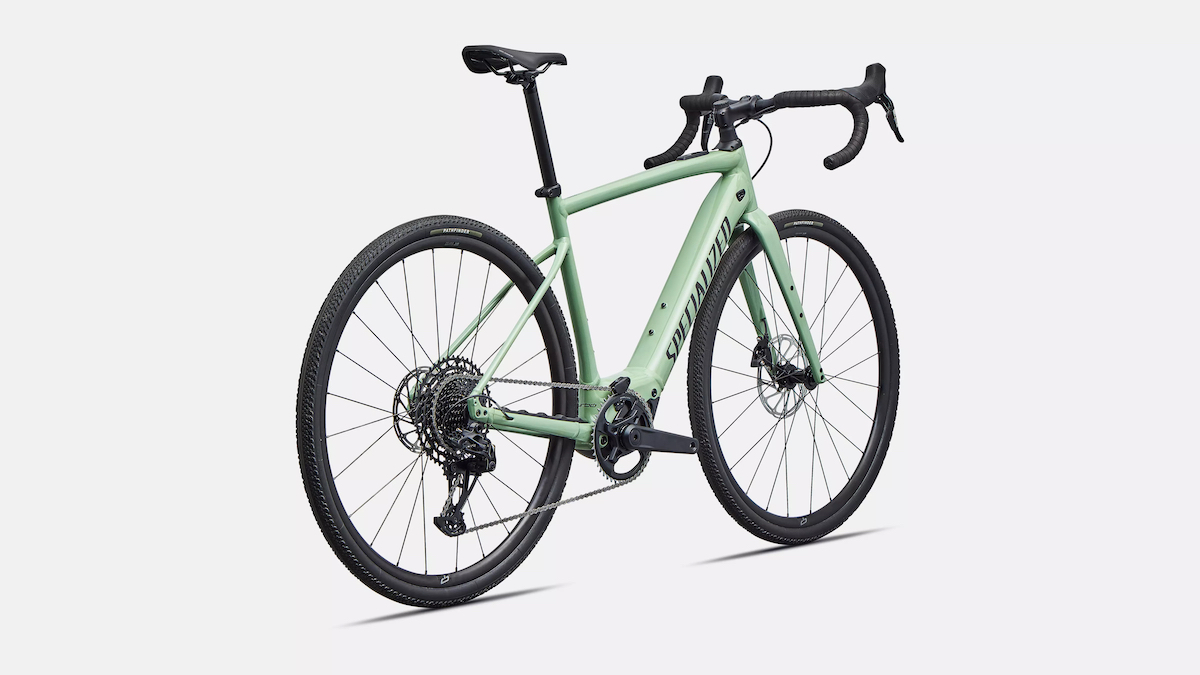
I chose a Specialized Creo (photo courtesy of Specialized). It’s billed as a gravel bike, but when I replaced the dropper seatpost with a standard post and mounted 32mm road tires, it worked admirably for fast road rides.
Here are some guidelines to consider if you want an e-bike for a PAC Tour.
—Get a Class-3 e-bike. These have a maximum assisted speed of 28 mph. And they require you to pedal to get the benefit. The Creo has 3 assist levels. In Eco, I get 35% more wattage than the power I’m generating myself. So if I’m pedaling at 100 watts, the bike gives me 35 additional watts. That’s enough to overcome the additional weight of the bike and produce a modest speed increase. The next assist level, Sport, increases the assist to 50% and Turbo boosts it to 100%. The drawback to the increased power assist is less range.
—Choose an e-bike that looks and feels as much like your standard bike as possible. Overly heavy and clunky e-bikes are no fun to ride. Bike fit is important too. It’s often difficult to change handlebar height and reach on e-bikes because they usually come with proprietary stems and bars, often with the cables internally routed. If the bike doesn’t fit initially, you’ll have a tough time adjusting it.
—Learn how much range your battery provides in different situations before doing a PAC Tour. Higher assist levels, headwinds, and hills all drain the battery faster. Experiment so you can estimate how many additional batteries you’ll need for the longest and hardest PAC Tour day. Headwinds are especially deceptive. Even a modest headwind drains the battery faster than you’d think. If you ride into headwinds before a tour, you’ll quickly get a feel for how much your range is lessened.
—Choose an e-bike that makes it easy to change batteries. The Creo has an optional Range Extender, an additional battery that fits in the seat tube water bottle cage and boosts range by about 35%. Extra ones are easy to stash in the support vans and exchange for enough power to get to the hotel. Other brands might make it harder to switch batteries. With the Creo’s standard charge, I can comfortably ride 65 miles on moderate terrain in the Eco and Sport settings and still have some charge left. With the Range Extender I am good for about 80 miles. Check the daily PAC Tour mileage and plan accordingly.
—Mesh seamlessly with other riders on regular bikes. If you’re in a paceline, don’t raise the pace by 3 mph when you’re on the front. Ride like you are on a standard bike. Practice on local group rides so you are a good paceline citizen. Save zipping along in the highest power output for when you’re riding solo—and have plenty of battery charge left.
—Finally, don’t apologize for riding an e-bike. Although I miss the agility and lively feeling of my Rivendell, I am happy to be still out there pedaling. And you don’t have to have a debilitating condition to justify an e-bike’s assist. They’re great for flattening the hills, allowing you to ride fast enough to arrive at the next hotel in a reasonable time and getting maximum enjoyment out of the day’s ride.
I’m grateful that e-bikes were developed just at the time in my life when I needed one. I’m not cheating by riding an e-bike; I’m compensating. The goal is to stay on the bike, enjoy daily rides, and be capable of riding a PAC Tour or Desert Camp. E-bikes are a great innovation for that end.
Jim Langley is RBR’s Technical Editor. A pro mechanic & cycling writer for more than 40 years, he’s the author of Your Home Bicycle Workshop in the RBR eBookstore. Tune in to Jim’s popular YouTube channel for wheel building & bike repair how-to’s. Jim’s also known for his cycling streak that ended in February 2022 with a total of 10,269 consecutive daily rides (28 years, 1 month and 11 days of never missing a ride). Click to read Jim’s full bio.