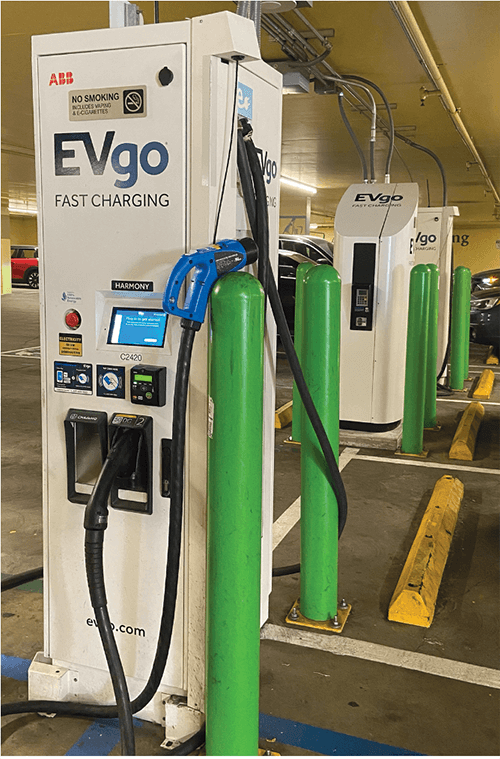
 EVgo electric vehicle charging stations located in the parking lot of Whole Foods Market at Rhode Island and 17th streets. Photo: Potrero View Staff
There are about 30,000 plug-in electric vehicles (EVs) registered in San Francisco, roughly seven percent of the automobile population. The switch from gasoline- to electricity-powered cars has increased demand for EV chargers. Meanwhile, statewide gasoline sales are roughly 15 percent lower than a 2004 peak, with transactions in the City likely declining even more.
There are about 1,481 publicly accessible Level 2 electric chargers – which can take four to 10 hours to charge an EV – in San Francisco and 249 fast direct current (DC) chargers, according to California Energy Commission data. In addition to public chargers there are nearly 2,000 shared Level 2 mounts that’re available to multiple vehicles, such as those located in apartment complexes.
San Francisco’s EV charging infrastructure has been buoyed by a cascade of state and local legislation and funds. The City’s Green Building Code requires five to 20 percent of spaces at parking facilities to offer EV charging. Tesla has four superchargers in San Francisco, including one at Potrero Center that was installed in 2023.
Last summer a set of six fast EVgo DC chargers were connected at Bayview Plaza. A smattering of reviews on PlugShare, which aggregates EV charger information and locations, indicates generally positive experiences at the facility, with some appraisers highlighting the convenience of being able to visit a nearby Starbucks or Panda Express while their car gets charged.
According to Henna Trewn and Joseph Piasecki, who work with the San Francisco Department of the Environment, the City wants to expand EV charger access by incentivizing and facilitating private entities to build and operate chargers to meet rising demand. However, a $15 million U.S. Department of Transportation grant to build another 270 Level 2 and 30 fast DC charging stations was suspended by the Trump Administration.
With diminished petrol demand and amongst the most expensive real estate in the country, gas stations have been steadily replaced by condominiums, apartment complexes, and mixed-use developments. Fifteen years ago, there were more than 100 gas stations in the City; today there are less than 90, which may collectively offer somewhat more than 1,000 pumps.
The Shell gas station at 16th and Guerrero streets caught fire during construction activity late last year and remains closed. Around half the pumps at the Speedway station at Cesar Chavez and South Van Ness are non-functional. The Alianza station at the triangular section bordered by Cesar Chavez and Bryant streets and Precita Avenue was recently demolished. As Bernal Heights neighbourhood social media posts noted, in a previous incarnation as a Phillips 66 station, it appeared in a car chase scene from the 1968 movie, Bullitt.
Mississippi Street resident Tejas Rao, observed that gas stations periodically change hands, including the Cesar Chavez Shell station that was replaced by National Petroleum. Utah street resident Caleb Boyd mentioned that the Gas and Shop at 17th and South Van Ness consistently offers the lowest priced petrol in the area.
While the number of EV chargers has grown, EV owner Zunaira Malik noted that many fast chargers are only accessible within paid parking lots, with compatibility issues between hardware and payment methods at different networks’ chargers. In her experience roughly a quarter of chargers don’t function properly.
“I do think coverage has gotten better in last few years and the chargers are being better maintained so they’re less frequently broken; however, it’s still not sufficient,” she said.
Post navigation