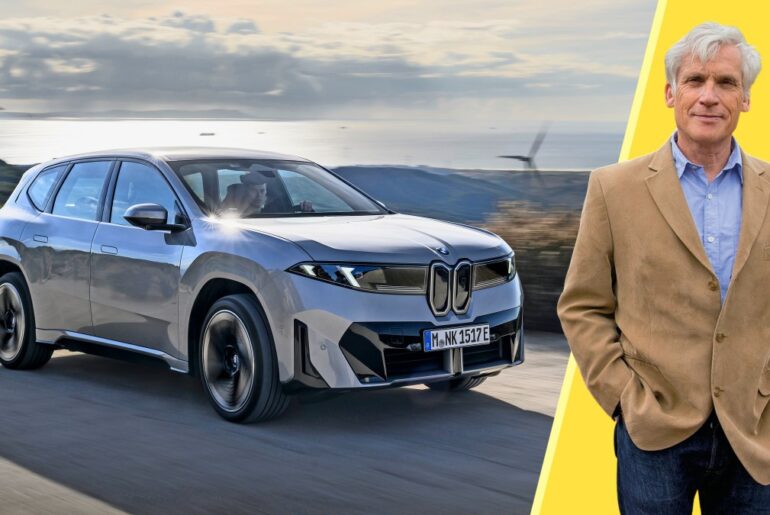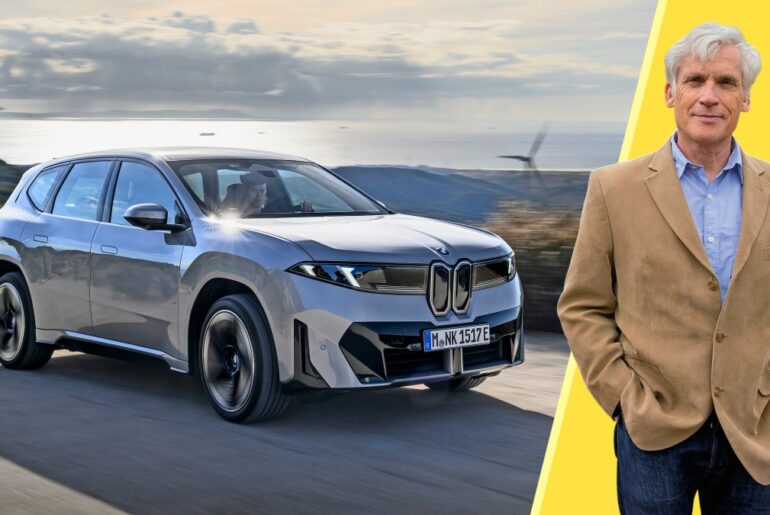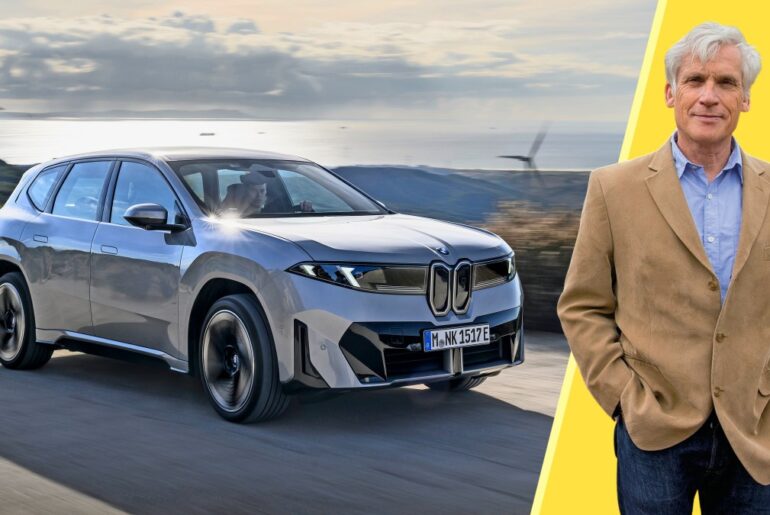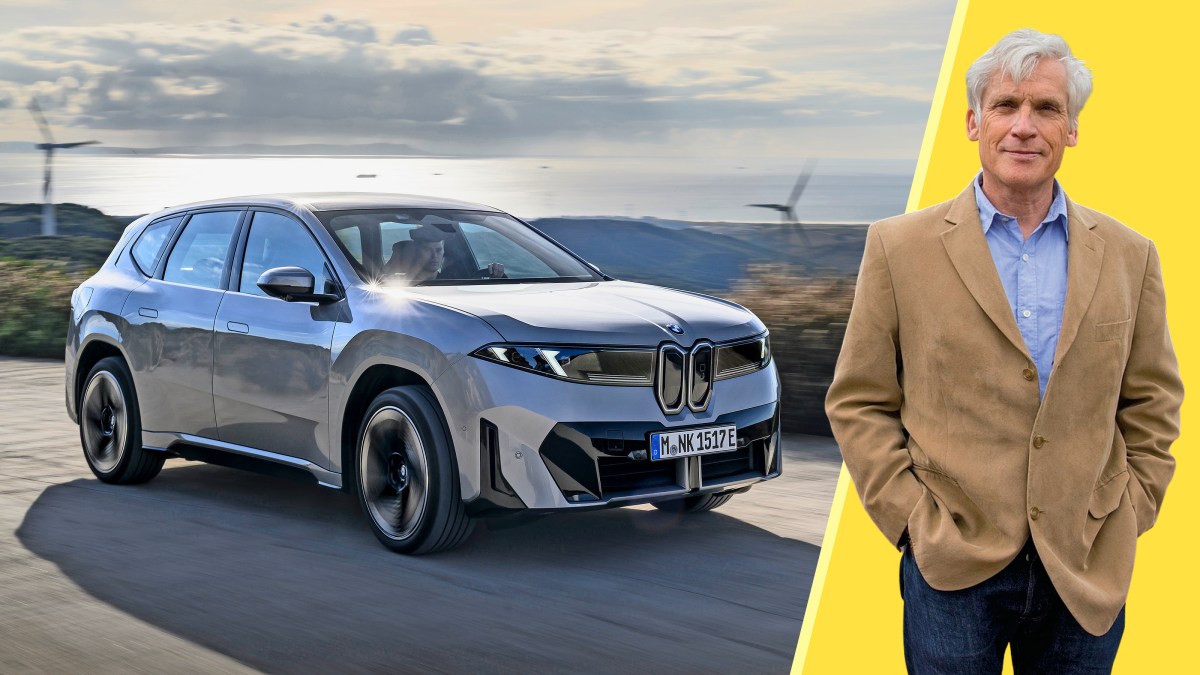
I am bowling along on a Bavarian autobahn on a crisp morning in an electric BMW — one that will boost sales of electric vehicles (EVs) by overcoming range anxiety, or so the manufacturer says. It’s a bold claim, not least because sales of EVs have recently flatlined. Recent data suggests about half of UK buyers who were considering an EV are now thinking again.
The BMW I’m driving is called an SAV, or sports activity vehicle, a name adopted by BMW to shake off the negative connotations of big SUVs. More significantly, it will be the first mass-production car to officially claim a 500-mile range when it arrives in UK showrooms next month. (The Lucid Air Grand Touring has a stated range of 512 miles but is sold primarily in the US, not the UK.) It is capable of travelling as far between charge-ups as similar-sized petrol counterparts can between fill-ups — or that’s the boast.
Achieving “range parity” with traditional cars is a holy grail manufacturers have been chasing for a while. There’s an element of hope over adversity here. First, the real-world range of EVs is generally less than the official figures. Indeed, the iX3’s range in more stringent American EPA tests is about 400 miles. Second, it’s the convenience — or rather the inconvenience — of charging that’s holding many customers back. About a third to half of all buyers, depending on which survey you look at, say there is little incentive to switch.
That said, the iX3 is impressive. Its extra range is thanks to improved electrical technology, which BMW says enables it to store 20 per cent more energy. The battery cells are integrated into the car’s structure, in contrast to traditional slab batteries that are slung between the front and rear axles. As a result the iX3 feels more spacious.
• Tesla Model Y Standard review: ‘The best cheapo EV out there’
The new iX3 looks good too. BMW bosses have ditched the cartoonishly inflated grilles on recent models and returned to a slimmed down double-kidney grille. It is also bristling with driver-assist systems that enable it to drive itself on autobahns at speeds of up to 80mph with minimal driver intervention. Like many other cars, the active cruise control accelerates and brakes to keep me a safe distance from the car in front, but it doesn’t cancel when I press a pedal. Instead it allows me to intervene, then picks up where it left off.
Unfortunately a neat feature on my German iX3 called Motorway Assistant, which offers me the option to change lanes simply by glancing in a side mirror, is switched off on the first UK models. BMW says that regulatory approval is “expected imminently”.
Inside the cabin there’s an instrument display projected on to a 1.1m wide, 5cm high strip of blacked-out glass that runs along the bottom of the windscreen. Climb in — the car senses the key and turns itself on — and it lights up with useful info you can read without your eyes straying from the road — speed, navigation arrows, battery level and so on. There’s also a big central tablet that controls functions relating to comfort, entertainment and navigation. Finally, a voice-recognition system responds to commands to, for example, navigate to a destination. It all seems to work well but the new iX3 is still a long way from the self-driving car that BMW said back in 2016 would be commonplace by now.
• Ferrari Amalfi review — entry into the supercar club starts here

Other criticisms? Well, it’s heavy — 2.36 tonnes, versus 1.92 tonnes for the long-range Tesla Model Y, which can do 387 miles between charges. Cynics will say that the iX3’s 500-mile range has been achieved at least in part by the blunt solution of making the battery bigger.
Nonetheless, BMW has enough faith in the iX3 to declare it the first in a whole new line of electric vehicles called Neue Klasse (New Class), which in the next few years will comprise about 40 models — all with advanced battery technology and driver-assist systems. Will cars like this be enough to revitalise Europe’s electric car market?
I’m pondering this as I turn off the autobahn and follow the road through snowy hills and Bavarian villages. Here, amid the solidly built wood and brick houses, every other car is a Beemer, including beautiful old classics from the 1960s and 70s. If BMW is to usher customers into the electric age it needs to win over its heartland. Many locals are old enough to fondly remember the first in BMW’s original Neue Klasse series from 1962. In those days it was a genuine wonder: a family-sized compact saloon with a 1.5-litre engine and independent suspension. Sales took off, rescuing the company from the near-bankruptcy of the 1950s.
• Jeep Compass review — Schwarzenegger in a onesie is ready for the shops
European carmakers need a similar-sized breakthrough to combat the threat from the three global giants: China, Korea and Tesla. Whether cars such as the iX3 deliver this may come down to price. At £58,755 to £62,755, the iX3 will be out of reach for many. BMW says prices will fall as soon as Neue Klasse models begin rolling out en masse. Could electric Beemers with a 500-mile range soon be as cheap as fritten? If so, it’s great news for EV buyers.