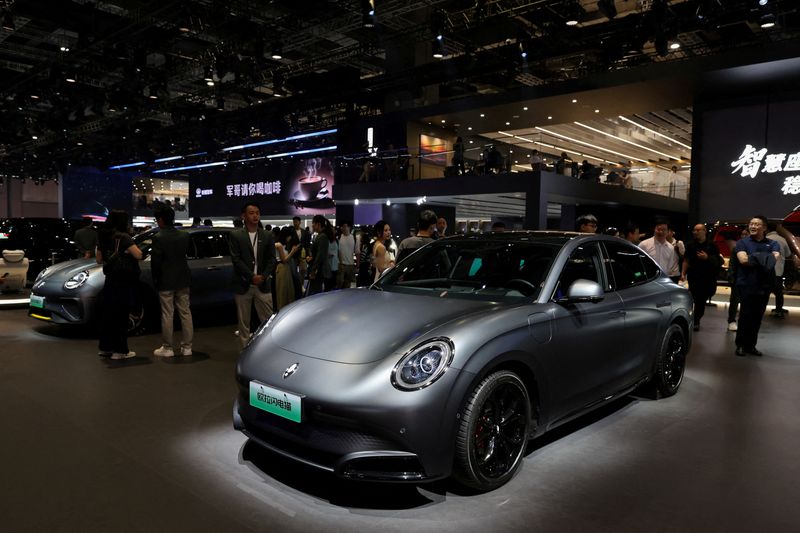
Feb 13 (Reuters) – Global EV registrations fell 3% in January as the introduction of a purchase tax and lower EV subsidies in China and policy changes in the U.S. hindered sales, data by consultancy Benchmark Mineral Intelligence (BMI) showed on Friday.
WHY IT’S IMPORTANT
Global carmakers with large exposure to the U.S. market have booked some $55 billion in writedowns in the past year as they scale back electric vehicle ambitions on a tough U.S. market under President Donald Trump, price wars in China and a more complex mix of vehicle types in Europe.
The European Union and China, the world’s largest EV market, also relaxed regulations aimed at supporting electrification.
BY THE NUMBERS
Global EV registrations, a proxy for sales, fell by 3% year-on-year to almost 1.2 million units in January, according to the data, which includes battery-electric and plug-in hybrid cars.
They were down by 20% in China to less than 600,000, the lowest in almost two years, and 33% in North America to just over 85,000 vehicles sold. The U.S. sold in the month the fewest EVs since early 2022.
Sales in Europe grew by 24% in the month, the slowest rate since last February, to over 320,000 registrations.
They were up by 92% in the rest of the world to just under 190,000, their highest on record, sustained by incentives in Thailand and strong growth in South Korea and Brazil.
QUOTES
“We’ve seen a growing number of exports reported from China for the EV market”, BMI data manager Charles Lester said. “We’re expecting that to continue, trying to have a strong year of EV exports over 2026, targeting many different regions, including the likes of Southeast Asia, which is where we’ve seen a lot of growth over the past few months.”
CONTEXT
Electrification proponents emphasise the need to curb planet-warming CO2 emissions, but carmakers say a quick transition threatens jobs and profit.
As a result hybrid cars, seen as a compromise between battery-electric and combustion engine engines, have become more popular among buyers. Some experts however argue that the emergence of “mild hybrid” cars, which mostly use traditional fuels, only modestly contribute to lowering emissions.
(Reporting by Alessandro Parodi in Gdansk, Editing by Matt Scuffham)