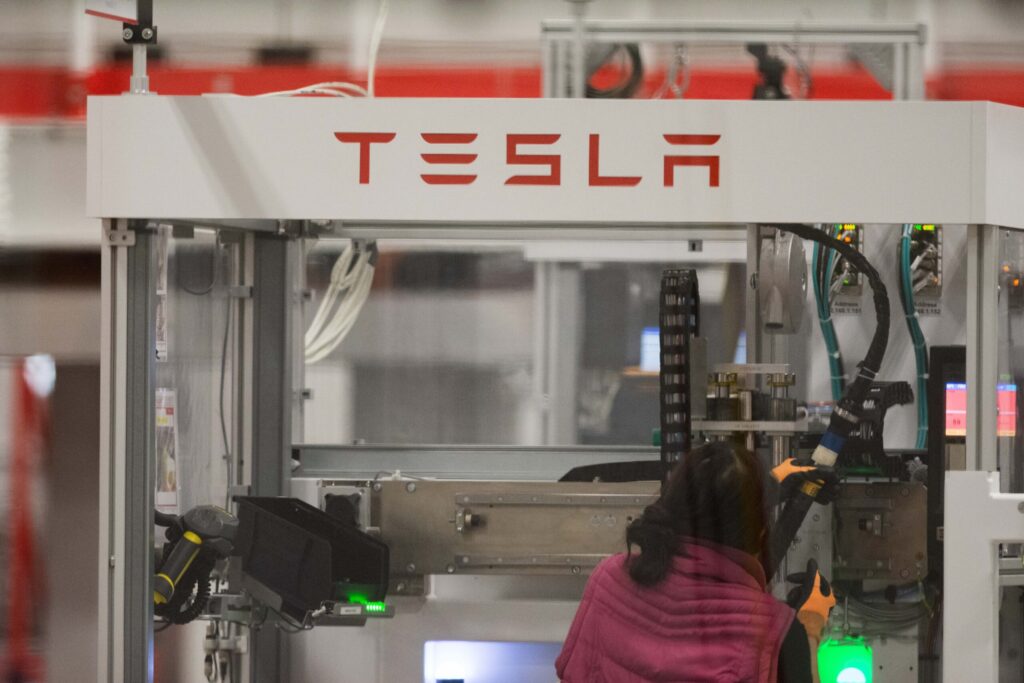
Tesla will pay Nevada $200,000 for operating battery recycling equipment at its Northern Nevada Tesla Gigafactory without a permit, according to a settlement signed by the company and the Nevada Division of Environmental Protection (NDEP) and obtained by The Nevada Independent through a public records request.
Tesla produces electric vehicle motors and battery packs at its facility in the Tahoe-Reno Industrial Center — a hub of data centers, warehouses and battery producing and recycling facilities. Tesla’s facility also includes battery cell recycling.
In February 2023, NDEP compliance staff visited the Tesla Gigafactory and discovered a “cell recycling” line, including a shredding unit and a module dissection unit — equipment used to recover valuable materials such as lithium and copper from end-of-life products such as batteries or solar panels — operating without a permit.
Records later provided to division inspectors indicated the equipment had been built in late 2020 and operating since at least May 2021.
The equipment was the subject of a draft permit being reviewed by the Environmental Protection Agency because it emits pollutants, according to a report filed by NDEP.
More than a year after the violation, NDEP held an enforcement conference with Tesla. Tesla did not deny the violation.
The settlement was signed Jan. 30, just days before state lawmakers grilled officials about the state’s potential oversight of environmental violations, including water contamination, at Southern Nevada tunnelling sites being developed by The Boring Co., another company run by Elon Musk, the world’s richest person. The Boring Co. is an expanding underground transportation tunnel network that has been accused of nearly 800 environmental regulation violations, as first reported by ProPublica.
Tesla must pay the $200,000 within 60 days. The company didn’t immediately return a request for comment on Thursday.
The money will be deposited into NDEP’s air quality management account and may be used at NDEP’s discretion to support the division’s Clean Trucks and Buses Incentive Program or other programs geared toward air quality improvement.
The money is not to be used for any grant or incentive that Tesla could receive.
Despite the violation, NDEP in October granted the Gigafactory a Class I Air Quality Operating Permit, reserved for facilities with the highest emissions. The permit allows the Gigafactory to emit more than 100 tons of a regulated pollutant and more than 25 tons of hazardous air pollutants per year. The updated permit was issued because of the company’s growth and potential to emit more pollutants.
The facility previously operated under a Class II Air Quality Operating Permit, issued in 2019. That permit allowed the facility to emit less than 100 tons of any one regulated pollutant annually and less than 25 tons of hazardous air pollutants.
History of violations
In 2022, Tesla reached a $275,000 settlement with the Environmental Protection Agency (EPA) for violating the federal Clean Air Act at its car manufacturing facility in Fremont, California.
In 2019, the EPA fined the company $31,000 for hazardous waste violations at its Fremont plant, according to Lookout Santa Cruz. The company was also ordered to pay $55,000 to the Fremont Fire Department. In 2021, Tesla was fined $1 million by the Bay Area Air Quality Management District after 33 violation notices, including emissions that exceeded permitted thresholds.
Last year, Tesla successfully fended off proposed environmental regulations in Nevada that would have applied more stringent rules on its battery production operations by petitioning NDEP and Republican Gov. Joe Lombardo. The proposals would have required companies such as Tesla to obtain more onerous permits for certain operations while also requiring them to continue following more stringent federal waste regulations.
Also last year, Musk’s Boring Co. was accused of releasing untreated water onto city streets and spilling muck from its trucks, according to ProPublica.
Some of those violations went against a settlement agreement the company had entered into after being fined previously for discharging groundwater into storm drains without a permit, violating state water pollution laws.
State officials issued $400,000 in fines, then withdrew them after finding the citations “legally insufficient.”
The Boring Co. also faced a $500,000 illegal dumping fine from the Clark County Water Reclamation District.
![Tesla’s New Automations Feature in Action [VIDEO]](https://www.evshift.com/wp-content/uploads/2026/02/1770927456_automations-2-770x515.jpg "Tesla’s New Automations Feature in Action [VIDEO]")