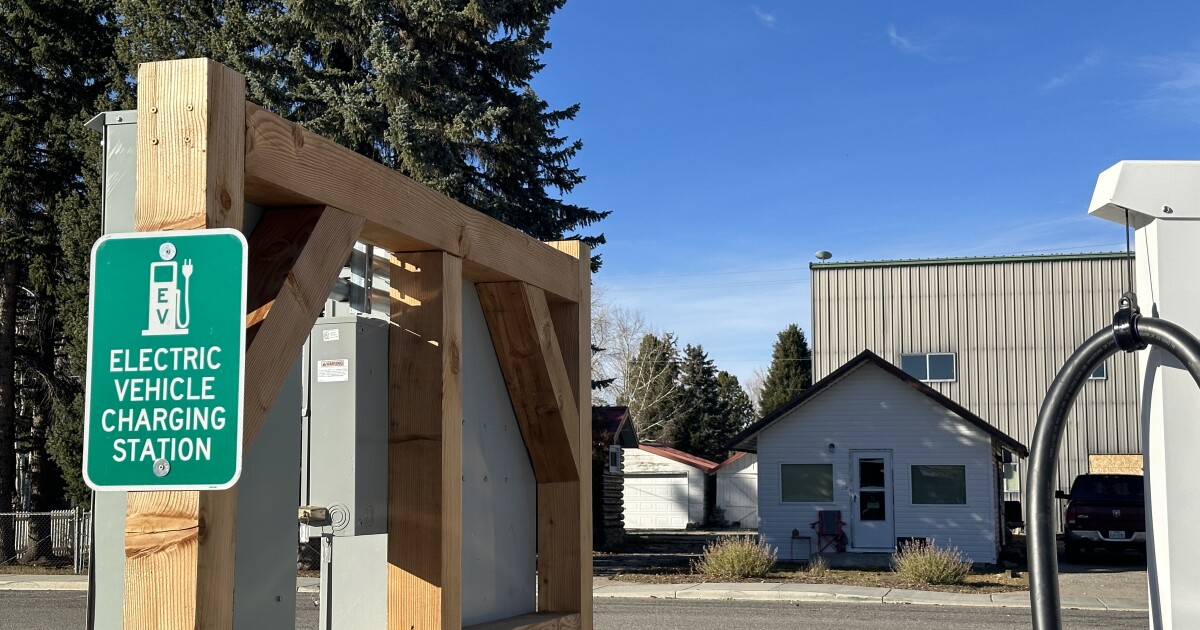
Some electric vehicle charging stations are shutting down across the state, citing a newly enforced state sales tax that’s creating logistical hurdles. A bill with a remedy is working its way through the Legislature.
In October, the Wyoming Department of Transportation (WYDOT) started enforcing a 2015 state alternative fuel tax on EV chargers. It amounts to 24 cents a gallon and is calculated for electricity using the gasoline gallon equivalent. There’s also a $25 annual license fee per location. It requires owners of public-facing level 2 and 3 charging stations to pay the fees and report to WYDOT monthly.
This new enforcement is hitting free public EV chargers, like in Rock Springs. According to a city notice, the city is discontinuing its charger, partly because the city would be required to pay a tax on electricity it provides for free to the public. Rock Springs said it also doesn’t have a way to track how much the charger is used.
“Because our charging unit does not have the capability to track or quantify the amount of electricity given away per vehicle, we have no mechanism to calculate or remit such a tax,” wrote Matt McBurnett, Rock Springs director of administrative services, in the memo. “As a result, we will be removing the EV charging station.”
This spurred HB 145, Removing triple taxation for resident EV drivers, sponsored by Rep. Mike Yin (D-Jackson).
“What’s happening is that the tax that’s being charged is like three cents a month, and it’s costing these EV charging stations more to even put in a meter [to] measure how much tax they have to pay and then mail it in every single month, from the tax that’s being collected for every one of those stations,” said Yin to his colleagues on the House floor Feb. 11.
He called it a “triple tax” because in addition to the new tax, in-state electric vehicle owners pay an annual $200 decal fee and those using a charging station pay a sales tax.
“We’re taxing EV owners that are residents in Wyoming three different times,” Yin said. “What we’re not doing is doing a good job of charging the people that drive through the state that use our roads the most, and that’s where most of the EVs are. They’re not from the residents.”
Yin’s bill would only charge level 3 fast chargers, which he said are primarily what people just passing through Wyoming use. Additionally, Wyoming residents who use the level 3 chargers would get a refund on the fuel tax they pay.
Level 2 chargers would be exempt from the tax. They are slower and take about four to 10 hours to charge an EV. These types of chargers, when public facing, are considered a way to incentivize local commerce.
“Like a hotel trying to get people to just stay the night and they can charge their EV there, or a local government wanting people to come to their downtown,” said Jonathan Williams with the Wyoming Outdoor Council. “Or a car dealership looking to sell vehicles and also power their own fleet, and other businesses and nonprofits that see value added by having tourism dollars come into their community.”
The bill’s co-sponsor, Rep. Ocean Andrew (R-Laramie), voiced his support as an EV driver. He said he’s personally finding fewer chargers, like when he was traveling to Casper for a legislative interim committee meeting.
“I booked the hotel that I usually stay at that has the EV chargers, and there were signs on all of them that said they had been removed by the management because Wyoming had started taxing their chargers,” Andrew said. “And this is starting to happen all over Wyoming. It’s becoming more difficult to travel with an electric vehicle.”
The House passed the bill on introduction with only one “nay” from Rep. John Winter (R-Thermopolis). It now heads to the House Transportation, Highways & Military Affairs Committee for further debate and public comment.