Interior Quality
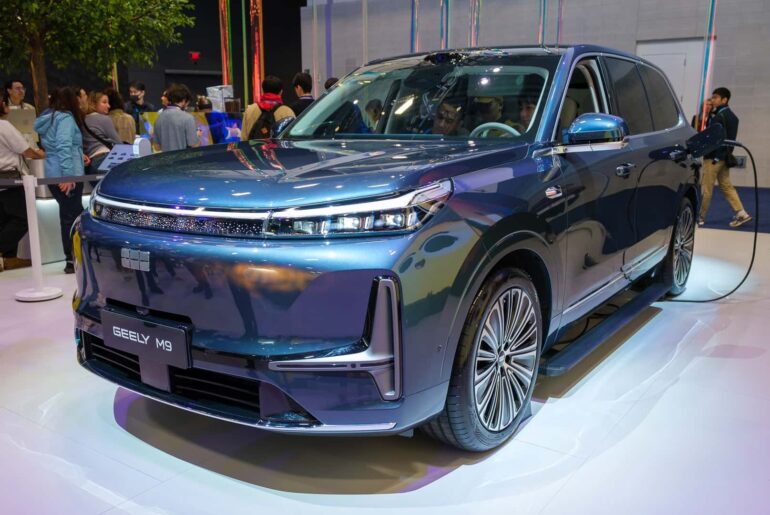
Inside, the Starray EM-i feels well-built, spacious, and airy, thanks in no small part to the panoramic sunroof, fitted as standard from the Max (which we’re testing) up. The soft, vegan leather-clad seats also provide plenty of room to the glass above, while storage space is impressive for a car with both petrol and electric hardware aboard. There’s space under the centre console in particular to shame petrol-powered rivals. There’s also a decent-sized storage box under the central armrest, while the glovebox and door bins aren’t short of volume either. That means items like small handbags and wallets can easily be hidden away.
In the back, there is ample room for your head, knees, and feet, with the latter rarely available in electrified cars due to batteries often located in the floor. But the Geely’s flat floor means even middle seat passengers have plenty of foot space. The boot also impresses with 428 litres when the rear seats are up, ranking it close to but not ahead of its key rivals, but the Geely offers 100 litres of extra lower boot storage, which is found under the two-stage floor, to stay competitive. For maximum space, you can remove the boot floor entirely and fold down the 60:40 split rear seats for 2,065 litres of space. But you’d need to leave the floor in its highest position to create a flat loading bay.
Still, that’s impressive stuff given that the Ultra model comes as standard with the bigger of two available batteries, a 29.8kWh pack, and yet it offers the same interior space as the 18.4kWh in the lesser setups.
Available Range
Both of the latter, by the way, are claimed to deliver 51 miles in electric mode and 585 miles of total range, while the Ultra promises the headline figure of 84 miles in EV mode and 618 miles of total range. The bigger-capacity Ultra can also charge its battery from 30-80% in 16 minutes on a 50kW plug, which is around 4 minutes quicker than the other variants, according to Geely.
That said, most plug-in hybrid buyers tend to charge overnight and then let the car use its battery range throughout the day to reduce fuel consumption, so for our test, we leave the car in its standard setting, where it automatically juggles engine and electric power. In this mode, the EM-i drives in purely electric mode by default, only calling on the petrol engine under heavy accelerator input. Even then, the delivery of its 262hp remains electric-like. It’s immediate and linear, but never particularly quick, although on a greasy surface, any sudden request for off-the-line performance results in the front’s eco-focused tyres initially scrabbling away. The car also has no problem powering up to fast lane motorway speeds.