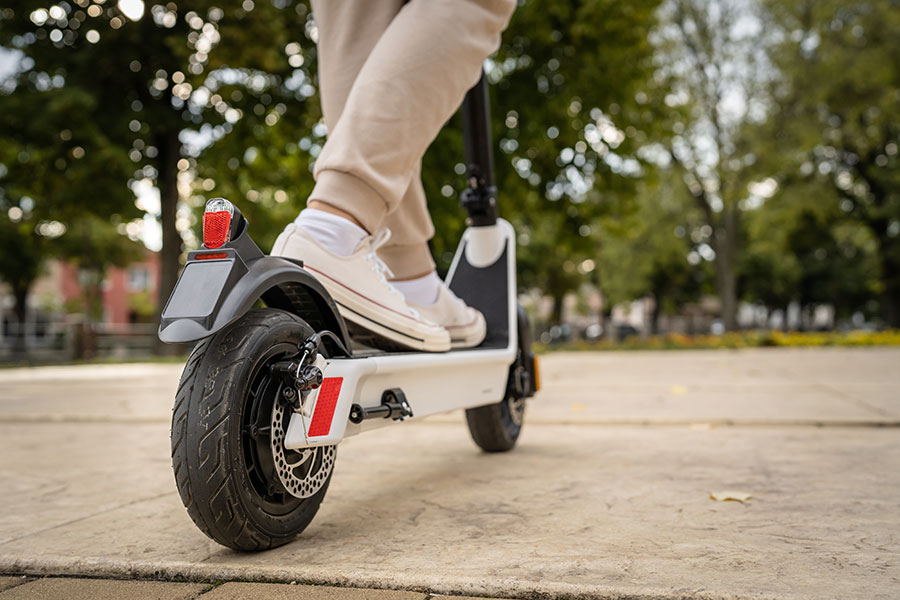
Helmets will become a requirement for anyone under 18 riding an electric-powered scooter, bicycle or other device in Leawood, the city council has decided.
The Leawood City Council last week approved the new rule, which will go into effect after its legal publication.
Although the vote was 5-3, every councilmember went on record backing helmets for juvenile riders. The disagreement was over whether the helmet rule should also apply to non-electric bikes, scooters, skateboards or other wheeled devices.
The new rule does not specify the type of helmet, but says it must be designed to prevent injury and be properly fitted and secured to the head. It applies to passengers as well as operators, riding on streets, sidewalks, trails and public rights-of-way within the city.
Police can issue warnings or tickets, which carry a $25 fine.
Leawood police asked for the ordinance last September so they would have a lawful reason to stop minors they see riding without a helmet, said Chief Brad Robbins. Without it, police have no legal rationale to stop and engage with youth in what is considered unsafe behavior, he said.
Robbins told the city council that officers are most interested in educational outreach that comes from stopping and talking with the riders, and they will focus on giving warnings in the early days after it goes into effect.
“It’s not our intention to start writing tickets from day one,” he said.
All warnings come with a paper receipt and would likely be followed up with a phone call to parents, he said. Children younger than 10 can’t be ticketed, according to state law, he added.
Councilmembers were offered a choice between an ordinance that only affected electric-assisted vehicles and a broader one applying to all bikes and scooters.
Young cyclists don’t have to wear helmets yet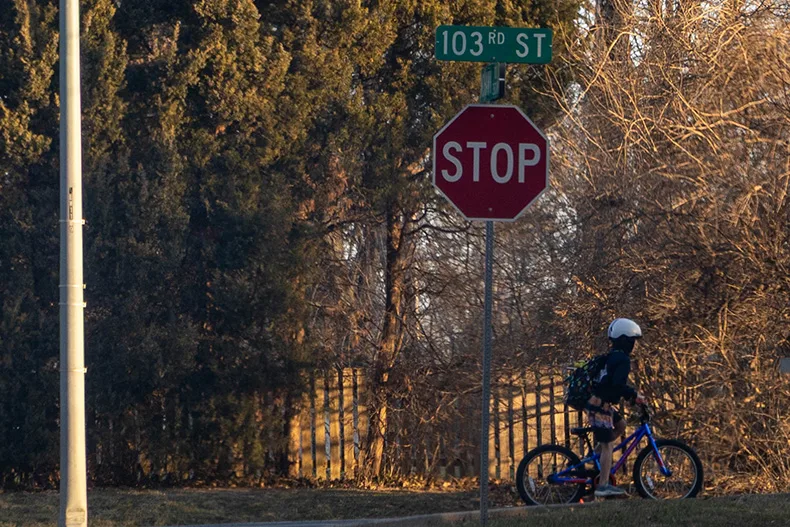 A cyclist wearing a helmt along 103rd Street on Wednesday morning. Photo credit Kylie Graham.
Councilmembers Matt Peppes, Rachel Rubin and Alan Sunkel came down in favor of the broader ordinance, saying it would be a consistent way of making helmets a habit among young riders.
Rubin said she informally polled some constituents, and most wanted the ordinance to apply to all types of vehicles, electric or otherwise.
She also cited the American Academy of Pediatrics, which recommends that children wear helmets on any kind of device with wheels.
“The reason is because it prevents head injuries, brain injuries and traumatic brain injuries,” she said.
She added that an ordinance would have been a good backup argument when her son was a teenager.
But the majority of the council said during discussion that making the rule apply to non-electric devices ran the risk of overstepping parental authority and may cause resistance.
Non-electric bikes and scooters don’t pose the same danger as electric ones because they generally don’t reach the same speeds. The class of e-bikes legal for minors in Kansas can go up to 20 mph.
What are rules like in other JoCo cities?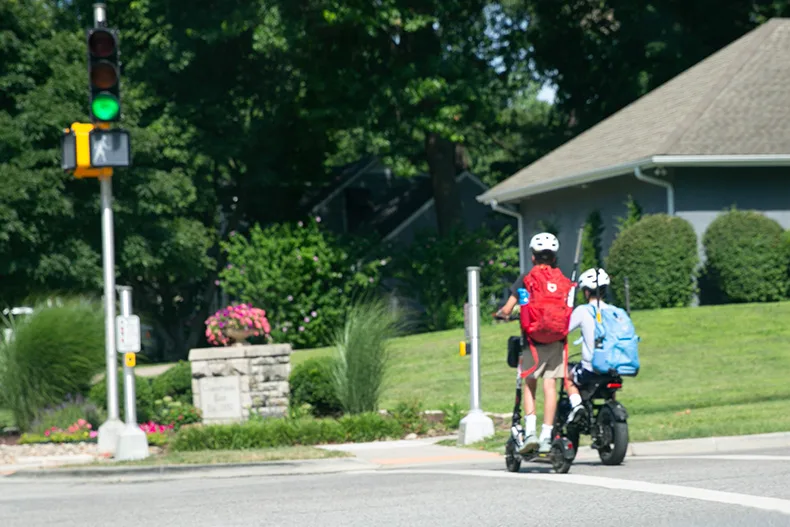 Two boys ride an e-scooter or an e-bike at 67th Street and Roe Avenue in July 2025 in Prairie Village. Photo credit Juliana Garcia.
Councilmember Mary Larson said the broader ordinane also could put Leawood out of step with surrounding communities.
Prairie Village, Fairway and Shawnee have new ordinances for electric bikes and scooters. Lenexa, Merriam, Overland Park and Kansas City, Missouri, do not have helmet ordinances, according to a document provided by the police department.
“I just want to be careful that we don’t overstep our authority and go too far with the ordinance,” Larson said. “Overregulation can sometimes be counterproductive to the behavior you were trying to encourage.”
Councilmember Julie Cain agreed.
“Sometimes, inadvertently, you shoot yourself in the foot by going too far too fast,” she said.
Councilmembers Cain, Larson, Lisa Harrison, Sherrie Gayed and Steven Kaster voted for the narrower ordinance, which specified helmets only for electric vehicles, with Peppes, Rubin and Sunkel voting against.
10-year-old riding e-scooter killed last year
Pedestrian safety has been much on the minds of the Leawood City Council since a fatal accident in which Duke Ommert, 10, was struck by a car in October. He was wearing a helmet at the time.
Parents had already been demanding better bike and pedestrian infrastructure, and the accident has prompted greater urgency, with two advisory committees focusing on the issue.
The city council also took action on three other items related to pedestrian safety at its Feb. 2 meeting.
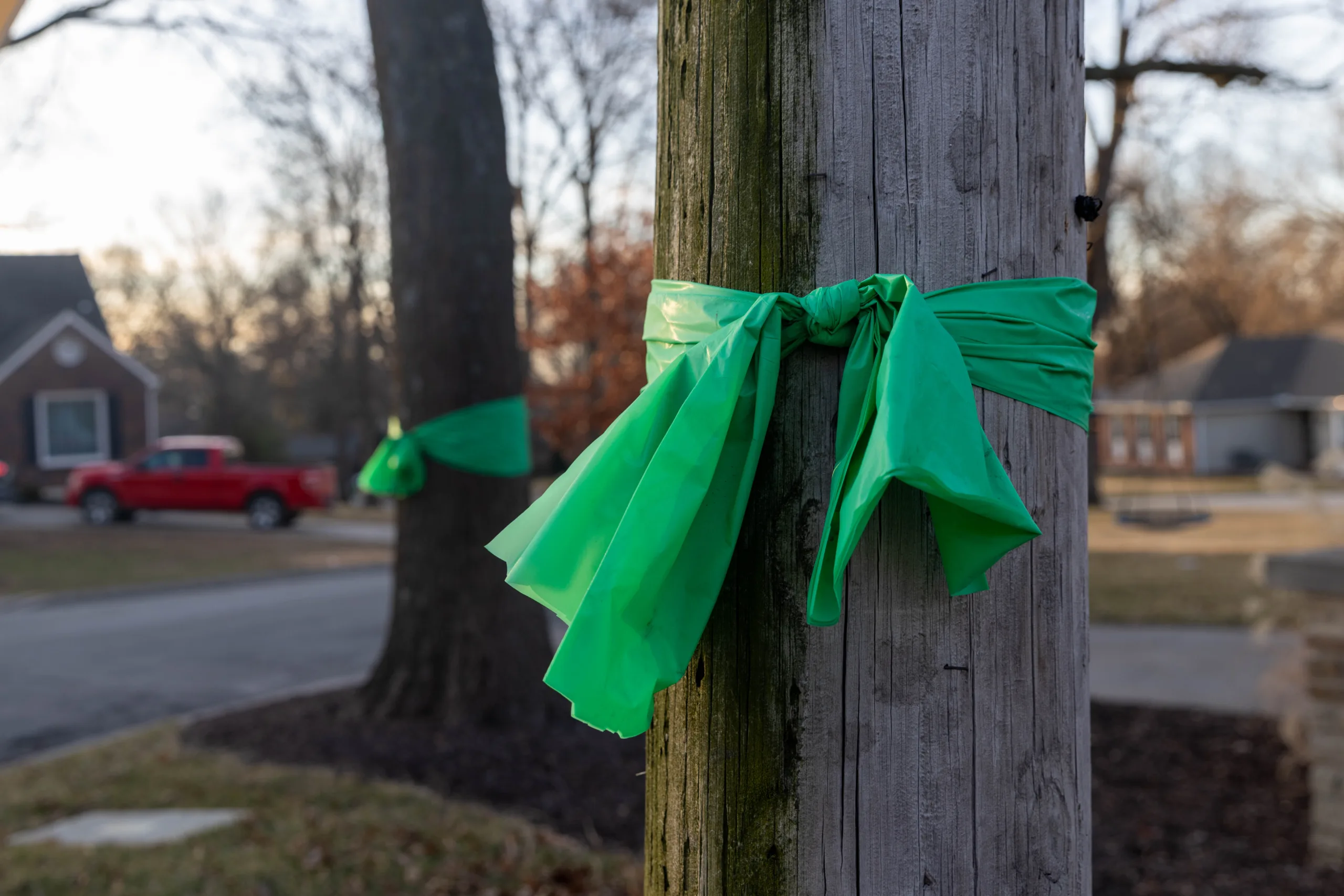 Green ribbons tied around a tre and light pole near Brookwood Elementary School in Leawood. The green ribbons are in memory of Duke Ommert, a Brookwood student struck and killed while riding an electric scooter last fall. Photl credit Kylie Graham.
They unanimously agreed on locations for two lighted pedestrian signals — one at a future crosswalk to be at 81st Street and Lee Boulevard, and the other at an existing crosswalk near 14600 Mission Road.
The Rectangular Rapid Flashing Beacons are a type that flashes yellow when a button is pushed, signaling drivers to slow down and look for people in the crosswalk.
The 81st and Lee location would also need some sidewalk construction.
The signal at Mission Road is proposed because pedestrian traffic has increased there since Blue Valley School District recently stopped providing buses for middle and high school students who live within two miles of their schools.
The flashing yellow signs have prompted some skepticism at recent meetings by councilmembers who note that they can be confusing to drivers, and they do not require cars to stop unless someone is in the crosswalk.
Still, the city council unanimously approved both signals.
The 81st Street location has not been budgeted yet, so the vote there was just to approve its location. The Mission Road signal is at an existing crosswalk, so the vote there was to go ahead and install it.
A closer look at street safety
Councilmembers also unanimously voted to hire Burns & McDonnell/ Kimley Horn as the consultant to guide them through a Safe Streets and Roads for All action plan with the aim of eliminating deaths and serious injuries related to streets.
The $565,000 Safe Streets study comes with a federal grant of $452,000, plus matches from the city and the Kansas Department of Transportation, and gives participants two years to study ways to enhance safety in such things as pedestrian crossings, street lighting and street infrastructure.
Assistant Public Works Director Brian Scovill told councilmembers that the goal is to complete the study in 18 months so that the city can begin to submit grants to implement the improvements.
Mayor Marc Elkins also emphasized that the two-year study will not be a “moratorium’ on safety improvements and that city leaders will continue to address safety issues during the study time.
Our past reporting on this issue: