
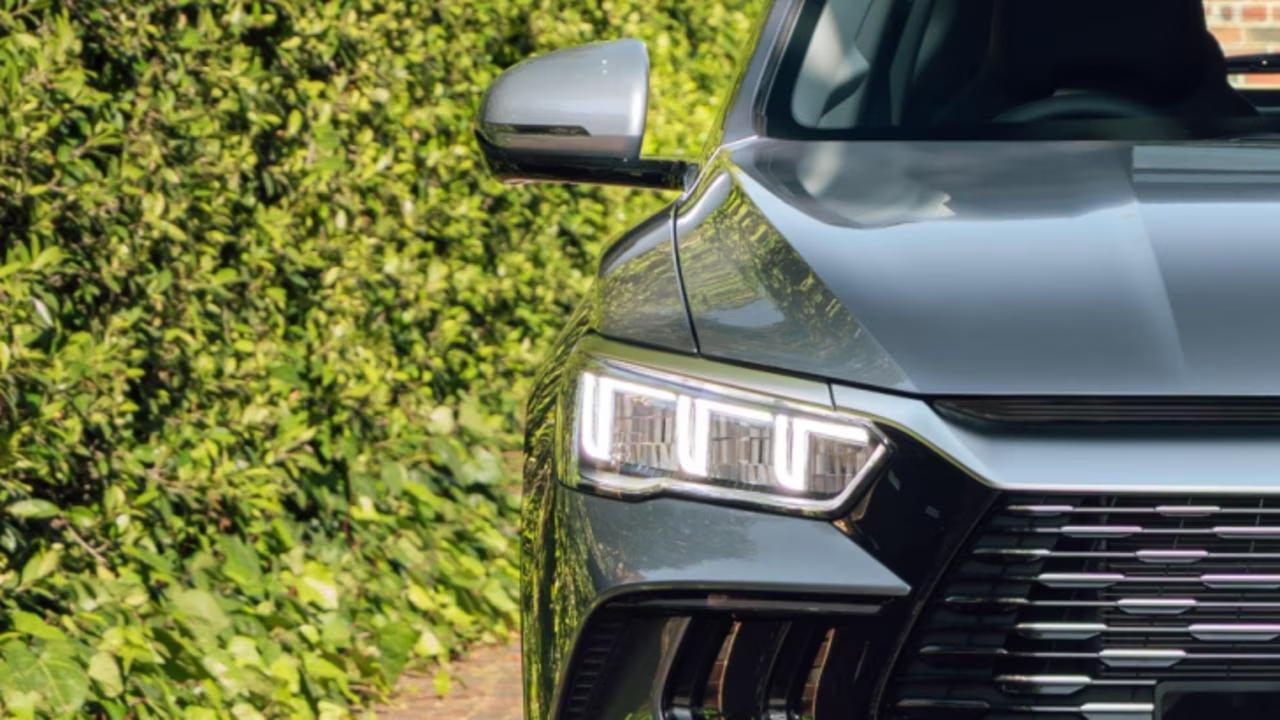
Build Your Dreams (BYD) has shifted from a name most Australian car buyers had never heard of to one of the fastest-growing brands on the road.
And 2026 is shaping up as its most aggressive year yet.
With a bunch of new models landing in Australia at prices designed to unsettle established players, this Chinese auto giant knows affordability is its strongest weapon.
The new Sealion 5 is a clear example of its strategy.
Arriving as Australia’s cheapest plug-in hybrid SUV, priced from $33,990 plus on road-costs, it undercuts not only rival PHEVs but petrol and hybrid family cars too.
Even when you factor in on-road costs, it still lands below the $40,000 mark where most competitors start.
This model lands in a growing but still relatively narrow segment, increasingly dominated by Chinese brands chasing buyers who want electrification without the price or “range anxiety” of a full EV.
MORE: New Aus EV sticking it to Tesla
But if you spend time in the Sealion 5, the compromises are easy to spot.
Its interior materials can feel cheap, and the presentation is basic.
An 8.8-inch digital driver display and a small 10.1-inch central infotainment screen feel underwhelming for a brand known for its big screens.
The plastics are hard, the cabin lacks the soft-touch finishes found in pricier rivals, and in Essential trim you miss out on features like electric seats and a panoramic sunroof.
The Sealion 5 feels compact, almost “cute” for a mid-size SUV, yet offers a larger body than many rivals including the RAV4 – with a generous 463 litres of boot space.
Around Brisbane’s Red Hill, the Sealion 5 is responsive enough but doesn’t deliver the polish or ride sophistication you’d find in higher-priced BYD models or their rivals.
Power comes from BYD’s DM-i plug-in hybrid system, pairing a 1.5-litre petrol engine with a 145kW electric motor for a combined 156kW, driving the front wheels.
Around town there was enough zip, but don’t expect it to feel fast or sporty.
Ride quality and suspension tuning are very much in line with the price point, getting the job done without wowing on the road.
MORE: Why Ferrari asked an Aussie to fix its cars
The Sealion 5’s battery was depleted before our test drive at the vehicle’s national launch, so it wasn’t possible to truly assess EV range (a claimed 71km for the Essential) or how seamlessly the system behaves when fully charged.
But what was visible is how the car behaves once the battery is flat.
The vehicle’s own energy display showed real-world fuel consumption closer to 6-7L/100km, noticeably higher than BYD’s ultra low official figures (1.2L/100km with a charged battery, rising to 4.5L/100km once the state of charge drops below 25 per cent), but broadly in line with what you’d expect for a petrol-powered mid-size SUV.
The Sealion 5 isn’t inefficient, it simply shows the reality of plug-in hybrids – any savings will depend entirely on whether or not you charge it.
If you’re plugging in at home and doing short trips, you’ll reap the benefits. If you’re not, your technically just driving a petrol SUV, just one that occasionally helps itself with electric assistance.
Despite the sharp pricing, BYD hasn’t skimmed on safety.
The Sealion 5 Essential comes standard with adaptive cruise control, autonomous emergency brakes, lane-keeping assist, blind-spot monitoring, rear cross-traffic alert, a 360 degree camera and a driver monitoring system.
For $33,990, you’re getting a bargain in today’s saturated SUV market.
But just know that bargain comes with compromise, the interior feels cheap, the ride and refinement isn’t anything you’d brag about, but it does offer space, hybrid-tech and modern safety features.
If you have the extra cash, I’d suggest upgrading to the premium trim for $4,000.
The premium adds comfort and convenience gear that the base car misses, including power front seats, a glass roof with sunshade, and a more up-market interior feel, while retaining the same DM-i plug-in hybrid powertrain and family-friendly SUV proportions.