Track your investments for FREE with Simply Wall St, the portfolio command center trusted by over 7 million individual investors worldwide.
Tesla announced major leadership changes, including the exit of senior executive Raj Jegannathan.
Joe Ward has been elevated to global head of sales as the company reshapes its management structure.
The company is redirecting focus toward AI, robotics, and robotaxi development, supported by higher capital spending.
These shifts come as demand for Tesla’s core automotive business softens and the company rethinks its future growth drivers.
Tesla, NasdaqGS:TSLA, is reworking its leadership team and business priorities at a time when its core vehicle segment faces weaker demand. The stock trades at $425.21, with a 1 year return of 29.4% and a 3 year return that is very large relative to that, while the 5 year return stands at 60.2%. Recent shorter term moves are mixed, with the share price up 0.8% over the past week and showing a 4.4% decline over 30 days.
For investors, the key issue is how this shift toward AI, robotaxis, and humanoid robots might reshape Tesla’s revenue mix over time. The combination of executive departures, Joe Ward’s new role, and heavier spending on advanced technology indicates a company working to redefine its main engines of growth beyond traditional EV sales.
Stay updated on the most important news stories for Tesla by adding it to your watchlist or portfolio. Alternatively, explore our Community to discover new perspectives on Tesla.
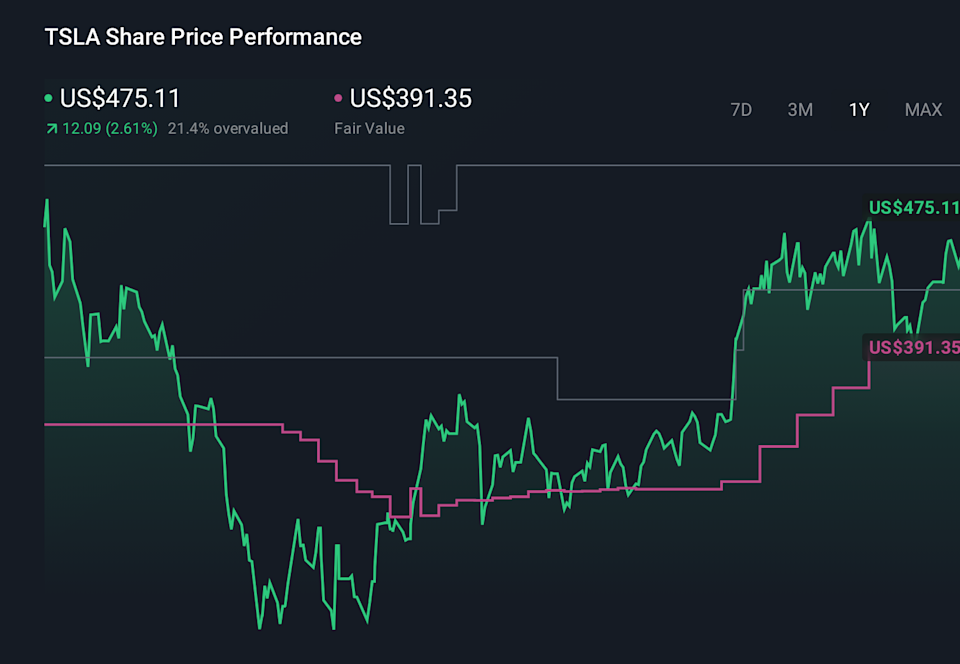 NasdaqGS:TSLA 1-Year Stock Price Chart
For you as a shareholder, these leadership moves sit at the junction of weaker core-auto results and a heavy pivot into AI, robotics and robotaxis. The exit of long-tenured executives like Raj Jegannathan, who was involved in both sales and AI infrastructure, raises questions about execution stability at the same time Tesla is planning more than $20b in capital spending focused on autonomy, humanoid robots and AI compute. Elevating Joe Ward to global head of sales appears to be an attempt to tighten control of a cooling EV demand picture while Elon Musk reallocates attention and resources toward higher margin software and service lines such as Full Self Driving subscriptions and robotaxi operations. With Q4 2025 net income at US$840m versus US$2,128m a year earlier and full year net income at US$3,794m versus US$7,091m, the company is trying to reset its growth engine while earnings are under pressure. For you, the question is whether leadership churn during this transition increases execution risk more than it accelerates the shift toward AI focused businesses.
The leadership reshuffle and heavier AI and robotaxi focus align with the narrative that Tesla is leaning into high margin software, autonomy and energy services as potential new earnings drivers.
At the same time, executive turnover and softer auto results, with full year revenue at US$94,827m versus US$97,690m, challenge the assumption that Tesla can simply layer new revenue streams on top of a solid core-vehicle base.
The discussion of possible tie ups with SpaceX or xAI, and the US$2b investment into xAI, adds a consolidation angle that is not explicitly captured in the existing narrative about Tesla as a stand alone AI and autonomy platform.
Knowing what a company is worth starts with understanding its story. Check out one of the top narratives in the Simply Wall St Community for Tesla to help decide what it is worth to you.
Rapid leadership turnover, including multiple senior exits in sales and AI infrastructure, could disrupt execution just as Tesla ramps AI heavy capital projects.
The pivot away from mature EV models toward robotaxis and humanoid robots concentrates risk in unproven markets where rivals like Alphabet’s Waymo and XPeng are already active.
If Tesla successfully scales robotaxis and AI powered services, the company could shift more of its mix toward higher margin, recurring software and service revenue.
Tighter global sales leadership under Joe Ward could help Tesla respond more quickly to demand trends and competition from BYD and legacy automakers in core EV markets.
From here, you may want to track three things closely. First, whether further senior departures follow, or if the leadership team stabilizes under Joe Ward with clear accountability for the AI, robotaxi and robotics push. Second, how the heavy capital spending on AI infrastructure, Optimus and Cybercab factories shows up in future earnings and cash flow, given that recent net income has moved lower year on year. Third, how Tesla executes against competitors in autonomy and robotaxis, such as Waymo and XPeng, including real world deployment milestones, safety records and regulatory approvals. Together, these signals will help you judge whether Tesla is repositioning itself from a high growth EV maker to an AI and autonomy focused platform company, or taking on more execution and financial risk while its core-auto segment cools.
To stay updated on how the latest news impacts the investment narrative for Tesla, head to the community page for Tesla to follow the top community narratives.
This article by Simply Wall St is general in nature. We provide commentary based on historical data and analyst forecasts only using an unbiased methodology and our articles are not intended to be financial advice. It does not constitute a recommendation to buy or sell any stock, and does not take account of your objectives, or your financial situation. We aim to bring you long-term focused analysis driven by fundamental data. Note that our analysis may not factor in the latest price-sensitive company announcements or qualitative material. Simply Wall St has no position in any stocks mentioned.
Companies discussed in this article include TSLA.
Have feedback on this article? Concerned about the content? Get in touch with us directly. Alternatively, email editorial-team@simplywallst.com