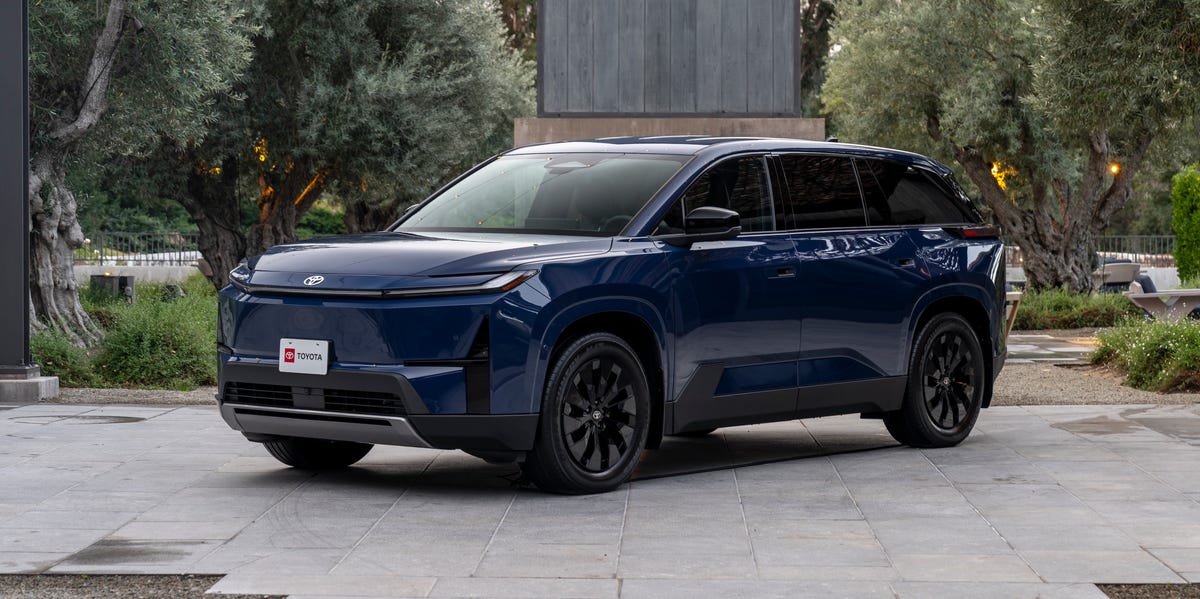
The 2027 Toyota Highlander ditches its gas and hybrid powertrains and goes fully electric.The new three-row Highlander EV can travel up to 320 miles on a charge, and all-wheel-drive models produce 338 horsepower.Sales are set to begin at the end of this year, and we expect the 2027 Highlander to start in the mid-$50,000 range.
Toyota’s latest EV wears a familiar name. Meet the 2027 Toyota Highlander. Yes, the mid-size SUV that first arrived in 2001 is ditching gas propulsion for its fifth generation. The new electric Highlander will challenge the Kia EV9 and Hyundai Ioniq 9, the only other two mainstream three-row electric SUVs currently available, when sales kick off later this year.
No Need for Gas
The 2027 Highlander, built on a modified version of Toyota’s TNGA-K platform, will come in two trims: XLE and Limited. XLE models offer either front-wheel drive or all-wheel drive, the former paired exclusively with a 77-kWh battery and the latter available with either the smaller battery or a 96-kWh pack. The Limited, meanwhile, comes standard with all-wheel drive and the bigger battery.
Toyota’s range estimates are respectable but not game-changing. The automaker says the XLE FWD can travel 287 miles on a charge, while the XLE AWD with the same battery achieves a claimed 270-mile range. Upgrading to the larger battery provides a 320-mile range estimate for both the all-wheel-drive XLE and Limited.
Charging occurs via a standard NACS port, and Toyota says the Highlander needs roughly 30 minutes to go from 10 to 80 percent when connected to a DC fast-charger. There’s an 11-kW onboard charger for AC charging too, and Toyota provides a 120-/240-volt charging cable. The Highlander also has vehicle-to-load capability, a first for Toyota sold in the United States. This lets owners use the SUV to power appliances or, in the event of an outage, act as a power backup for their home.
The switch to electric power should make the Highlander feel peppier than its gas-fed predecessor. Front-wheel-drive models produce 221 horsepower and 198 pound-feet of torque from a single electric motor, while all-wheel drive adds a second motor that helps generate a combined 338 horses and 323 pound-feet of torque. If those outputs sound familiar, it’s because the Highlander’s setup is identical to that of the smaller bZ electric SUV.
Toyota hasn’t published performance figures, but we expect at least the AWD models to post a significant improvement over the current Highlander’s 7.2-second run to 60 mph. All-wheel-drive electric models also feature terrain-specific drive modes and Crawl Control, where the vehicle handles acceleration and braking at low speeds to allow the driver to focus on steering around obstacles.
A Boxy New Look
Compared with the fourth-generation Highlander, the new EV has blockier styling, with chunky fenders and full-length daytime running lights that emphasize its width and echo Toyota’s other electric models. The new Highlander is also now substantially larger. While the roofline is nearly an inch lower, the SUV measures 2.3 inches wider and almost four inches longer, with a roughly eight-inch-longer wheelbase.
The Highlander is characterized by straight lines and hard edges, with the main headlights tucked into geometric housings at the bumper’s edge. Sharp creases break up the visual mass along the side of the SUV, along with a ribbed fin that pokes up from the lower body trim. At the rear, the rectangular taillights sit just below the glass and wrap around the sides of the vehicle. The Highlander can be ordered with a trendy two-tone look sporting a black roof on the Limited trim, which also offers sizable 22-inch wheels.
Big Screens and Lots of Space
The cabin looks appropriately modern, sporting a 14.0-inch touchscreen and a 12.3-inch digital gauge cluster. The infotainment system features 5G connectivity, a voice assistant, and wireless Apple CarPlay and Android Auto, and the Highlander can connect to two phones via Bluetooth at once. The SUV also comes standard with what Toyota calls “Drive Recorder,” a built-in dashcam that utilizes the exterior cameras.
Thankfully, despite the large screens, Toyota still provides physical controls for functions such as the HVAC system, drive modes, and stereo volume. A head-up display is standard on the Limited, and there are plenty of ways to keep your devices juiced up, with dual wireless chargers in the center console and USB-C ports for the second and third rows. Ambient lighting that can glow in 64 different colors comes standard and is linked to the Safe Exit Assist system, flashing the lights to alert passengers if a vehicle is approaching before they open the door.
The Highlander has space for up to seven passengers when fitted with a bench seat in the second row, but this configuration is available exclusively on the XLE AWD trim. The seats are wrapped in SofTex, Toyota’s synthetic leather upholstery, and all Highlanders come with heated front seats and a heated steering wheel. Ventilated front seats are standard on the Limited trim, as are heated second-row seats. The third row can fold completely flat to expand the cargo area to over 45 cubic feet of storage.
Toyota maximized interior space in other ways too, with 18 cupholders throughout the SUV and storage spots in the center console and second-row cubby, including slots designed for stashing phones and tablets. The Highlander also includes a hands-free power liftgate.
The standard sound system is a six-speaker setup, but buyers of the XLE AWD and Limited can upgrade to an 11-speaker JBL system. A fixed-glass panoramic roof, the largest in Toyota’s lineup, is optional on both Highlanders. Toyota promises a quiet ride, with noise-absorbing material integrated into the door panels, front pillars, wheel wells, roof, and underfloor. Acoustic glass for the windshield and front side windows, as well as a dynamic damper on the back door panels, should help further minimize noise.
When Can You Buy One?
As with many modern cars, an array of functions can be controlled from the Toyota app on your smartphone, including remotely preconditioning the battery and managing charging. Toyota’s Connected Services features are initially included as a free trial before requiring a subscription. The Highlander also includes a lengthy suite of driver-assistance features, including a pre-collision system with pedestrian detection and automatic emergency braking, adaptive cruise control, lane-departure alert with steering assist, blind-spot monitoring, and automatic high-beams.
The Highlander is Toyota’s first EV assembled in the U.S., with production set to begin at Toyota’s plant in Georgetown, Kentucky. The SUV’s batteries will also hail from America, following a $13.9 billion investment in a new battery assembly plant in Liberty, North Carolina. Toyota says sales should begin in late 2026 and into early 2027, giving a bit of leeway for Highlander production to get off the ground. Pricing will be announced later, but we expect it to start in the mid-$50,000 range.
More on Toyota EVs➡️ Skip the lot. Let Car and Driver help you find your next car.

Caleb Miller began blogging about cars at 13 years old, and he realized his dream of writing for a car magazine after graduating from Carnegie Mellon University and joining the Car and Driver team. He loves quirky and obscure autos, aiming to one day own something bizarre like a Nissan S-Cargo, and is an avid motorsports fan.