Thailand’s electric vehicle (EV) sales (passenger car and light duty vehicles) more than tripled year-on-year to over 44,000 units in January 2026, a record month for the country. Its penetration rate grew to 48%, another monthly record, surpassing its previous high of 37% set in December 2025.
The significant increase in sales was underpinned by vehicle manufacturers being granted an extension within which to register their vehicles under the Thailand’s EV3 scheme. The previous deadline of December 2025 had been extended to January 2026 in November 2025. At the same time, the deadline for EV3.5 vehicles was moved from December 2027 to January 2028.
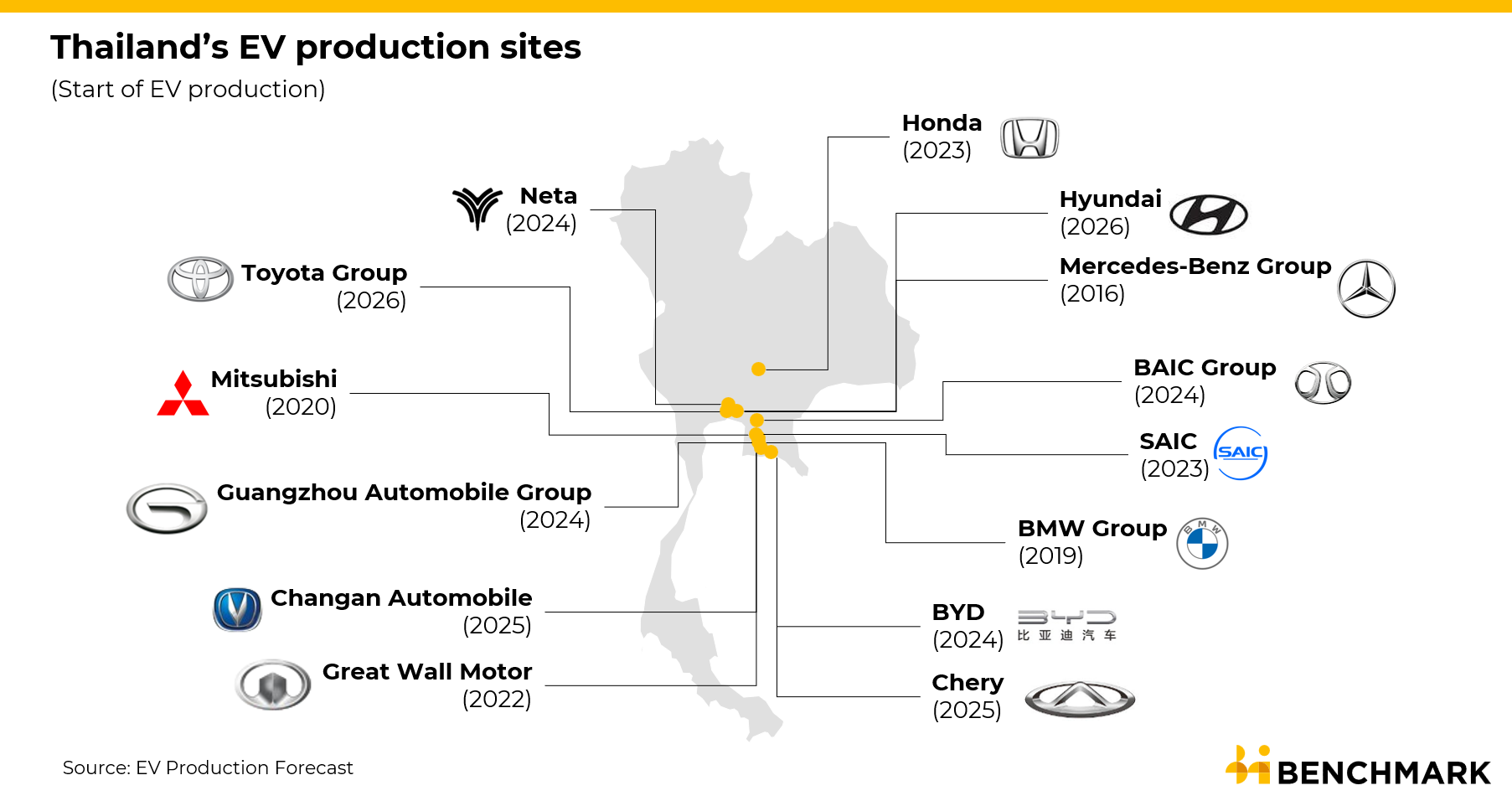
Thailand’s EV3 and EV3.5 schemes promote the adoption of EVs through consumer subsidies. The schemes also offer reduced import duties on completely fully assembled, providing these are later offset by local EV production. The schemes are crucial to Thailand’s ambition to become an EV production hub within Southeast Asia and have started to see success with several OEMs building out EV capacity within the country. To date 14 OEMs have established manufacturing operations in the country with it being a key player for EVs in the regional market but also for export.
 The surge in sales was also supported by changes in vehicle excise tax rates from January 1st, 2026. For passenger car battery electric vehicles (BEVs), the rate was reduced from 8% to 2%, while BEV pickup trucks saw a reduction from 2% to 0%.
Benchmark Intelligence subscribers can access exclusive EV sales in theEV Sales Briefing.
The sharp increase in registrations in January 2026 is likely a one-off event, with OEMs looking to register EVs before the EV3 registration deadline. Thailand’s EV3.5 scheme will continue to encourage the ramp up of domestic EV production using local content which will continue to provide the foundation for EV sales growth in the country.
EV production ramp up is encouraged through increasing the required number of locally produced EVs to offset every imported EV. The ratio is currently set at two locally produced EVs for every imported vehicle, however in 2027 this increases to a three to one ratio. In late 2025, the Thai government further incentivised local EV production by stipulating that every EV exported from Thailand counts as one and a half vehicles towards an OEM’s local production requirements.
The insights in this article were produced using data from Benchmark’s EV & Battery Service. For more information, get in touch with the form below: