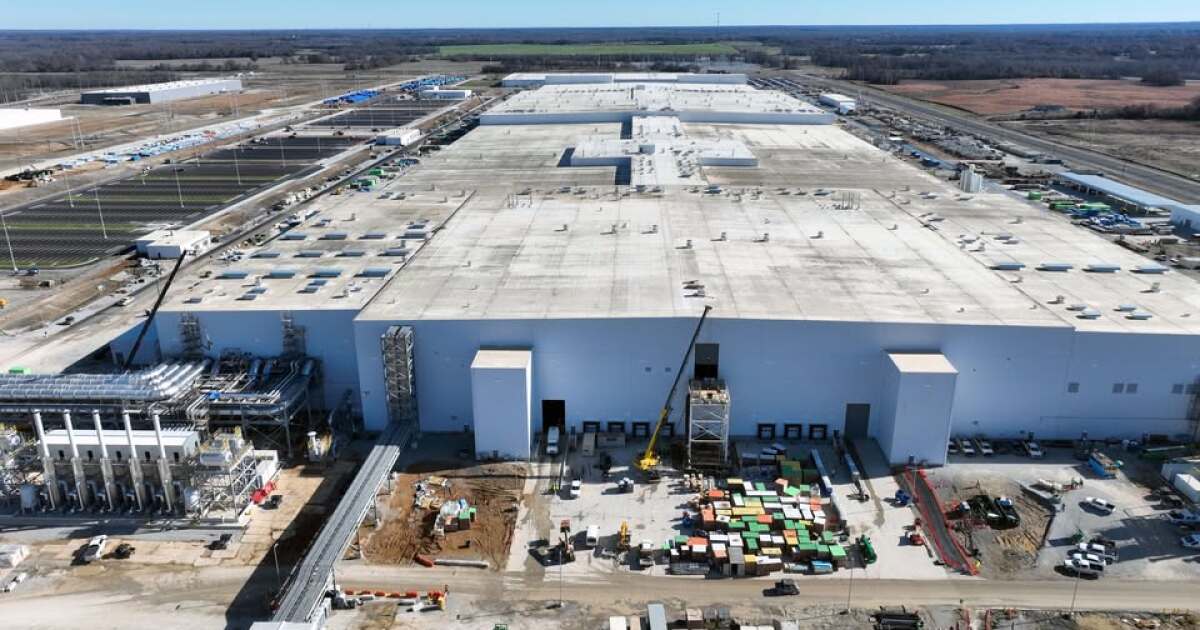
Four years ago, Gov. Andy Beshear announced what he called the biggest economic development project Kentucky has ever seen — a joint manufacturing venture between Ford and a South Korea-based company to build batteries for electric vehicles.
The state gave the plant a $250 million loan. The BlueOval SK project brought two, roughly 4-million-square-foot facilities to the central Kentucky community of Glendale, an investment of $5.8 billion.
As a result, Hardin County was projected to grow by 22,000 residents. The community spent hundreds of millions of dollars to build a workforce training center, redesign the Glendale exit off Interstate 65, build more homes, expand the hospital, and upgrade electric, water, and sewer systems.
Now, this metro with momentum is in a slowdown.
The Glendale plant shuttered six months after the first electric vehicle batteries rolled off the assembly line.
BlueOval SK restructured the project after Congress ended the $7,500 tax credits to buy electric vehicles, changes to a manufacturing credit program that denied tax credits to projects owned by foreign entities, and declining EV sales.
Kentucky Senate President Robert Stivers has called the battery plant “the biggest boondoggle of economic recruitment in the state’s history.”
Now Ford is taking sole ownership of the battery campus off I-65 in central Kentucky. A subsidiary, Ford Energy, plans to hire 2,100 workers, repurpose the plant and start production in late 2027.
Some former plant workers feel spurned by the closure, but community leaders feel all those investments will pay off eventually as the plant is retooled to produce batteries for energy storage.
Beshear says that while the project failed in its original version, there’s still opportunity for it to be a win for Kentuckians.
“It’s just going to take a little longer to get there. Remember, a $7.8 billion plant would still be the single largest investment we’ve ever had,” Beshear said.
Keeping a roof ‘over our head’
In December, Ford and South Korea-based SK On announced they were ending their partnership, closing the Glendale plant and eliminating the entire workforce.
The announcement wiped out Brittany Disprisco’s family livelihood. Both she and her wife Tiffany were employed at BlueOval SK as quality operators. Their pay and benefits end on Valentine’s Day.
“We’re trying to figure out now how to keep a roof over our heads after Feb. 14, and having two kids to provide for is very scary,” Disprisco told WKU Public Radio.
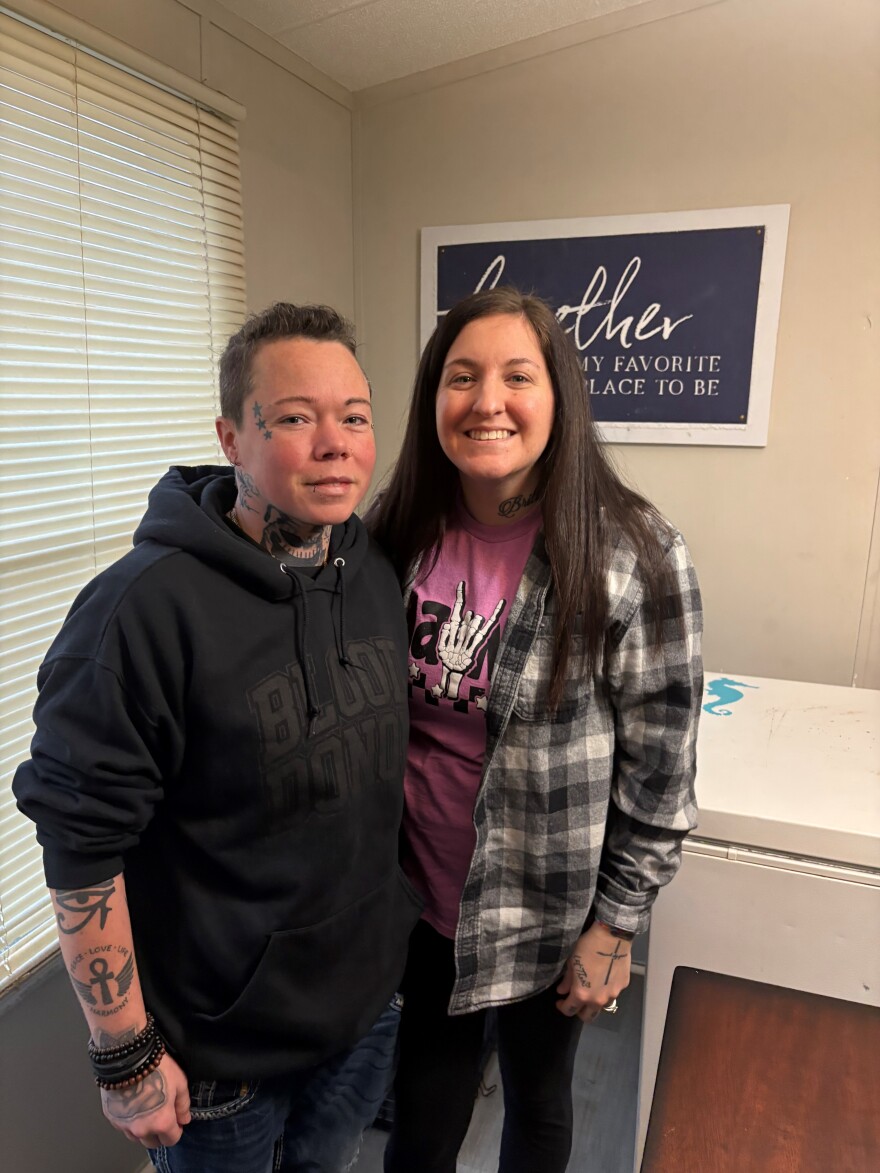
Brittany and Tiffany Diprisco were among about 1,600 workers laid off by BlueOval SK’s plant closure in Glendale.
Disprisco sat at the kitchen table last month at her home in Ekron, a small town in Meade County where there aren’t a lot of good paying jobs. She said she would consider going back to Ford if it becomes a union shop where there are more worker protections.
BlueOval SK workers voted last summer to join the United Auto Workers union, but the 11-vote victory was contested by the company. BlueOval SK challenged 41 ballots that could have changed the outcome of the election. The National Labor Relations Board ruled last month in favor of the UAW, but the company is challenging the decision. It’s unclear if Ford’s next venture in Glendale will recognize the union.
Former production operator and trainer Scott Musgrove of Leitchfield says he’ll likely fall back on his previous career as a licensed contractor. He said he has no desire to work for Ford again.
“Honestly, I probably won’t put BlueOval on my resume,” Musgrove said. “It was a waste of my time and I wish I never even applied there, knowing what I know now and how they had done pretty much everybody, especially people that are pro-union.”
Production Operator Sandie Yarborough can’t wait until late 2027 to find new work. She’s been job searching and finding it difficult to replace the $23.50 in hourly pay she was earning at BlueOval SK.
“They did pay pretty decently. I agree with that,” Yarborough said. “So now, trying to find something comparable, I think a lot of us are trying to pivot into something else.”
Yarborough is also thinking about going back to school to become an electrician or get her CDL license. She lives in Elizabethtown, but Andy Games, President of the Elizabethtown-Hardin County Industrial Foundation, says about 15% of the workforce moved to the region, some from out of state, to work at BlueOval SK.
“That’s been the main focus, to try to help them stay here or find something within a 30- to 45-minute drive where they can still stay in this area and don’t have to pick up and move their stuff again,” Games said.
Hardin County Judge-Executive Keith Taul doesn’t think Ford will have trouble filling jobs when the plant reopens.
“I believe, from what I’ve heard, the wages will be good and maybe better than BOSK wages,” Taul said. “They may struggle some, but this is an area that continues to grow so I believe there will be people around who want those jobs.”
Although Ford abandoned its EV battery business in Glendale, some locals see it as just a bump in the road.
At Mountain Mike’s Coffee House in Glendale, owners Brian and Lisa Burchard said BlueOval SK workers were good for their bottom line. The couple expects a short-term drop in business from the plant closure. But for the long-term, they’re optimistic.
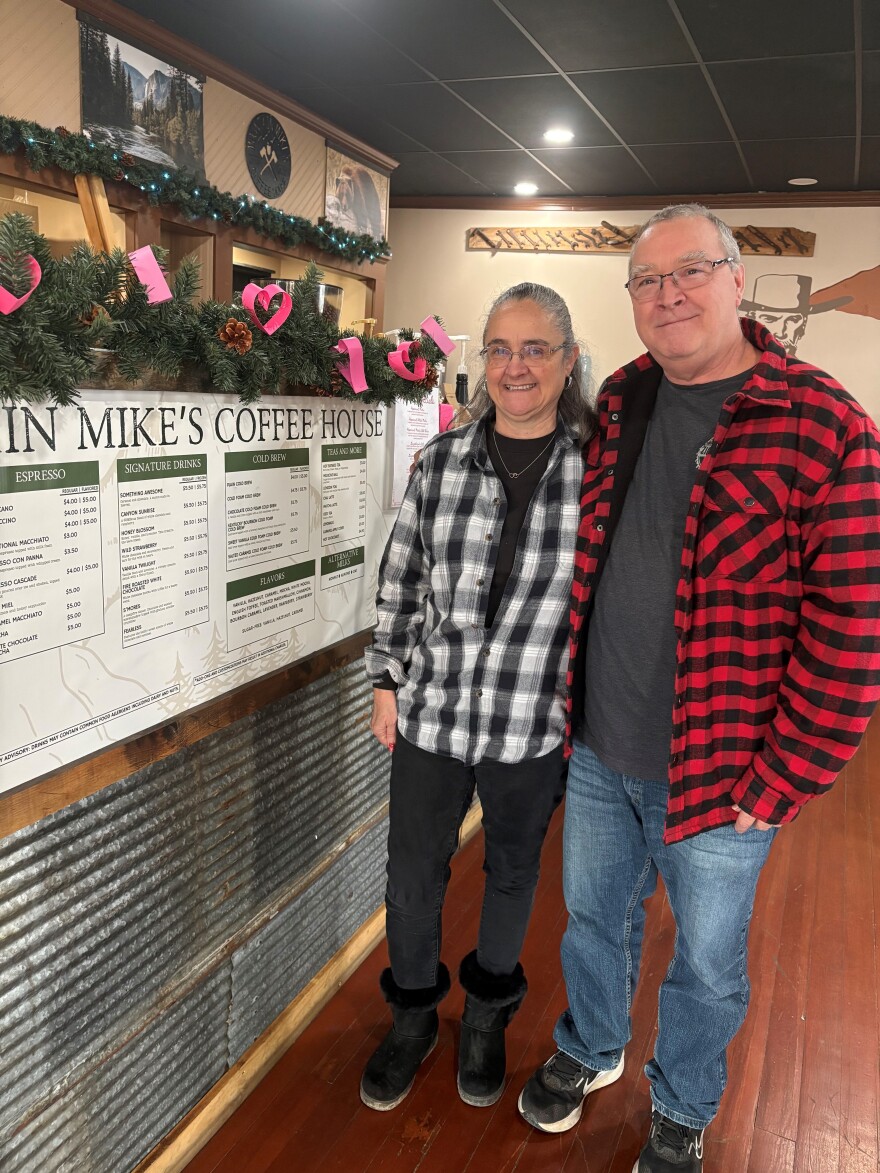
Brian and Lisa Burchard, owners of Mountain Mike’s Coffee House in Glendale, are optimistic about the community’s future, despite Ford’s shift in plans for the former EV battery plant.
“No matter who goes in there and no matter what develops out of it, people like coffee,” Lisa Burchard said.
“And I think that’s the general feeling in town. They’re not going to leave it vacant. Someone will be in there and they’ll be doing something one way or another,” Brian Burchard added.
From EVs to battery storage, Hardin County expects business to continue
Hardin County is still betting on Ford as the automaker switches gears to produce batteries used in energy storage. Rather than the automotive sector, these batteries will support data centers, utilities and large-scale commercial customers. As judge-executive, Taul is confident Ford’s new venture will be sustainable.
“This is a product they’re going to be making that is desirable,” Taul said. “I’ve heard three or four years of backlog orders.”
The mega factories sit on 1,500 acres of land that Hardin County transferred to BlueOval SK, valued at more than $27 million, according to the deed. Now, there are questions about whether they’ll ever be fully utilized.
Only the first plant, Kentucky 1, was home to EV battery manufacturing. Construction on Kentucky 2 was halted due to sluggish electric vehicle demand before Ford announced its transition away from the EV battery industry.
State tax dollars were used to build a $25 million workforce training center through Elizabethtown Community and Technical College. Games, president of the Elizabethtown-Hardin County Industrial Foundation, expects the facility to train the next crop of battery workers.
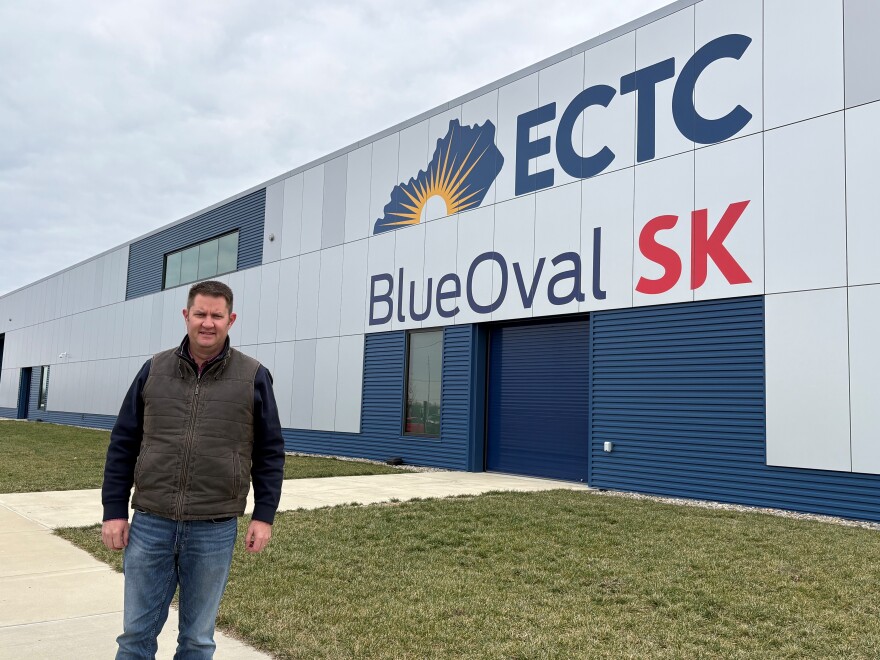
Andy Games, president of the Elizabethtown-Hardin County Industrial Foundation, believes the BlueOval SK workforce training center will still be utilized by Ford Energy.
“I see Ford needing it because they’ve got a new process,” Games said. “I’m sure ECTC and their people will have to revamp the equipment but I think it will be used heavily with any projects that Ford decides to do.”
Hardin County has built upwards of 3,000 apartments and single-family homes, according to Games. Laid off production worker Halee Hadfield posted a video to social media suggesting Hardin County is overstocked on housing without BlueOval SK workers.
“These apartment complexes are going to sit empty because they’re upwards of $2,000. That’s more than 60% of what I was bringing home on a monthly basis when I was still fully employed,” Hadfield said. “My prediction is those apartments will sit vacant until the rent is decreased or until adults who are desperate enough go and squat in them or bored teenagers go break in and vandalize them or do whatever.”
An impact study projected Hardin County to need 8,000 new housing units under BlueOval SK’s original plan for a 5,000-member workforce, but at the time of the plant’s closure, only about 1,600 people had been hired. Taul said Hardin County needed more housing before the project’s announcement.
“My understanding is we still need more homes in the area. There’s been a lot of apartments, more dense housing that’s been built and some in the process right now,” Taul said. “My understanding is, it’s still not up to what we need for this area.”
Two South Korean companies, both suppliers for the EV battery industry, located in the Patterson Industrial Park following the EV battery announcement. Baptist Health Hardin invested more than $200 million in a hospital expansion, including construction of an outpatient medical pavilion.
More than $30 million was spent to reconfigure the Glendale exit off I-65. The project included building a new bridge over the interstate, changing up ramps, and reconfiguring the intersection of U.S. 31 W and Ky. 222 into the BlueOval SK worksite. Kentucky Utilities built two substations, transmission lines and a natural gas pipeline extension to support the facility. The city of Elizabethtown performed water and sewer upgrades.
Local farmer and retired firefighter Jason Buckles lives on more than 300 acres adjacent to the industrial site that’s been in his family for generations. He’s not worried about the return on investment. Buckles has confidence in Ford, a company that’s been around since the Model T.
“I have faith that they have faith to sink another $2 billion dollars into it, to make something work,” Buckles commented. “So many of these EV ventures have just gone belly up once they got the government check. That hasn’t happened here yet.”
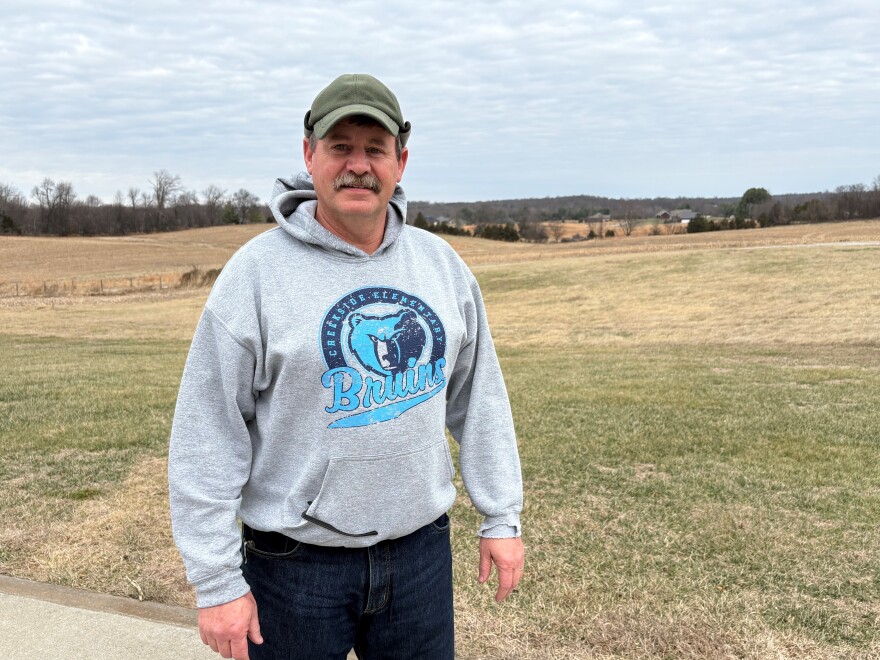
Lifelong Glendale resident Jason Buckles lives on a family farm adjacent to the battery campus. He’s more confident in Ford Energy from a business standpoint, as well as how the plant will impact his land and the community.
Despite hundreds of millions of dollars in state and local investments, Hardin County’s population hasn’t grown by 22,000 as projected in a consultant’s report following the 2021 BlueOval SK announcement. In fact, the population only increased by just over 2,100 residents between 2020 and 2024. The 2020 population was 110,703 which grew to 112,826 in 2024, the most recent year for which census data is available.
Still, Hardin County continues to make investments in the Ford project in Glendale. If anything, Taul said the automaker’s transition to energy storage gives the community more time to prepare for long-term growth.
“There’s a new water tower going up in the Glendale area for pressure, for additional volume as that area grows, and really, it’s just starting,” said Taul. “We would fully expect there to be a hotel or hotels at that intersection with I-65, and more restaurants, all the things that should come about with that many people working in that area of the county.”
Republican Senate President Stivers helped shepherd a massive incentive package through the General Assembly to help land the project. The package included a $250 million state-funded, forgivable loan if the company meets specific targets for job creation and average wages over a 10-year period.
Gov. Beshear said the state has the ability to claw back taxpayers funds, but actions are on hold as Ford develops a long-term plan for the manufacturing site.
“There’s security in the agreement with these companies,” Beshear said. “The state could recoup those dollars, but where we are is in negotiation, because the project changed, for what’s fair, and we haven’t worked through all of that.”
Ford has a lot riding on its transition to energy, assuming responsibility for the $250 million the state approved for EV battery production.
“The carrot is, ‘Let’s keep working together,’ but the stick is, ‘You have to repay us,’” said Economic Development Secretary Jeff Noel at a legislative hearing last week. “And if not, and you don’t create more jobs, then you’re going to repay.”
Ford is scheduled to start repaying the state next year for not hitting employment targets. According to Noel, Ford doesn’t intend to use the second plant in Glendale but agreed to help the state market it to other potential manufacturers.
On top of Ford’s $5.8 billion investment in the EV battery campus, the company plans to invest another $2 billion to scale the new energy storage venture.
This story was produced by the Appalachia + Mid-South Newsroom, a collaboration between West Virginia Public Broadcasting, WPLN and WUOT in Tennessee, LPM, WEKU, WKMS and WKU Public Radio in Kentucky, and NPR. Sign up for the weekly Porch Light newsletter here for news from around the region.
![Kia's electric hot hatch spotted in action for the first time [Images]](https://www.evshift.com/wp-content/uploads/2026/02/1770676792_Kia-electric-hot-hatch-spotted-770x515.jpeg "Kia’s electric hot hatch spotted in action for the first time [Images]")