Editor’s note: This is a reported explanatory analysis. Unlike a straight news story that focuses on the basic facts of an event, this format examines data, context, and underlying factors to help readers understand the issue more deeply.
STATE — A bill extending California’s road user charge pilot program has ignited debate over whether the state’s gas-tax revenue is declining, a central claim behind the push to eventually charge drivers per mile.
Assembly Bill 1421 would continue the pilot through 2035 as the state conducts additional studies for a mileage-based fee, or RUC. Supporters, including legislative Democrats and environmental advocates, argue the shift is needed because electric vehicles are reducing gasoline demand and eroding funding for transportation infrastructure.
However, the numbers tell a different story. State tax records show gas-tax revenue hit a record $7.94 billion in Fiscal Year 2024-25, even as gasoline consumption has dropped by 2 billion gallons from FY 18-19 and EV sales surged. Rising revenue is driven by the state’s steadily increasing per-gallon excise tax and annual inflation adjustments adopted under Senate Bill 1 in 2017.
EVs currently account for about 7% of the state’s on-road vehicles, a small share compared to the 35.9 million total registered vehicles statewide.
What follows is an examination of the data behind the gas-tax system, how California ended up with its current tax structure, and under what conditions gas-tax revenue may actually decline.
For years, the common claim has been gas-tax revenues are declining because drivers are switching to EVs and will no longer be able to fund transportation projects, according to Caltrans. Other common claims is a RUC treats all vehicles equitably, is a user-pay system, among others.
But the California Department of Tax and Fee Administration (CDTFA) data shows the opposite.
Drivers purchased 13.336 billion gallons of gas in FY 2024-25, down from the 15.3 billion seen in FY 18-19, the agency reported. Despite the decline, revenue increased because the state’s per-gallon excise tax increased faster than gas consumption fell.
In FY 2024-25, the excise tax, which was reformed and approved under Senate Bill 1 in 2017, reached 59.6 cents per gallon. In FY 2025-26, the tax is 61.2 cents.
A review of CDTFA’s FY 24-25 fuel‑tax data shows:
Gasoline excise‑tax revenue rose sharply after 2017 due to increases enacted under the Road Repair and Accountability Act (SB 1).
Even as gasoline consumption declined from roughly 15.5 billion gallons to about 13.3 billion over the past decade.
Annual revenue trends upward because of the tax rate.
Diesel revenue, which also contributes to transportation funding, similarly grew, supported by strong freight activity and its own inflation-indexed rate adjustments.
In short, revenue equals the number of gallons multiplied by the tax rate.
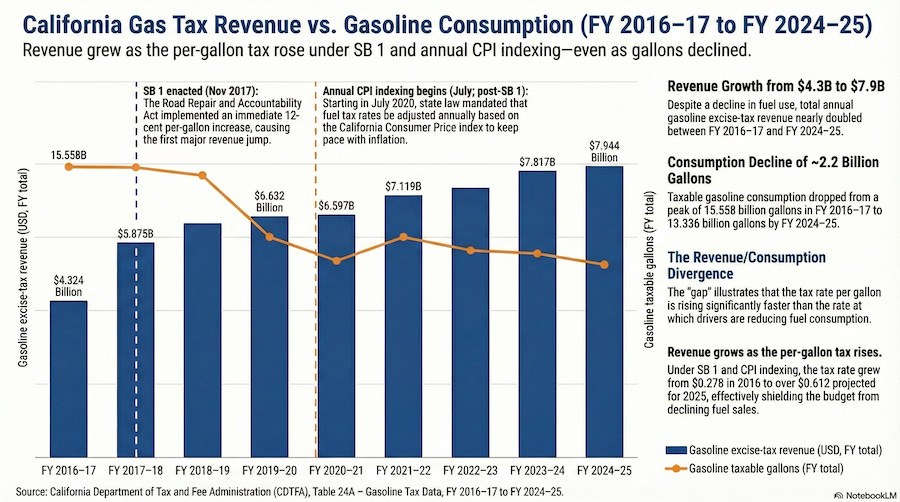 The graphic shows the increases in gas-tax revenue despite fewer gallons of gas being consumed by drivers over nine years. Steve Puterski graphic/AI
California did hit a milestone recently, though, with EVs as the state surpassed 2.5 million zero-emission vehicle sales, according to the California Energy Commission. Quarterly new-car sales account for about 23% as of the end of 2025; however, the impacts of the Trump Administration’s elimination of federal tax credits have yet to be fully realized.
While sales have plateaued at 23%, with some analysts reporting sales at 18%, new-car sales are different than fleet share, the actual vehicles on the road.
DMV data shows about 35.98 million registered vehicles as of January 2025. EVs represent about 7%, while gas-powered vehicles account for 93%, a significant gap.
The political narrative in support of the RUC centers on the growth of EV sales, but increases or decreases in the gas tax respond to the makeup of the fleet. And it takes decades to change the composition of a fleet as vehicles typically last between 15 and 20 years, according to industry experts.
The history of California’s gas tax system also plays a massive role in where the state is today.
In 2010, former Gov. Arnold Schwarzenegger was facing a budget crisis and a legal ruling preventing the state from diverting sales-tax revenue on gas to cover transportation debt, according to reports. So, Schwarzenegger signed the Fuel Tax Swap (ABX8-6 and SB 70), which did two things:
Eliminated most of the sales tax on gas, a percentage-based tax fluctuating with fuel prices.
Replaced it with a much higher per-gallon excise tax, designed to produce the same revenue as the previous tax.
The increase was significant as the sales tax was just 18 cents per gallon in 2009-10 and jumped to 35.3 cents in FY 2010-11, according to CDTFA records. The CDFTA (formerly the Board of Equalization) was required to adjust the new tax each year to keep it revenue-neutral compared to the sales tax.
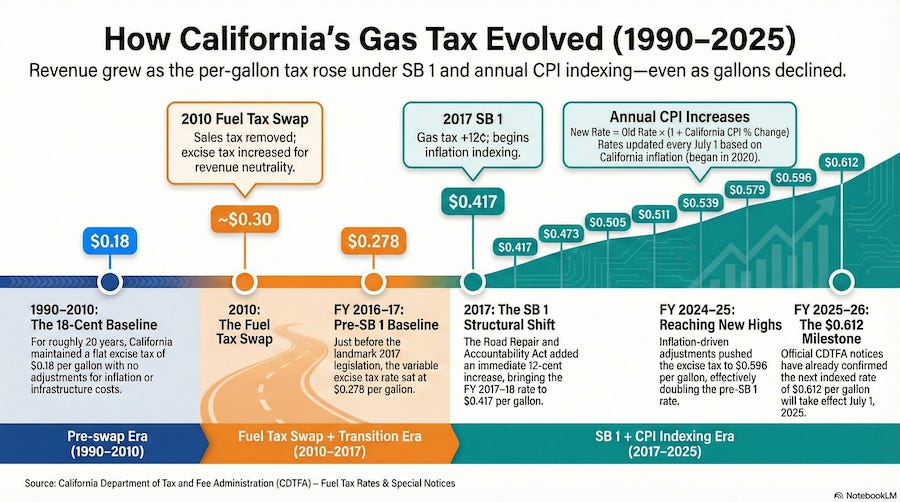 This graphic shows the timeline of how the gas excise tax in California evolved over the past 35 years. Steve Puterski graphic/AI
However, an earthquake was coming in the form of SB 1, also known as the Road Repair and Accountability Act, which was adopted in 2017. SB 1 did the following:
Added a 13.9-cent per-gallon excise tax increase in November 2017.
Added a 20-cent per-gallon diesel excise increase.
Added new transportation fees, such as for registration and vehicle value fees.
Indexed the gas and diesel taxes to inflation, adjusting the rate every July 1 based on the California Consumer Price Index (CPI).
Before SB 1 was enacted, the gas tax was 27.8 cents per gallon, according to the CDTFA. After the bill was signed, the tax spiked 41.7 cents, where it remained for two years until a 6-cent increase in FY 2019-20.
Since the tax is tied to inflation and not consumption, revenues continue to increase every year. For example, gasoline consumption has fallen about 2% over the last several years, but the excise rate increases between 3% and 5% each year. Some experts say the gas tax is designed not to fail.
The rate is calculated by the following: New rate = Old rate (1+CPI percentage change).

Forecasting outside five years is difficult, so the long-term future of gas-tax revenues is cloudy. Even though revenues are at record numbers, it could eventually face pressure from long-term EV trends.
One key element is the difference between EV sales and fleet share. Sales are the percentage of new vehicles sold, such as EVs. Those projections have cooled over the past five months after the federal tax credits were eliminated.
Analysts saw new sales between 18% and 23% for the fourth quarter of 2025, which is a decline from 25% earlier in the year and in 2024.
Fleet share, meanwhile, represents the share of all vehicles on the road. For EVs, it’s currently about 7%. Fleet turnover, though, is slow and methodical and isn’t guaranteed by legislative mandates from Gov. Gavin Newsom, as a host of factors contribute to the sale of a new or used vehicle.
Those mandates, though, have been eliminated by Congress, although Newsom is proposing a $200 million EV rebate in the FY 26-27 budget. However, his proposal also would require automakers to contribute a dollar-for-dollar match, CalMatters reported.
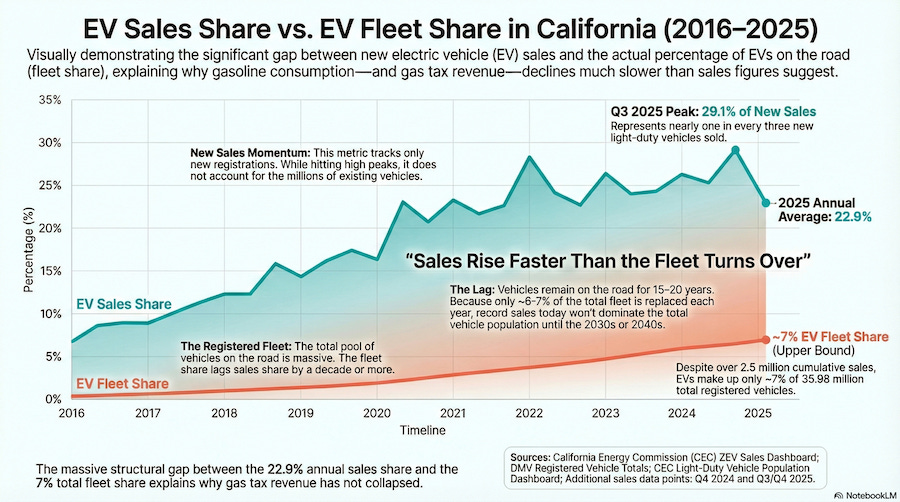 This graphic shows a comparison of EV sales share and EV fleet share over the past nine years. Steve Puterski graphic/AI
California transportation agencies base their gas‑tax “decline” warnings on the assumption that EV sales keep rising. If EV sales stop rising or decline, the fleet takes decades longer to flip, and the gas tax remains stable far longer than projected.
Even modest declines in EV sales dramatically push out the timeline for any revenue drop. At today’s EV fleet share of about 7%, and with cars lasting 15 to 20 years, it takes roughly three decades of steady EV sales at 20% just to reach a 30% fleet share, the point where gas‑tax revenue begins to fall, according to an analysis by North County Pipeline. Those projections place the earliest revenue impact in the late 2050s or 2060s, not the 2030s often cited in public debate.
(Fleet turnover estimates in this story are derived by applying California’s current EV fleet share, DMV vehicle-registration totals, and an industry-standard 6% annual vehicle replacement rate. Projected timelines reflect mathematical extrapolation, not agency forecasts.)
Regardless, the projections show several scenarios:
If EV sales hit 40% to 60% per year, the fleet transitions by the mid-2030s.
If EV sales are stagnant at 20% per year, the earliest fleet share is likely 2058.
If EV sales drop below 20% to 15% or 10%, the earliest fleet share would be in 2071 or 2090, respectively.
It’s possible the state can reach its ZEV mandates by 2035, although unlikely according to the projections and current data. The situation is fluid, and will remain so, as dozens of obstacles can impact the required adoption rates of EVs asked by the state.
Even though the Trump Administration killed those mandates, another administration may reinstate the mandates and tax credits. But that is, at minimum, three years away, and assuming Democrats take control of the White House and Congress.
However, other issues such as supply chains, access and cost of minerals and metals, labor costs, geopolitical concerns, the nation’s and state’s economies, cost of living, personal income, the cost of EVs (new and used), registration, insurance, automakers pulling back on production and investment, plus many more, will all play a role in meeting any mandate or expectation.
As for Newsom’s rebate, there’s no guarantee a vehicle will cost less upon purchase. First of all, his proposal has yet to include a specific per-vehicle rebate dollar amount.
Second, an automaker could increase the retail price by the rebate amount to avoid having to pay the dollar-for-dollar cost and avoid losing more money. For example, a $50,000 EV with a $5,000 rebate equals a $45,000 total price. But the manufacturer could increase the initial cost of the vehicle to $55,000 to offset the rebate and sell it at $50,000.
However, some automakers may absorb the rebate to retain or build market share. While the rebate program is unclear at this moment, it will take shape in the coming weeks and months.
As for the RUC, one of the main sticking points, other than charging residents to drive on roads they have already been taxed on, is whether it will add yet another cost to a gas-powered vehicle and owner who can’t afford an EV or doesn’t want an EV.
Or, and this seems obvious, what about applying a RUC to just EVs? Gas-powered vehicles already pay the excise tax, plus about 60 cents more in additional fees per gallon, while EVs only have registration fees.
Even more of an obvious question is, how do we know EVs will take over? With a finite amount of natural resources, rare-earth minerals, and other industries fighting over those, is the legislature certain there will be this mass adoption of EVs in the next 20 to 30 years, leading gas-powered vehicles toward the land of the Dodo?
Compounding the issue, many Californians are asking why the legislature and Newsom can’t put forward a balanced budget. Deficits are growing, and many residents can only take on so many new taxes before they decide to leave or are forced to take other drastic actions to ensure their survival.
Additionally, how does the state reconcile its own data, which, as of now, doesn’t support the claims of lost or declining gas-tax revenue? Also, since the future is uncertain, is a RUC the best path forward, especially since the cost of living is showing no signs of declining?
These are issues the legislature has yet to grapple with or address, at least publicly, even though it appears a RUC could be implemented by, or before, 2035, depending on how fast the pilot program moves. It is incumbent for a decision of this scale for the legislature to fully understand the scope of the issue to make the best decision for all Californians.
Send story ideas and tips to ncpipeline760@gmail.com. Follow North County Pipeline on Instagram, Facebook, X and Reddit.