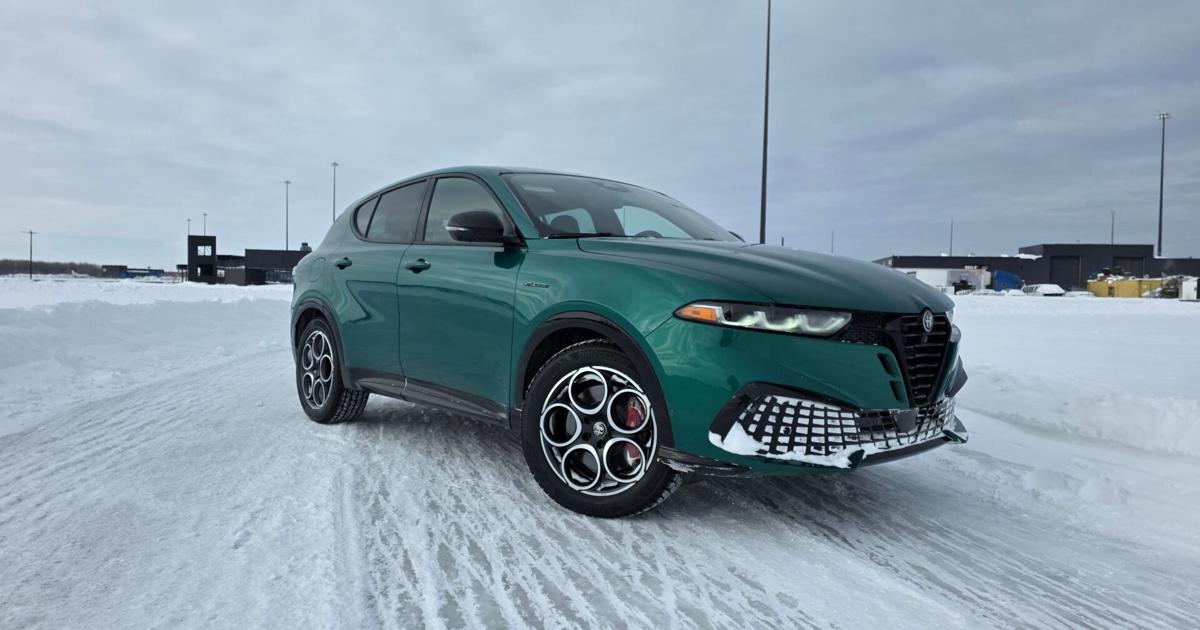
MONTREAL — Three years ago in Italy, the plug-in-hybrid Tonale SUV projected a new era for Stellantis’s storied Alfa Romeo brand. The automaker’s first electrified model, Tonale, would lead a parade of six fully-electric Alfas by 2030 as the Italian maker transitioned with other luxury brands — including Cadillac, Buick, Jaguar, Genesis, Volvo and Mercedes — to battery power. Just three years later, the industry has done a U-turn.
And so has Alfa.
For 2026, the refreshed Tonale SUV will only be offered as a turbo-4 model, leading a brand retreat to reliable gas power. Plans for an all-EV showroom by 2030 have been shelved, and the aging, gas-powered Stelvio SUV and Giulia sedan fill out the U.S. lineup. Like the rest of the industry, EV sales — including of the plug-in Tonale — slid without hefty government subsidies.
“The market has changed. The whole industry, I think, has changed,” said Eduardo Gelista, Alfa’s North America head of product planning, at a winter test. “We’re trying to evolve with the market. We continue to think, of course, electric vehicles are in our sights – but also other sorts of multi-energy platforms.”
Three years ago, Alfa had its foot to the floor toward electrification.
“I feel … big pressure on my shoulders as we go all-electric,” said CEO Jean-Philippe Imparato at the Tonale’s media test-drive at Alfa’s Balocco Proving Grounds northwest of Milan, Italy. “We could have stayed in the internal-combustion engine space, but we decided to move to zero-emission by 2027.”
It was a risky move for Alfa, an Italian brand built on goosebump-inducing, high-revving V-12 and V-8 engines and a rich racing history. And it was not alone. Cadillac — synonymous with roaring V-8s — was going all-electric as were Mercedes and Genesis, known for powerful, twin-turbocharged engines.
All have backtracked as the EV market stalled in the U.S. at 8% market share — then stumbled backward at the end of 2025 as $7,500 federal sales subsidies dried up. Only Jaguar, another European brand with deep V-12/V-8 roots, has remained committed to its all-EV plans.
“Going all-electric sounded progressive three years ago and seemed to make sense for brands struggling to compete in the internal combustion arena,” said iSeeCars senior analyst and gearhead Karl Brauer. “Now, after telling their customers that EVs represent the future, those brands are in a ‘checkmate’ situation. Many of their traditional customers had no interest in EVs and left, while existing or new customers that supported EVs feel betrayed as these brands back away from an ‘all-EV’ commitment.”
Imparato & Co. admitted the decision to go all-electric was driven, in part, by government mandates forcing battery drivetrains in coming years — in particularly California, by far Alfa’s largest U.S. market — where automakers had to meet 35% EV sales targets by this year or face draconian fines. Congress pulled California’s authority to regulate emissions last year.
But ex-CEO Imparato also said consumer tastes has been fundamentally changed by Tesla.
“The premium consumer demands electric power,” he told journalists. “They see internal combustion engines as old-fashioned, as a thing of the past.”
Get updates from the editors of GMToday.com sent directly to your email inbox:
That demand didn’t materialize. While luxury brands (led by Tesla) make up a majority of EV sales (at $58,034, the average EV sales price is about eight grand above the overall market’s average sale price), EV sales declined in ‘25. Alfa wasn’t the only loser — Mercedes’ EV sales dropped 54%; Genesis by 37%.
“Names like Cadillac, Mercedes, even Dodge (which also detoured away from V-8s), have enough brand equity to back out of the EV mantra while drawing on a vibrant past,” said analyst Brauer. “But a brand like Alfa Romeo — with a limited model line and even more limited market share before going all-EV — will be hard-pressed to grow volume if buyers can’t define Alfa’s core values. This is particularly true for Alfa Romeo in the U.S., where its fanbase is tiny.”
Sales were off 36% in the U.S. as Alfa’s business plan stalled.
“You will have an all-electric Giulia,” said Imparato in 2023, but the EV sedan hasn’t materialized. Plans for more EVs by 2030 in the U.S. are on hold. Alfa did deliver on Imparato’s promise of a small “Mini Countryman killer, a perfect urban EV” for the European market.
Called the Alfa Junior, the subcompact SUV was introduced for the 2025 model year in hybrid and EV form, with the latter making up 18% of model sales last year. The European Union boasts some of the most ambitious EV mandates in the world. Junior contributed to a 33% gain in Alfa Europe sales.
Stateside, Stellantis has nixed its plug-in options — not just in the Alfa but Jeep models, too — due to poor sales. The 2026 Tonale will be offered only with a peppy 263-horsepower turbo-4 engine mated to a standard, all-wheel-drive platform. Indeed, the entire Alfa U.S. lineup will be powered by 2.0-liter turbo-4 engines.
“Listening to our customers in the U.S.,” said Gelista. “We are staying only with the two-liter gasoline version. But in other markets, the plug-in continues.”
While the Tonale subtracted a drivetrain, it added a Sport Speciale trim as well as other goodies. “(The front end) looks a lot more modern,” said Gelista. “Designers refreshed the whole front end, the fascia, the headlamps. We’ve got new wheel designs (and) a lot more customer options like a black roof.”
Three years ago, Alfa reportedly planned to build its next-generation Stelvio and Giulia on the multi-energy STLA Large platform — just as sister brand Dodge has done to accommodate the Dodge Charger Daytona EV and gas-powered, six-cylinder Charger Sixpack.
Gelista, however, would not confirm any future plans.
In addition to the $40,245 Tonale, Alfa offers the nimble $47,745 Giulia and $52,745 Stelvio for 2026.
Henry Payne is auto critic for The Detroit News. Find him at hpayne@detroitnews.com or @HenryEPayne.