 Middle East & Africa Electric Scooter Market Size & Forecast
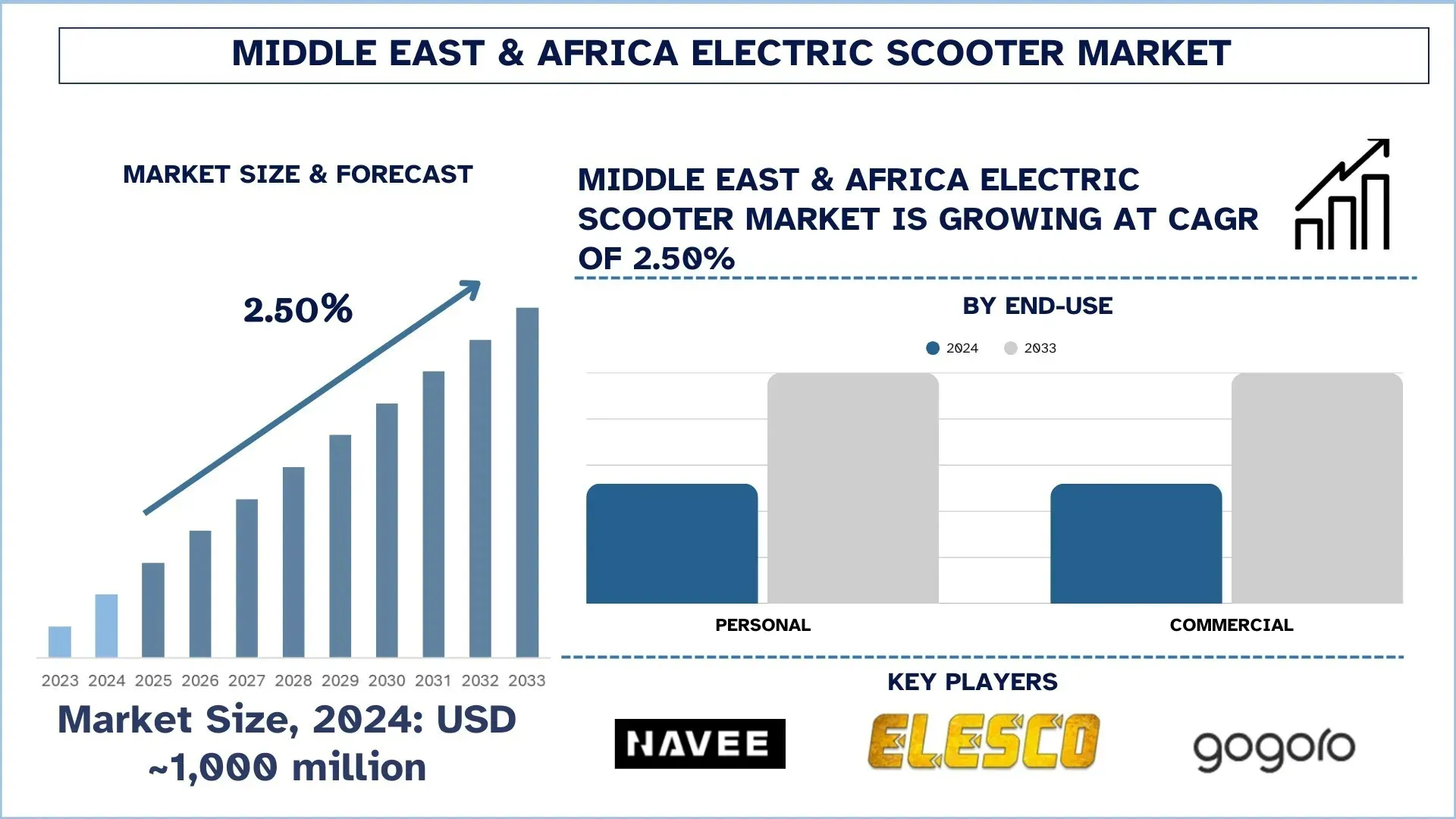
The Middle East & Africa Electric Scooter market was valued at USD 1,000 million in 2024 and is expected to grow at a strong CAGR of around 2.50% during the forecast period (2025- 2033F). Lowered running and operating costs of Electric Vehicles, and Government smart-city pilots are some of the key factors that have supported the market growth.
Middle East & Africa Electric Scooter Market Analysis
MEA electric scooters market is an organized, city-by-city expansion, supported by congestion control, sustainability goals, and the development of short-trip urban mobility. The regulated shared-micromobility program and corporate fleets are the main adoption drivers in the GCC with the help of more transparent permit frameworks, fixed-riding zones, and rising investments in smart-city infrastructure. In Africa, the pace of change is greatest where two-wheelers already represent the core of everyday transportation and delivery – this is a natural progression to electric, however, adoption is more price-sensitive, dependent on access to funds, and the availability of energy. The market is further broadening its consumer leisure use to high-utilization markets like the last-mile delivery, campus/industrial mobility, and tourism corridors. This has led to the fact that ecosystem capabilities are of more importance than the vehicles; charging, swapping, maintenance networks, and after-sales.
Middle East & Africa Electric Scooter Market Trends
This section discusses the key market trends that are influencing the various segments of the Middle East & Africa Electric Scooter market, as found by our team of research experts.
Growing Demand for Battery Swapping Infrastructure:
An increase in battery swapping infrastructure is becoming one of the trends in the Middle East and Africa electric scooter ecosystem, as it directly resolves two barriers to adoption: charging downtime and range anxiety. Rather than waiting hours before batteries are recharged, ride and fleet operators can swap out used batteries in a few minutes with fully charged batteries to keep vehicles on the road and maximize daily use. This is particularly appealing to high-mileage applications like last-mile delivery, courier, or the shared micromobility fleets, where profitability is quickly lost in unproductive operating time. The replacement of networks also assists in standardizing the energy management- operators can centralize the charge process, check battery conditions, and minimize degradation by carrying out controlled charging processes. Where home charging is either not available (high-density urban housing, slums) or grid reliability is not consistent, swap stations can offer a viable alternative to household charging with larger fleets, swapping turns into an infrastructure layer, which can be expanded faster, at a more stable service level, and more easily to a profitable point.
Many of the shifts in terms of battery swapping infrastructure have been observed, which is anticipated to be conducive to the emergence of electric scooters and other electric mobility infrastructure. For instance, in 2025, ADNOC Distribution and Terra Tech Ltd. launched the first battery swapping stations for electric motorbikes with an aim to increase the adoption of electric vehicles in the country.
Key Market Segmentation:
This section provides an analysis of the key trends in each segment of the Middle East & Africa Electric Scooter market report, along with forecasts at the country and regional levels for 2025-2033.
The Belt Drive segment has shown promising growth in the Electric Scooter Market.
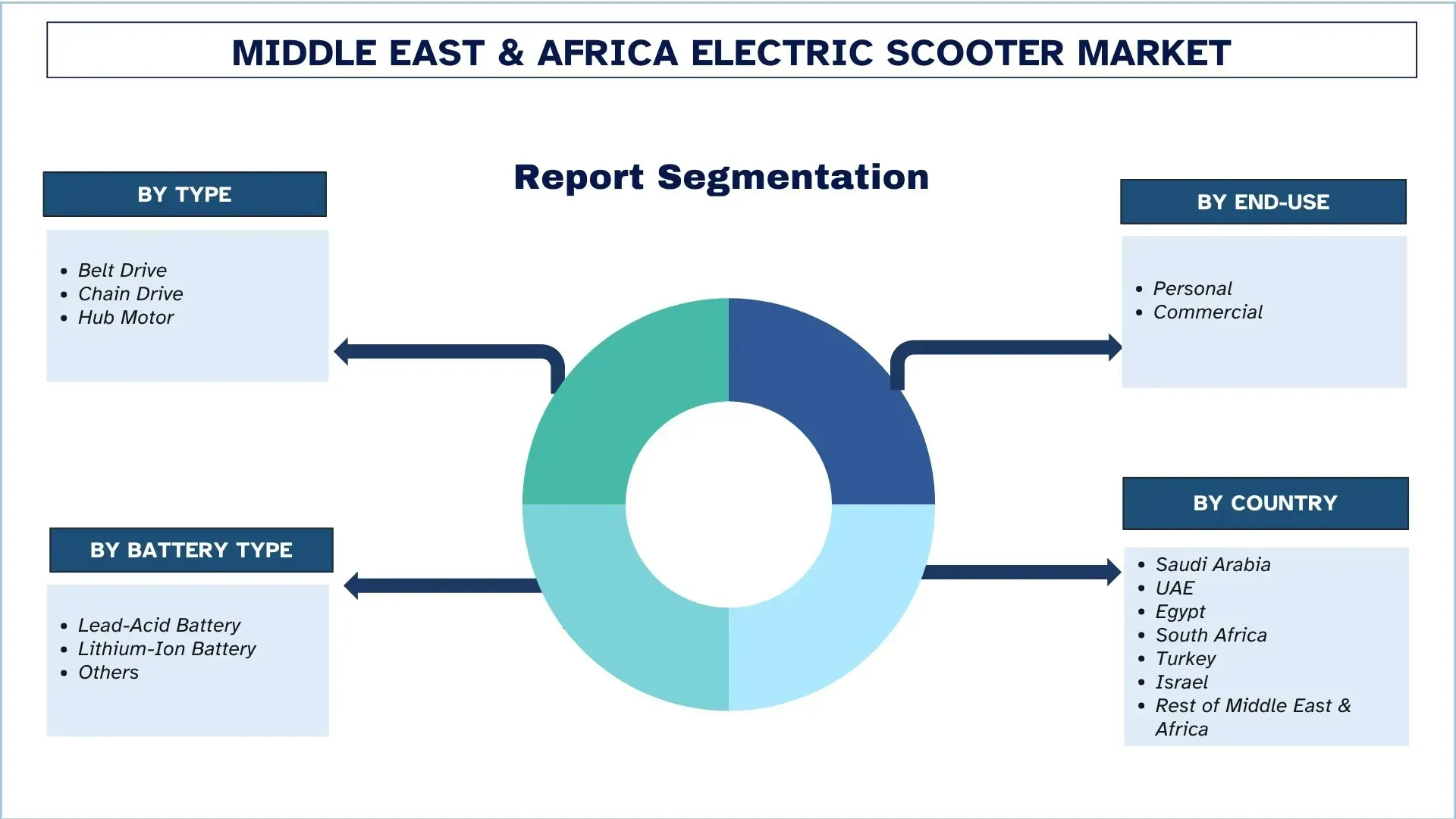
Based on type, the Middle East & Africa Electric Scooter market is segmented into belt drive, chain drive, and hub motor. Among them, the belt drive type has dominated the significant market share, mostly because it is less demanding in terms of maintenance, it is quieter, and it is cleaner when in an urban setting. Compared to chains, belt-driven systems do not need lubrication and, as such, reduce routine maintenance and are appealing to shared-mobility operators and high-utilization commercial fleets that need greater uptime and certainty in operating costs. Also, they provide more comfortable acceleration and reduced noise – valuable in high-value city quarters, tourist areas, and residential belt lines where micromobility is being actively encouraged. Moreover, belt drives are also likely to work in stop-start situations that are prevalent in overcrowded MEA cities. Although hub motor scooters are still popular due to their simple architecture, cost benefits, and the chain drive due to its durability in some heavy-duty applications, the belt drive segment is still being dominated, where customers are concerned with reliability, rider comfort, and the overall cost of ownership.
The Personal category held a significant share of the Middle East & Africa Electric Scooter Market.
According to End-use, the market of the Middle East & Africa Electric Scooter is divided into personal and commercial. Among these, the personal category has been the largest market share, and this has been aided by increased consumer desire to have convenient, cheap mobility, two-wheelers, when traveling around in urban locations. Individual scooters are popular to use as a means of commuting within neighborhoods, metro or bus station connections, and recreational riding along promenades and mixed-use areas in cities. This has been supported by the fact that they are easily owned, require less charging than fleet operations, and are more flexible in their place and time of use. Moreover, the increasing interest in sustainability and the attractiveness of compact mobility options in highly trafficked hubs keep increasing the scope of personal purchases, especially in urban centers of the GCC.
The UAE is expected to grow at a considerable rate during the forecast period.
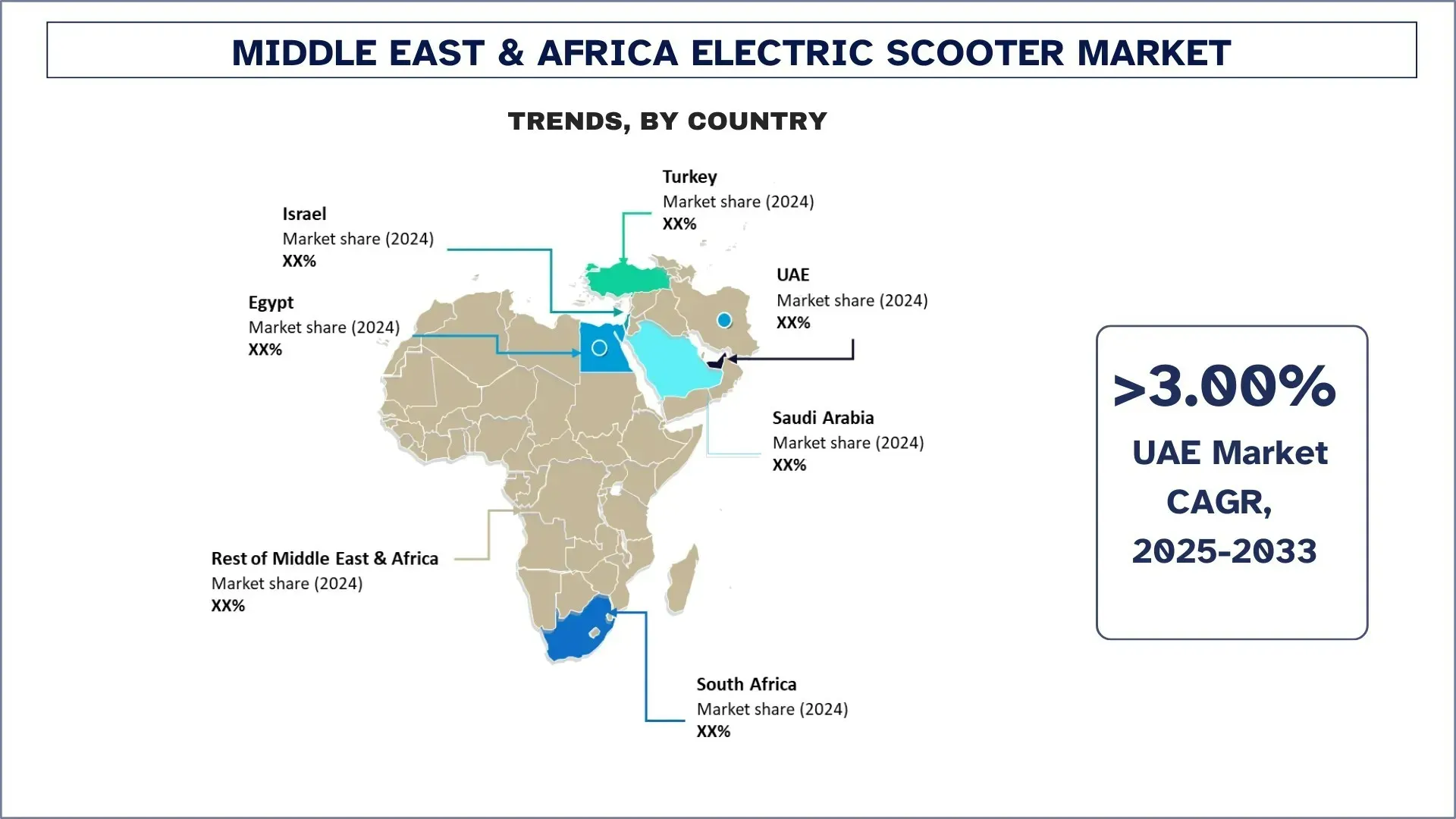
The UAE electric scooter market is becoming a high-momentum sector for micro-mobility, with the need of progressive urban planning. Additionally, a high level of last-mile demand and an increase in consumer interest in convenient travel with low emissions. The market is scaling fast with favorable pilot programs, better cycling and shared-mobility infrastructure, and increased application in commuting, tourism, and delivery use cases. It is important to note that the UAE is considered to be the most rapidly expanding electric scooter market in the MEA region due to the high penetration of smartphones, high-quality mobility services, and the ongoing investment in the development of smart-city projects. Global OEMs and operators are being drawn to this growth.
Additionally, many of the shifts in terms of easy regulations for the electric scooters have been observed in the region. For instance, in 2025, Dubai’s Roads and Transport Authority (RTA) introduced a new digital service that enables electric scooter users to obtain their riding permit through the government’s official online platform. The initiative is a part of enhancing riders’ safety as well as promoting the usage by the customers, further driving the market rise in the coming years.
 Middle East & Africa Electric Scooter Industry Competitive Landscape:
The Middle East & Africa Electric Scooter market is competitive, with several global and international market players. The key players are adopting different growth strategies to enhance their market presence, such as partnerships, agreements, collaborations, new product launches, geographical expansions, and mergers and acquisitions.
Top Middle East & Africa Electric Scooter Companies
Some of the major players in the market are Honda Motor Co Ltd, Elesco, NAVEE, Hero MotoCorp, PIERER Mobility AG, Gogoro Inc, Bayerische Motoren Werke AG ADR, Ather, and others.
Middle East & Africa Electric Scooter Market Report Coverage
Report Attribute
Details
Base year
2024
Forecast period
2025-2033
Growth momentum
Accelerate at a CAGR of 2.50%
Market size 2024
USD 1,000 Million
Country analysis
Saudi Arabia, UAE, Egypt, South Africa, Turkey, Israel, and the Rest of the Middle East & Africa
Major contributing Country
Saudi Arabia is expected to dominate the market during the forecast period.
Companies profiled
Honda Motor Co Ltd, Elesco, NAVEE, Hero MotoCorp, PIERER Mobility AG, Gogoro Inc, Bayerische Motoren Werke AG ADR, Ather, and others.
Report Scope
Market Trends, Drivers, and Restraints; Revenue Estimation and Forecast; Segmentation Analysis; Demand and Supply Side Analysis; Competitive Landscape; Company Profiling
Segments Covered
by Type, by End-Use, by Battery Type, by Country
Reasons to Buy the Middle East & Africa Electric Scooter Market Report:
The study includes market sizing and forecasting analysis confirmed by authenticated key industry experts.
The report briefly reviews overall industry performance at a glance.
The report covers an in-depth analysis of prominent industry peers, primarily focusing on key business financials, type portfolios, expansion strategies, and recent developments.
Detailed examination of drivers, restraints, key trends, and opportunities prevailing in the industry.
The study comprehensively covers the market across different segments.
Deep dive Country-level analysis of the industry.
Customization Options:
The Middle East & Africa ELECTRIC SCOOTER market can further be customized as per requirements or any other market segment. Besides this, UnivDatos understands that you may have your own business needs; hence, feel free to contact us to get a report that completely suits your requirements.
Research Methodology for the Middle East & Africa Electric Scooter Market Analysis (2023-2033)
We analyzed the historical market, estimated the current market, and forecasted the future market of the Middle East & Africa Electric Scooter market to assess its application in major countries. We conducted exhaustive secondary research to gather historical market data and estimate the current market size. To validate these insights, we carefully reviewed numerous findings and assumptions. Additionally, we conducted in-depth primary interviews with industry experts across the Electric Scooter value chain. After validating market figures through these interviews, we used both top-down and bottom-up approaches to forecast the overall market size. We then employed market breakdown and data triangulation methods to estimate and analyze the market size of industry segments and sub-segments.
Market Engineering
We employed data triangulation techniques to finalize the overall market estimation and derive precise statistical numbers for each segment and sub-segment of the Middle East & Africa Electric Scooter market. We split the data into several segments and sub-segments by analyzing various parameters and trends, by Type, by End-Use, by Battery Type, and by country within the Middle East & Africa Electric Scooter market.
The Main Objective of the Middle East & Africa Electric Scooter Market Study
The study identifies current and future trends in the Middle East & African Electric Scooter market, providing strategic insights for investors. It highlights Country-level market attractiveness, enabling industry participants to tap into untapped markets and gain a first-mover advantage. Other quantitative goals of the studies include:
Market Size Analysis: Assess the current forecast and market size of the Middle East & Africa Electric Scooter market and its segments in terms of value (USD).
Middle East & Africa Electric Scooter Market Segmentation: Segments in the study include areas by Type, by End-Use, by Battery Type, and by
Regulatory Framework & Value Chain Analysis: Examine the regulatory framework, value chain, customer behavior, and competitive landscape of the Middle East & Africa Electric Scooter industry.
Country Analysis: Conduct a detailed Country analysis for key areas such as Saudi Arabia, UAE, Egypt, South Africa, Turkey, Israel, and the Rest of the Middle East & Africa.
Company Profiles & Growth Strategies: Company profiles of the Middle East & Africa Electric Scooter market and the growth strategies adopted by the market players to sustain the fast-growing market.