LCV/Shutterstock
Ford is starting 2026 on a tumultuous note, with bright as well as gloomy prospects for the year ahead. The company began a fresh journey with massive charges totaling $19.5 billion in its bid to restructure its EV roadmap, canceling multiple projects and shifting focus to more profitable avenues. The company’s plans to manufacture lithium iron phosphate cells and energy storage systems in partnership with CATL have just attracted the scrutiny of a U.S. House committee. Then it was reported that Ford was planning a partnership with the Chinese giant Xiaomi over electric cars, a rumor that was swiftly denied by both brands.
In the meantime, the company also landed a plum engineering opportunity and designed Red Bull’s Formula One racing car engine. The journey ahead, however, is not going to be an easy one for the brand. Ford chief Jim Farley recently claimed that Chinese car brands are an “existential threat” and that they might unsettle the North American market. The warning has already started to take shape. China and Canada have struck a trade deal that ends the 100% tariff on Chinese electric cars and brings it down to just 6.1%, though there’s a cap on the number of imported units.
The likes of BYD have already toppled Tesla as the world’s biggest EV brand, and they’re now knocking at the North American market’s doors. Plus, the progress in tech stack, especially in terms of battery efficiency and in-cabin conveniences, is making Ford EVs look overpriced. All these market factors have kick-started some major internal changes and restructuring at Ford. And what’s lined up for the carmaker in 2026 could very well change the company’s trajectory in the years to come.
A leaner and smarter EV strategy
John Keeble/Getty Images
The global EV market is expected to slow down in 2026, as per a market research shared by Reuters. Moreover, the end of the EV tax credit slowed down the adoption in the North American market. S&P Global also notes that the current year is going to be a tough one for electric cars in the U.S. Ford is no exception and has adjusted its electrification plans accordingly. The biggest casualty of this new shift is the F-150 Lightning electric truck, which is no longer a part of Ford’s immediate plans. Instead, the company is turning the iconic ride into a hybrid.
The company is also canceling its electric vans destined for the European and North American markets. “Ford no longer plans to produce select larger electric vehicles where the business case has eroded due to lower-than-expected demand, high costs, and regulatory changes,” the company said in a press statement. Instead of duking it out in the premium segment, Ford says it’s going to focus on a lineup of smaller and more efficient electric cars. The carmaker notes that the first car to come out under this adjusted roadmap is an upcoming electric pickup truck that will be built atop the Universal EV platform and will arrive next year.
On the brighter side of things, Ford says it plans to offer cutting-edge eyes-off driving technology on its budget-friendly electric car, which will cost approximately $30,000 a pop. That’s a pretty stark deviation, as such frontier tech is usually reserved for more premium rides. As far as the next-gen EV platform goes, the company says it reduces parts used by 20% and speeds up the assembly process by a 15% margin, ultimately delivering a lower ownership cost than a Tesla Model Y.
More hybrids and gas-guzzlers, for now
Torkgaur/Shutterstock
Ford’s retreat from the EV market was a tad surprising, albeit not shocking, given the market realities. Now that aggressive electrification has been postponed, the company is focused on offering more platform choices to customers. To get started, Ford is converting the F-150 Lightning electric pickup truck into an Extended Range Electric Vehicle (EREV). Ford says the upcoming version will maintain the quick acceleration, towing capability, and the ability to power your home as a backup source.
As far as fresh launches go, AutoExpress exclusively reports that a Bronco Sport-inspired mid-sized crossover is on the cards. The 2026 lineup also includes the updated 2026 Ford Mustang Shelby GT500 and the 2026 Ford Mustang Raptor. Ford’s website lists the 2027 Bronco RTR and 2026 Mustang Dark Horse SC as the upcoming vehicles. Beyond the current slate of 2025 model year electric vehicles, the Blue Oval is offering the F-150 Hybrid, Maverick (in gas and Hybrid models), and the 2026 Escape (in Hybrid and Plug-In Hybrid variants).
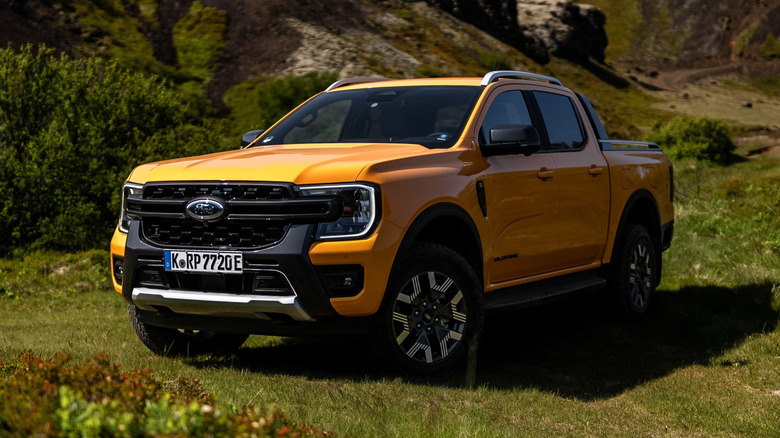
The combustion models on the lineup include the 2026 Ford Expedition, Escape, Explorer, Bronco (regular and Sports models), and the 2026 Mustang. The brand’s existing truck and van portfolio includes the Transit, Super Duty, and Ranger pickup truck across the 2025 and 2026 model year configurations. That’s a pretty busy lineup and offers plenty of choices to buyers across all form factors. However, the EV retreat will sting, as Tesla is discontinuing its Model S and X, leaving other brands to try to fill that gap. Ford is planning to ramp up the production of trucks for the U.S. market and plans to repurpose its Tennessee Truck Plant and Ohio Assembly Plant to roll out Built Ford Tough truck models and the Ford Pro series of ICE and hybrid vans.
Ford and F1
It is often observed that the cutting-edge tech that appears in F1 cars eventually trickles down to consumer cars. Steering wheel controls, carbon fiber chassis, and aerodynamic lines are some of them. For Ford, the return to F1 with a Red Bull partnership is pretty historic. Ford’s start as an automobile company is actually tied to an unlikely victory in a race all the way back in 1901 at the hands of founder Henry Ford. Ford is the third-most successful engine maker in racing history with 174 Grand Prix titles in its name. After a long hiatus, Ford is finally returning to Red Bull as an engine supplier.
This is an opportunity for Ford to, once again, carry over some engineering magic from the track to consumer cars. And it seems the company wants to lap up that opportunity. “Getting into the ultimate laboratory, the ultimate torture test for high-performance hybrids, there’s no better way for us to advance our capabilities and proving it than out in the F1 competitive landscape,” Will Ford, General Manager at Ford Racing, told The New York Times. “Ultimately, everything we do and learn through this Red Bull partnership is going to work its way into our production vehicles for our customers.”
But Ford’s plans go beyond the F1 tarmac. Ford chief Jim Farley says the company’s time designing the F1 gear offered an insight into the secret sauce to help beat the surging Chinese car brands. “We need these capabilities from Formula 1, and we can put them right in the Transit van,” Farley was quoted as saying. It’s going to take some time, but a bold promise, nonetheless.
A new start with energy storage
In December, while announcing its EV shift, Ford also revealed that the company is building a battery energy storage business. “Ford plans to begin shipping BESS systems in 2027 with 20 GWh of annual capacity,” the company said in a press statement. The company hopes to tap into the strained grid demands and also address the needs of data centers, which are so hungry for power that tech giants like Google and Meta are directly funding nuclear reactors. Ford will begin by repurposing a factory in Kentucky and plans to invest $2 billion in the next couple of years to make 5 MWh+ advanced battery energy storage systems (BESS).
According to CNBC, the company has already spent $10 billion on the two facilities that will be a hub of its energy storage business. To operate the battery plants, the company has also inked deals with SK On, SK Battery America, and BlueOval SK. Moreover, the carmaker will also produce smaller battery cells targeted at residential usage at the BlueOval Battery Park Michigan plant. This facility will also produce LFP prismatic battery cells destined for the company’s Universal EV Platform, which makes its debut atop a mid-sized electric truck in 2027. Lisa Drake will lead the efforts as the President of Ford Energy.
Ford is not the only player in the segment. Tesla already has a massive energy storage business in place. General Motors, under the GM Energy label, is also making solid progress. The company announced in October that sales volumes had grown five times within a year. Notably, the company said seven out of ten electric cars under the GM brand are now being sold with a GM product. The timeline for Ford’s battery energy goals and next-gen EVs suggests the company is chasing a similar result.