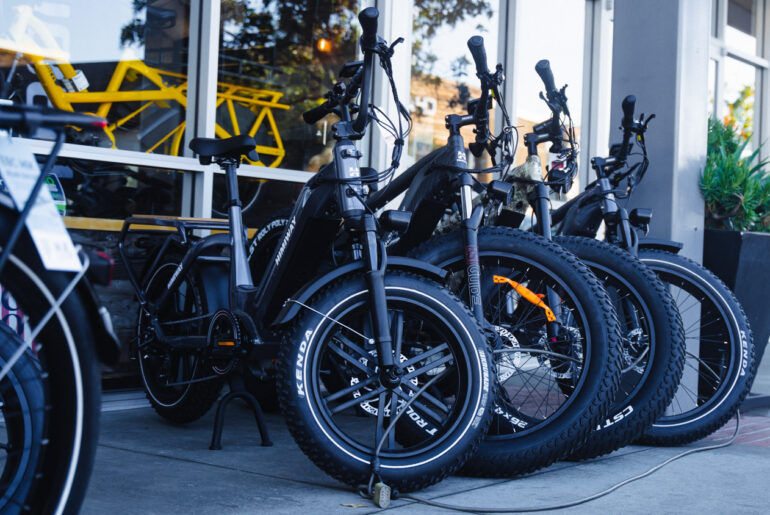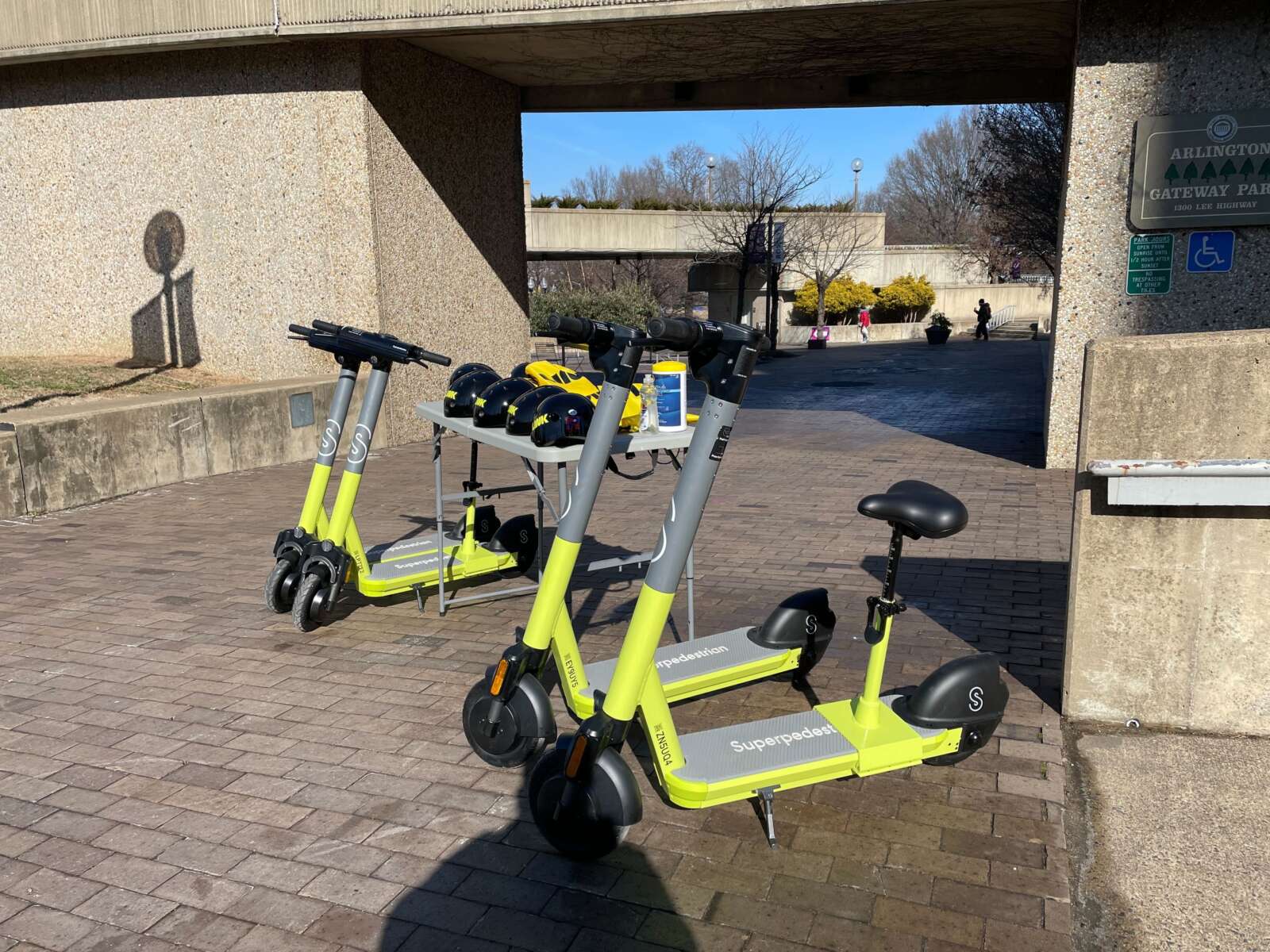
Nearly seven years after a failed first attempt, Falls Church officials are trying again to entice e-scooter and e-bike operators to the city.
Council members are considering a proposal to allow a maximum of 100 total operating certificates for “shared mobility devices”: motorized skateboards, scooters, bicycles and electrically assisted bicycles.
They’re expected to send a staff proposal out for public review at their meeting on Monday, Feb. 9, with final action possible in March.
Falls Church leaders in 2019 first put out a request for firms interested in positioning the mobility devices around the city, but found no takers — in part because of the restrictive operational rules the officials planned to put in place.
At the time, the concept of localities regulating the industry had just been authorized by the General Assembly, and local governments seemed wary of being the first to jump in and set rules.
“I’m optimistic that this time around will go better,” Mayor Letty Hardi said at a Monday night (Feb. 2) work session.
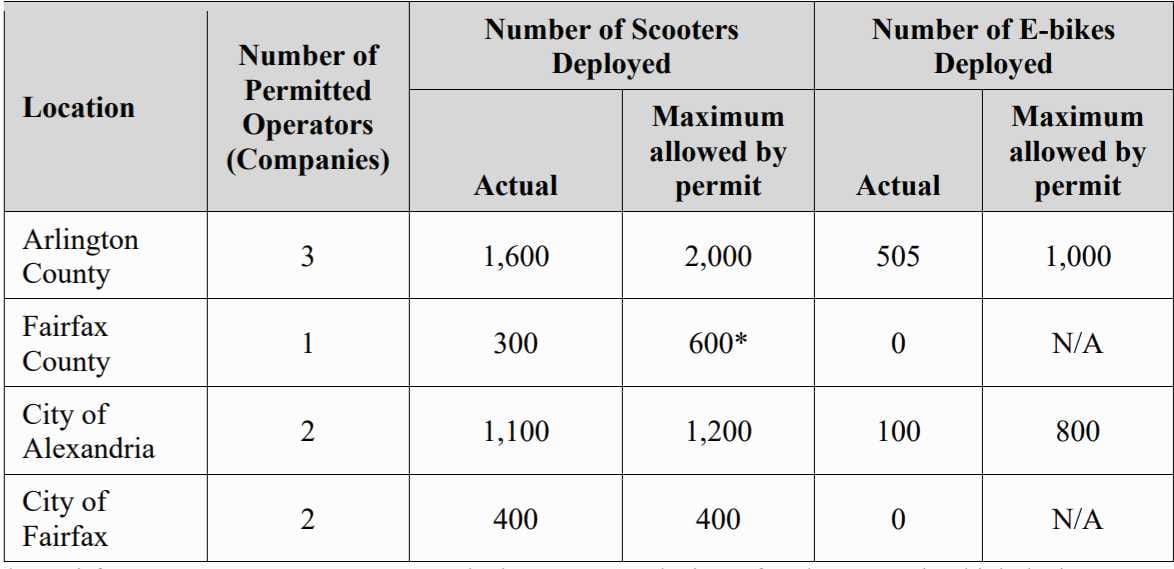 Regional limits on scooters, e-bikes (via City of Falls Church)
In 2019, “we were very apprehensive, because it was kind of like the Wild West,” Hardi said.
Since then, Arlington, Alexandria and both the city and county of Fairfax have adopted regulatory measures.
“Things have settled down,” Hardi said.
The issue was first discussed last September, with staff directed to come back with recommendations.
Under the staff proposal, which could be altered by Council, a maximum of 100 total operating certificates would be available for firms to request for a one-year trial period. After that, the program would be reviewed and could be continued, amended or eliminated.
Among staff proposals:
Firms would have to provide a permit fee of $5,000 along with $2,500 cash bond to be drawn on by the city for removal and storage of improperly parked vehicles
Riders would have to be a minimum of 16 years old
Helmets would be encouraged but, under state law, cannot be mandated
Devices cannot be parked on sidewalks in a way that impedes pedestrians or other traffic
Riding on sidewalks would be permitted, but riders would be encouraged to use streets and bicycle lanes where available
Maximum speed limits on streets would be set at 15 mph for e-scooters, 20 mph for e-bikes, with a maximum speed limit of 6 mph on sidewalks
Companies will be required to provide information to riders in English and Spanish
Still an open question, from both a legal and logistical standpoint, is whether vehicles could travel into surrounding jurisdictions. Currently, most if not all Northern Virginia localities do not allow the e-vehicles to go outside their boundaries.
That could be a problem for Falls Church, particularly for those wanting to travel from inside the city to the East Falls Church Metro station (just over the border in Arlington) and West Falls Church Metro station (in Fairfax County). Seven Corners is also located just outside Falls Church’s borders in Fairfax County.
 City Council members Laura Downs, Erin Flynn and Arthur Agin (screenshot via Falls Church)
At the Feb. 2 work session, Council member Justine Underhill — who owns an e-bike — said she hopes that, if a program is implemented, sidewalks will not become a battleground between pedestrians and e-device users.
“I bike on the sidewalk a lot of times because I don’t feel safe biking in the street,” Underhill said, noting that “not everybody is super courteous.”
While a majority of Council members raised questions at the meeting, the general feeling seemed to be to move forward and see if any firms want to participate.
“I’m optimistic,” Underhill said.
According to city staff, the typical cost of an e-scooter ride locally starts with a $1 charge to unlock the device, plus fees ranging from 45 cents to 50 cents per minute of use.
“Given an average trip distance of a mile, and trip duration of 15 minutes, the average cost of a ride is around $8,” staff said in a memo to Council members. “Some companies also provide weekly or monthly subscriptions that may lower the average cost per ride.”
Arlington currently has three permitted providers allowed to operate a maximum total of 2,000 scooters and 1,000 e-bikes. The program has seen a succession of comings and goings among operators.
Fairfax County has one permitted operator, which is allowed to operate e-scooters only.